Content Marketing Unleashed: Crafting Compelling Narratives to Drive Engagement


You opened the laptop on Monday morning, looked at the content calendar your agency shipped last quarter, and noticed the same thing most marketers have been quietly noticing in 2026: the prose is fluent, the frameworks are sound, and yet none of it sounds like the brand. Generative AI made fluent, generic copy a commodity. The thing that compounds for organic traffic and email engagement now is the thing AI cannot easily counterfeit — an authentic brand narrative that someone would actually want to receive or click on if they had a choice.
This is brand storytelling for 2026, written for the content lead who has watched their organic traffic flatten while output volume tripled. The numbers worth holding in front of you while you read it: 92% of consumers want brands to make ads that feel like a story, 55% are more likely to remember a story than a list of facts, and 68% say brand stories influence their purchasing decisions. Stanford's Jennifer Aaker has the foundational stat that every article on this topic cites: stories are roughly 22 times more memorable than facts alone.
This article walks through what brand storytelling actually is, the framework most teams use to build one, seven named brands doing it well with the engagement numbers attached, the funnel reframe that wins the search query, the AI-in-storytelling decision matrix most articles still skip, and a measurement section that names the metrics rather than waving at them. Closing with one Search Console move worth doing in the next hour.
What Brand Storytelling Actually Is
Email and search have more in common than most teams realise. Both reward the kind of content that someone would actually want to receive or click on if they had a choice, and both punish the kind of content that was written for a pipeline report. The best-performing newsletter I ever shipped in-house was one where the open rate, the click rate, and the organic traffic to the companion landing page all climbed together for six consecutive months. That was not a coincidence. We had stopped writing things that sounded like marketing and started writing things that sounded like a friend who happened to know the category.
That is the operational definition of brand storytelling, in plain terms. Not "evoking emotion" — that is the symptom. The thing underneath is structural: a brand story is a piece of content that survives being read by a human (rather than skimmed by a search engine), and that survives being shared by one person to another (rather than being indexed by a crawler and forgotten). The 22x memorability stat is downstream of that. The conversion lift is downstream of that. Companies with compelling brand stories report roughly 20% higher customer loyalty — also downstream.
The 2026 modification is the part most beginner content articles still miss. Generative AI commoditised fluent generic prose to the point where any team can ship 10,000 words a month at zero marginal cost. Volume is no longer the constraint. Authenticity is. AI Overviews appearing in roughly half of all Google searches only cite content the answer engine recognises as substantive — and increasingly, the substantive signal is a real author, real specifics, real numbers, real screenshots, real lived experience. The thing AI cannot counterfeit at scale is the human signal. Brand storytelling is now the durable content moat for the same reason topical authority used to be: because it is hard to fake at the volume the SERP demands.
Brand Storytelling Examples That Worked
The single fastest way to write a better brand story is to study the ones that worked, with the engagement data attached. Seven brands worth knowing, in rough order of how durable the story remains:
- Nike — "Dream Crazy" (Colin Kaepernick). Equal parts narrative and brand-stand. The story works because it has a character, a conflict, a guide, and a stakes structure — the StoryBrand framework operating in 60 seconds.
- Patagonia — "Don't Buy This Jacket". A counter-intuitive Black Friday ad that explicitly told customers to buy less. It is one of the most-cited brand-storytelling examples in the 2025-2026 marketing literature because it earned trust precisely by trading short-term conversion for long-term affinity.
- Airbnb — "Belong Anywhere". Reframed lodging as a relational concept rather than a transactional one. Branded the entire category, not just the company.
- Dove — "Real Beauty". A two-decade story franchise. Most attempts to imitate it fail because they treat the campaign as a single ad rather than as a sustained editorial position.
- LEGO — "Rebuild the World" (extended with Tom Holland in 2025). Long-running narrative franchise that sustained double-digit social engagement growth across multiple years. Worth studying for the editorial discipline of franchise extension.
- Capital One. A storytelling-led brand investment drove a 16% lift in brand recall — a real, measurable number on a real, named brand.
- Palo Alto Networks (Keanu Reeves campaign). +45% website engagement and 7.1 million video views in month one — a B2B-adjacent brand using a celebrity narrative as a category category-perception lever, not just an awareness play.
The pattern across all seven: a clear protagonist (almost always the customer, not the brand), a clear conflict (a problem the customer faces in their actual life), and a clear stakes structure (what happens if the conflict goes unresolved). The brand is rarely the hero. The brand is the guide.
A Framework for Brand Storytelling: StoryBrand in Seven Parts
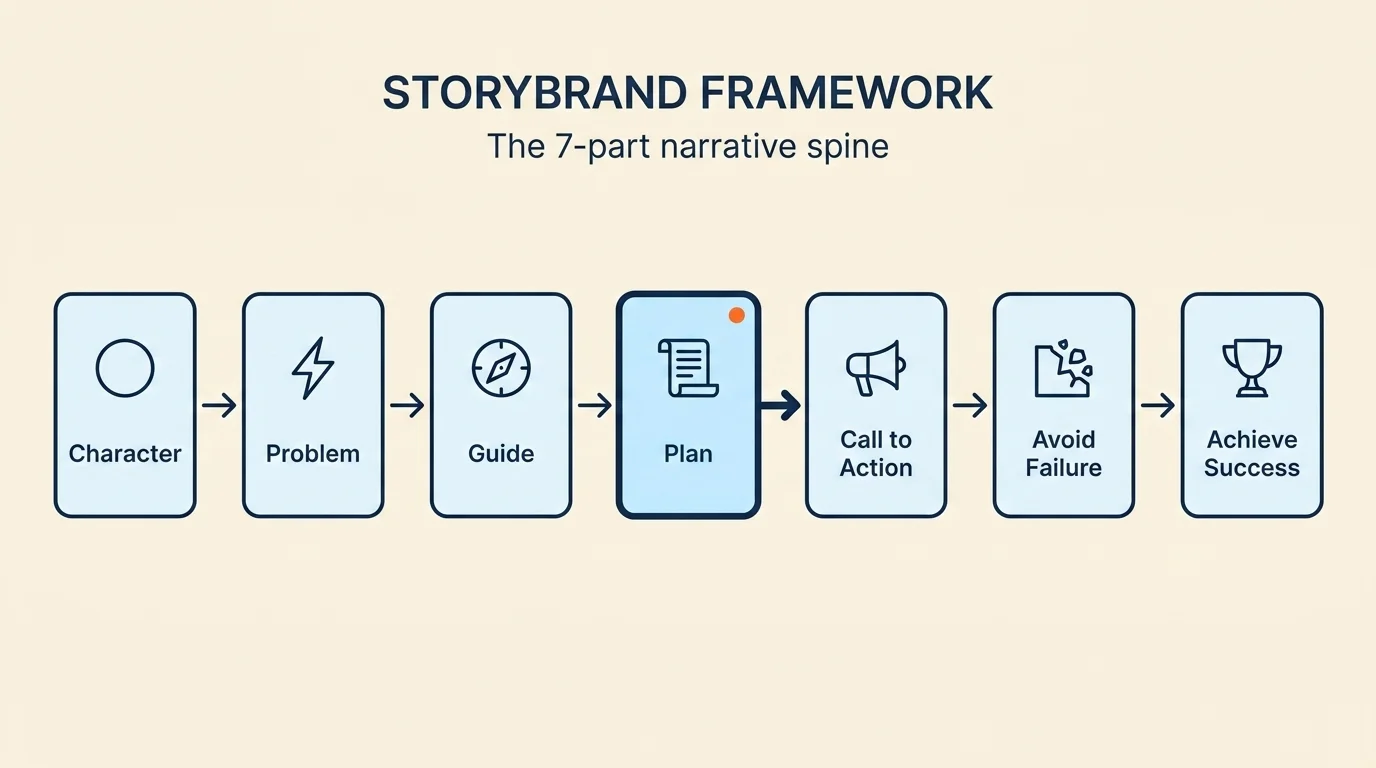
The most widely cited framework in the SERP for this query is Donald Miller's StoryBrand, and there is a reason — it operationalises the pattern above into a checklist a junior writer can apply consistently. The seven parts:
- A Character with a clear, specific desire — usually the customer.
- Has a Problem — the obstacle blocking that desire.
- Meets a Guide — the brand, positioned as expert and empathetic, not as hero.
- Who gives them a Plan — typically a 3-step process the customer can act on.
- Calls them to Action — direct (buy, subscribe) and transitional (download, demo).
- Helps them avoid Failure — the negative stakes that make the action urgent.
- And achieves Success — the positive outcome that makes the action worthwhile.
Most generic content marketing articles on this topic walk through StoryBrand without modification and call it a day. The 2026 modification: the framework is now the checklist for survivability against AI commoditisation, not just a creative aid. Each of the seven parts asks the writer to commit to specifics — a specific customer, a specific problem, a specific plan. Specifics are the human signal. Generic AI prose collapses on the specifics. Brand stories survive because they refuse to.
The thing the reader probably already tried: applying StoryBrand to the brand itself ("our brand is the character, our challenges are the problem"). It does not work, because the customer reading the content is the character, not the brand. Switching the protagonist from the brand to the customer is the single edit that fixes more failed brand-storytelling attempts than any other intervention.
Building a Content Marketing Funnel: TOFU, MOFU, BOFU Narratives
The customer-journey reframe most articles get wrong: treating the funnel as a sequence of content topics rather than a sequence of narrative roles. The 2026 reframe maps content type to funnel stage with intent and depth-of-narrative scaling together.
- Top-of-funnel (TOFU): Awareness narratives. Short, hook-led, problem-defining. The character meets the problem, but the resolution is just out of reach. Format: short-form video (TikTok, Reels, Shorts), social posts, blog intros, podcast trailers. The KPI here is reach × completion rate, not conversion.
- Middle-of-funnel (MOFU): Consideration narratives. The Guide appears. Format: long-form blog (the kind that cites named tools and benchmarks), webinars, comparison content, case studies. The customer is evaluating; the brand demonstrates expertise without aggressive selling. KPI: engaged session time + content-attributed return visits.
- Bottom-of-funnel (BOFU): Decision narratives. The Plan and the Call to Action. Format: product-tour content, customer success stories, testimonials, ROI calculators, free-trial offers. The narrative collapses to specifics — what happens after the customer says yes. KPI: conversion rate + content-attributed revenue.
The mistake most teams make: shipping the same narrative depth at every stage. A TOFU video that opens with the brand's three-step solution before it has named the customer's problem is doing TOFU work with BOFU framing — the audience has not earned the resolution yet. A BOFU testimonial that opens with abstract industry context before naming the specific customer outcome is doing the inverse. Match the narrative depth to the funnel stage.
Format: Where the Story Actually Lives in 2026
The 2024 article you are reading the refresh of treated long-form video as the default visual format. The 2026 reality has fragmented into three formats with distinct narrative grammars.
Short-form vertical video — TikTok, Instagram Reels, YouTube Shorts. The narrative grammar: hook in the first three seconds, payoff by fifteen, reinforcement in the caption. The discipline of the short form is the discipline of respecting the sound-off, thumb-ready viewer who owes you nothing. If you cannot land the hook in three seconds, you will not get the next twenty-seven. 95% of internet users watch video monthly, and short-form delivers the highest ROI of any content format in 2026 — but this is the format most pre-2024 brand storytelling articles still treat as a sub-format of video, when it is the dominant format.
Interactive content — Typeform quizzes, Ceros experiences, Outgrow calculators, poll widgets, product configurators. The narrative grammar: the user is the protagonist, the content is the journey, the reveal is the payoff. Worth particular attention because the keyword carries a $50+ CPC — readers shopping for these tools are deep-funnel buyers, not casual researchers.
User-generated content as brand narrative — 84% of consumers trust UGC over branded content, and the most durable UGC programmes are not collections of customer photos but curated narrative arcs. The brand acts as editor, not author, but the editorial eye matters. The strongest UGC programmes I have audited are the ones where someone on the brand team is reading every submitted story and selecting for the ones that fit the brand's editorial position — not the ones that have the most likes.
The pre-2024 default of "blog post + long-form video + infographic" is not gone in 2026; it just is not the default any more. The default is short-form vertical video plus interactive plus UGC, and the team that ships those three formats consistently outperforms the team shipping a polished 60-second brand spot, in most categories, in most quarters.
B2B Brand Storytelling
The single most-overlooked subset of this topic. The SERP for brand storytelling is overwhelmingly B2C — Nike, Dove, Apple, Patagonia — and the B2B reader closes the article assuming none of it applies. It does. A memorable story increases the likelihood of a B2B purchase by 55%, per the Marketing LTB 2025 storytelling statistics — the magnitude is genuinely meaningful for considered enterprise purchases.
Four B2B brands worth studying:
- Salesforce — "Trailblazer". Repositioned the customer as a heroic professional pioneer rather than a software user. The narrative gave Salesforce a customer-community vocabulary that competitors still struggle to replicate.
- HubSpot — Inbound. Inbound is technically a marketing methodology and arguably a content-strategy textbook, but it functions as a brand story: it cast HubSpot as the guide who would teach the customer how to do marketing the new way. The narrative is the product positioning.
- Slack — "Where Work Happens". Sub-narrative: less email. The story landed because it named a frustration every knowledge worker recognised, and then positioned the brand as the resolution.
- Mailchimp — Brand voice. Less a single story than a sustained editorial position — the brand-voice quirks ("Did You Mean MailChimp?") earned distinctiveness in a category where every other ESP sounded interchangeable. Worth studying as a discipline of voice consistency at scale.
The framework stays the same; the protagonist changes. The B2B character is a professional with a career-stake desire (to ship the project, hit the number, be promoted, look credible to leadership). The B2B problem is the bureaucracy and tooling friction that blocks the desire. The B2B brand is the guide who removes the friction. The B2B success is professional. The B2B failure is professional. The narrative scaffolding ports cleanly across B2C and B2B; the texture is what changes.
AI in Brand Storytelling: Where It Helps, Where It Hurts
81% of marketing professionals in North America and Western Europe use AI automation daily. AI personalisation lifts email open rates by ~43% and reduces content production cost by ~67%. The numbers are real, large, and tilt strongly in favour of AI adoption.
And yet — authentic human-led video converts roughly three times better than AI-generated video for SMB audiences, in the categories where emotional resonance drives purchase. AI is not the durable content moat it sometimes appears to be. The cleaner read is that AI helps in some places and actively hurts in others, and the team that wins in 2026 is the team that knows the difference.
A working matrix of where AI earns its seat in brand storytelling and where it does not:
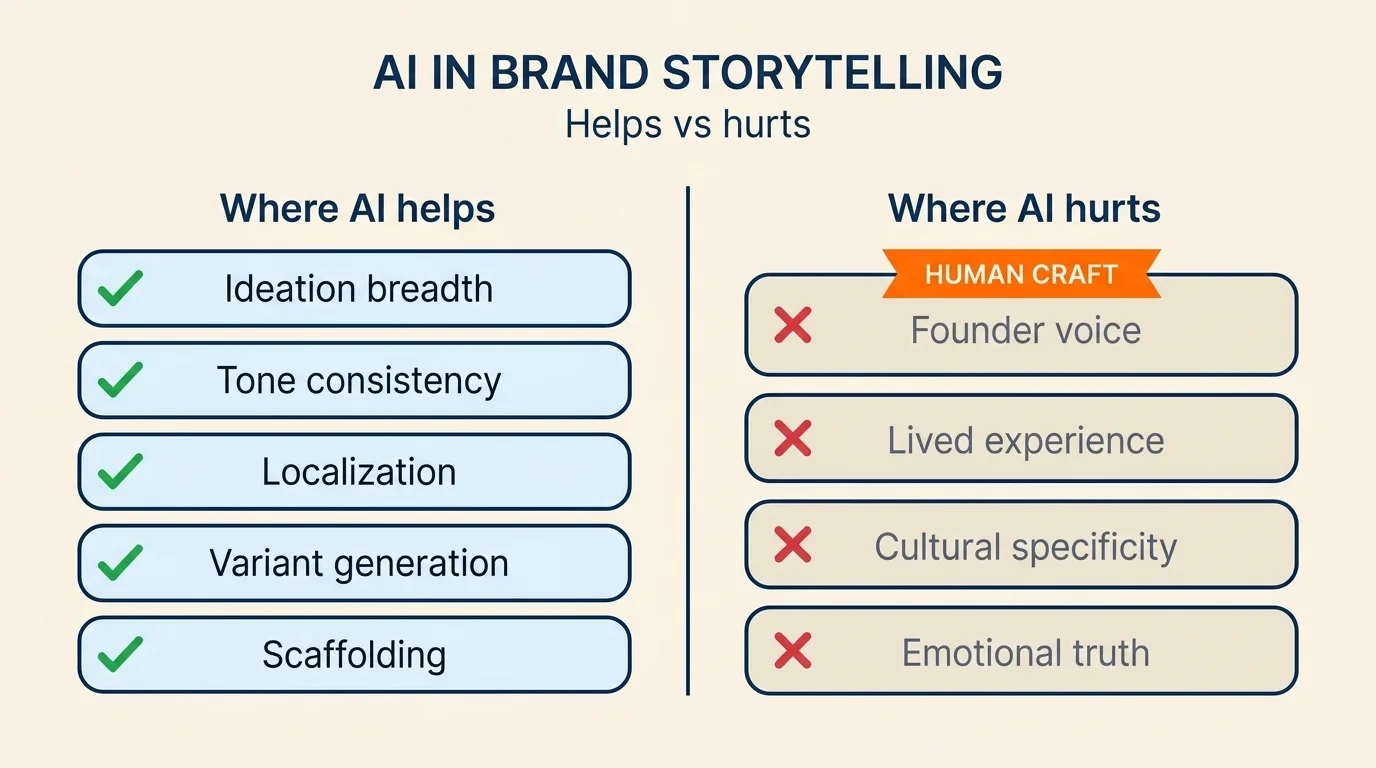
AI helps with: ideation breadth (generating fifty headline variants in two minutes); tone consistency (auditing a draft against a brand voice guide); localisation at scale (translating a campaign across twenty markets without losing tone); A/B variant generation (producing the eight to twelve creative variants the platform optimisation engines need); editorial scaffolding (outlines, structural drafts, fact-checking).
AI does not help with: founder voice (anyone reading a piece can feel the difference); lived experience (the specific anecdote, the specific screenshot, the specific number from the project the writer actually ran); cultural specificity (the joke that lands in São Paulo and not in Stockholm); emotional truth (the moment in the brand story where the protagonist's actual stakes get named).
The 2026 production discipline that produces the best results: AI drafts, humans refine the narrative. The AI handles the scaffolding, the variant generation, the tone consistency check, the fact-checking. The human writer does the thing AI cannot do — they bring the specific lived detail that makes the brand sound like itself rather than like every other brand using the same model. Pages that read as if AI shipped them get penalised by audiences and increasingly flagged by platforms. Pages where AI clearly contributed but a human clearly finished the work do not show the penalty, in the same datasets.
Measurement: The Metrics That Actually Earn Their Seat
This is the section every content article promises and almost none deliver. Seven metrics, in rough order of leverage, with the tools that measure them:
- Engagement rate by format — likes, comments, shares, saves, divided by reach. Useful as a directional creative-health signal. Tracked in platform-native analytics (Meta Business Suite, TikTok Insights, LinkedIn Page Analytics) and aggregated in Sprout Social, Hootsuite, or Buffer.
- Average view duration on video — short-form completion rate matters more than absolute view count. Tracked natively on TikTok, Reels, and Shorts.
- Scroll depth × dwell time on long-form — the article-quality signal. Tracked in GA4 (engagement events), Hotjar, and Microsoft Clarity.
- Branded-search lift — the strongest single signal that a brand-storytelling campaign actually moved the needle. Tracked in Google Search Console (filter for branded queries) and Google Trends (relative interest over time, for larger brands).
- Conversion rate by content-source — the analytics question that matters when finance asks. Tracked in GA4 with proper UTM tagging and ideally server-side event measurement.
- Content-attributed revenue — closes the loop between content investment and pipeline. Tracked through CRM attribution (HubSpot, Salesforce) joined with web analytics; honest only when paired with a holdout-grounded incrementality estimate.
- Emotional response signals — the underused 2026 metric. Tools like Affectiva (computer-vision emotion detection) and BuzzSumo (emotion-tagged content shares) provide signal that engagement metrics alone miss.
86% of marketers plan to increase original-research budgets in 2026, and original-data publishers report roughly 64% higher conversion and 61% stronger SEO uplift than republishers. The implication for measurement: tracking your own original data points and reporting them publicly is itself a measurement-and-distribution tactic. The numbers you produce are downstream content; track them as content.
What I'd check in the next hour
Most of the playbook above will take a quarter to compound. None of it pays back this week. So if you are reading this and want one thing to do before lunch tomorrow, here it is.
Open Google Search Console. Filter to the last 90 days. Look at your branded-query impression count — searches that contain your brand name. Compare it to the same window a year earlier. If the branded-search count is flat or declining while your content output has held steady or increased, your brand storytelling is not working: more content is producing fewer people thinking about you specifically. That gap is what brand storytelling is supposed to close.
The cheapest second move: pick the one piece of long-form content on your site that has the highest organic-search engagement (highest scroll depth × highest average position), audit whether it tells a clear character-problem-guide-plan-success story, and rewrite the introduction to lead with the character rather than the brand. The rewrite takes an afternoon. Re-check Search Console in two weeks. If the article moves up on the queries it already half-rank for, you have your proof of concept; the rest of the content programme is just that, repeated.
Pick one content piece. Move the protagonist from the brand to the customer. Rewrite the introduction. Re-check the rank in two weeks. Brand storytelling in 2026 is mostly that, repeated, until the branded-search count starts moving in the right direction.
Frequently Asked Questions
Brand storytelling is the practice of using a structured narrative — character, problem, guide, plan, success — to communicate what a brand stands for and why it matters to a specific customer. Unlike traditional advertising, it humanizes the brand, builds emotional resonance, and is up to 22x more memorable than facts alone (Stanford / Aaker).
Generative AI made fluent, generic copy a commodity, so authentic human narrative is now the only defensible content moat. 92% of consumers want brands to make ads that feel like a story, and authentic human-led video converts roughly 3x better than AI-generated content for emotional categories.
Donald Miller's StoryBrand 7-part framework is the most widely adopted: (1) a Character with a desire, (2) facing a Problem, (3) meets a Guide, (4) who gives a Plan, (5) and a Call to Action, (6) helping them avoid Failure, (7) and reach Success. Hero's Journey and Freytag's Pyramid are alternative spines.
Nike 'Dream Crazy' (Kaepernick), Patagonia 'Don't Buy This Jacket', Airbnb 'Belong Anywhere', Dove 'Real Beauty', LEGO 'Rebuild the World' (extended with Tom Holland in 2025), Capital One (+16% brand recall lift), and Palo Alto Networks' Keanu Reeves campaign (+45% website engagement, 7.1M views in month one).
Combine seven metrics: engagement rate, average view duration, scroll depth × dwell time, branded-search lift, conversion rate, content-attributed revenue, and emotional-response signals (via tools like BuzzSumo, GA4, Mutiny, Affectiva). No single metric tells the full story; the cluster does.
AI is strong at ideation breadth, tone consistency, localization, and variant generation — useful for drafts. AI is weak at founder voice, lived experience, cultural specificity, and emotional truth — exactly the elements that make a brand story memorable. The 2026 standard is human-led, AI-assisted: AI drafts, humans refine the narrative.
B2B narratives center on the customer's transformation as a professional (Salesforce's 'Trailblazer', HubSpot's inbound philosophy, Slack's 'where work happens'), not on emotional consumer aspiration. The framework stays the same; the protagonist changes — and a memorable story still increases B2B purchase likelihood by 55%.