The Power of Digital Marketing: Transforming Small Businesses in Today's Digital Age


You opened the laptop on a Monday morning, scrolled the bank balance for the third time this week, and decided this was the quarter you'd actually do digital marketing properly. Then you opened a browser tab to research it and found seventeen articles all telling you to "leverage social media" without naming a tool, a budget, or a single number. I have read most of those articles. I am sympathetic to the impulse. They are, almost without exception, useless to anyone who needs to actually ship something this month.
This is digital marketing for small business, written for the owner who is doing the work, not for the agency pitching the deck. The numbers worth keeping in front of you while you read it: 52% of US small businesses run on under $1,000 a month for marketing, 67% are now using AI tools for content marketing (up from roughly nothing when most older guides were written), and only 34% still work with an agency — down from 60% a year earlier. The math has shifted. The advice has not.
What follows is a working playbook: which channels actually compound for a small business in 2026, which tools earn their seat, when paid ads start to make sense, and how to tell whether you need an agency at all. I will name specific tools, give you rough price bands, and at the end I will give you the one Search Console check worth doing in the next hour.
Social Media: Where the SMB Core Actually Lives Now
The 2024 social-media advice for small business reads like a museum piece in 2026. It told you to post on Facebook, Instagram, Twitter, and LinkedIn and treat all four as roughly equal weight. They are not. LocaliQ's 2026 SMB report puts Facebook usage among small businesses at 90% (up from 76%) and Instagram at 74% (up from 63%). TikTok, by contrast, dropped from 34% to 22% of SMB social investment as platform uncertainty pushed budgets back toward Meta. Twitter — now X — has not been the SMB platform of record for a long time. If you are still scheduling daily X posts as part of a content calendar, that is a tactic you can audit out before the weekend.
The thing the reader probably already tried: posting "consistently" three times a week to all platforms simultaneously, using the same caption rewritten lightly per channel. It does not work, not because consistency is wrong, but because the content shape that wins on Facebook (community, longer captions, Group surfaces) is not the content shape that wins on Instagram (visual-first, Reels), and a one-size-fits-all calendar will underperform both. The fix is to pick the platform where your customers actually spend attention and concentrate there for two quarters before you split focus.
Video is the other shift worth pricing in. 53% of SMBs plan to increase video ad spending in 2026, and the format weighting tipped back toward longer videos as TikTok extended to 10-minute uploads and YouTube continued to hold over half of global social watch time. Short-form is still the top of the funnel; it just is not the entire funnel anymore. A small business with one good 6-minute YouTube explainer and three 30-second cutdowns of it will out-pull a small business posting a fresh Reel every day, in most categories.
Content Marketing: Writing for People First, Search Engines Second
Content and email have more in common than most teams realise. Both reward the kind of writing someone would actually want to receive or click on if they had a choice, and both punish the kind that was written for a pipeline report. The best content I ever shipped in-house was a piece where the open rate, the click rate, and the organic traffic to the companion landing page all climbed together for six consecutive months. That was not a coincidence. We had stopped writing things that sounded like marketing and started writing things that sounded like a friend who happened to know the category.
The 2026 content workflow has changed in one specific way worth noting. Marketing teams using AI report 44% higher productivity, saving an average of 11 hours per week. That is real, and you should be using it. But the productivity gain shows up in drafting, outlining, and research — not in the final voice. Articles that read as if AI shipped them, get cited as if AI shipped them: AI platforms increasingly weight authorship signals and editorial originality, and human editing is the difference between content that earns a citation in Google's AI Overview panel and content that vanishes into the long tail. Use AI for the scaffolding. Edit it like a human. Both halves matter.
Email Marketing: Still the Best ROI in the SMB Stack
Email is the highest-CPC keyword in the SMB cluster — the search behaviour around "email marketing for small business" is buyer-shaped, not browser-shaped — which is to say the people searching for it are usually about to spend money and are not sure where. The named-tool decision matters more than most articles let on:
- Mailchimp — the SMB default for under 2,000 contacts. Free tier still useful; the upgrade pressure starts around 5,000 contacts.
- Klaviyo — ecommerce-first, deep Shopify and BigCommerce integration. If you sell physical product, this is usually the right pick.
- MailerLite — the practical choice for content-led businesses (newsletters, courses) on tight budgets. Cleaner editor than Mailchimp at the same scale.
- ConvertKit — creator-led, strong for courses and digital products. Tag-based segmentation is the moat.
- HubSpot Marketing Hub — only justifies its cost if you are also using the CRM. Not the email tool to pick standalone.
The thing the reader probably already tried: blasting the full list a generic monthly newsletter and watching open rates drift down quarter over quarter. Open rates drift because the underlying attention budget shrank, not because the subject lines got worse. Segmentation is how you compensate. Three segments — new subscriber, engaged customer, lapsed — with three different cadences and content angles is more work than one broadcast, but the engagement uplift is consistent enough across studies that it is worth the additional 90 minutes a week.
Local SEO and the Google Business Profile Edge
This is the section where most small-business marketing guides get quiet and most small-business owners are leaving money on the table. Local SEO is the single highest-ROI channel for any business with a physical address or a defined service area, and the bar to entry is lower than almost any other channel.
The fundamentals, in order of impact:
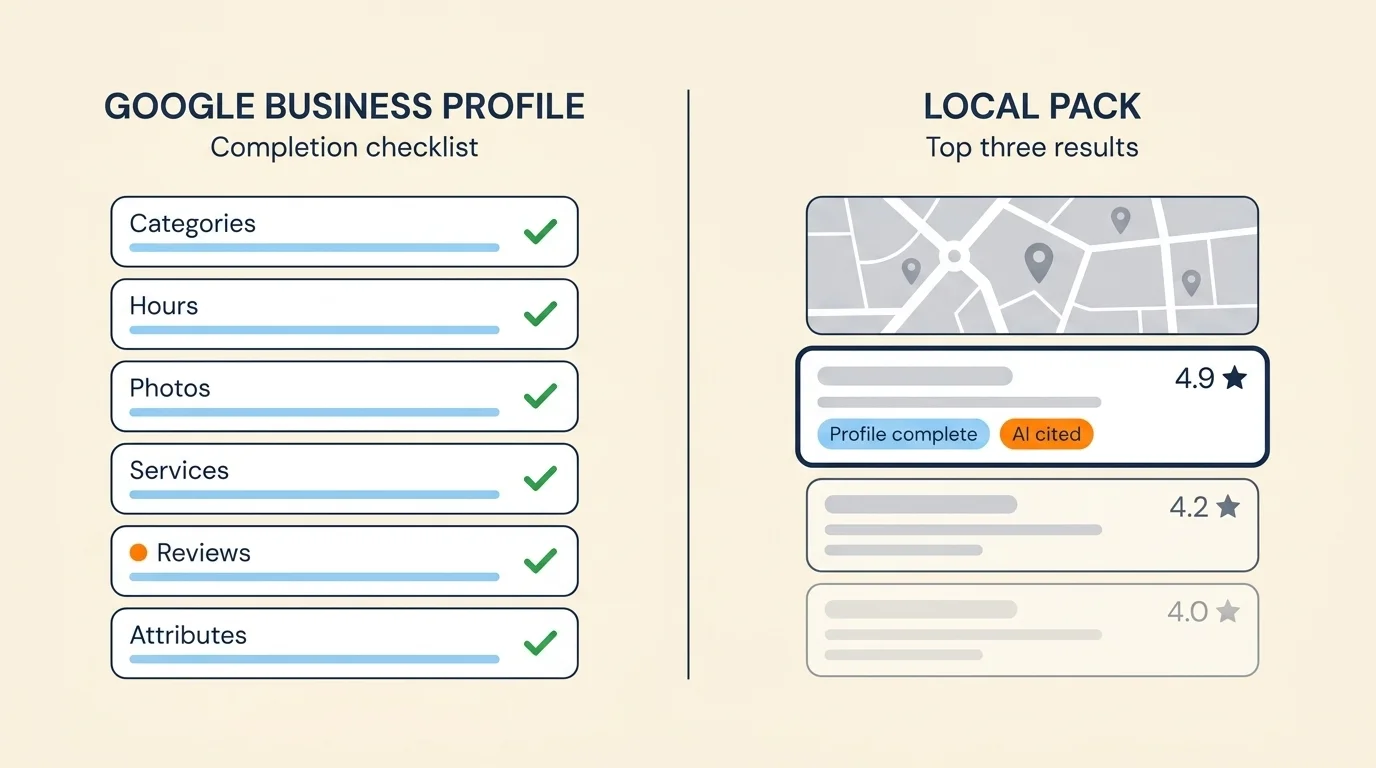
- Claim and fully complete your Google Business Profile. Every category, every operating hour, every relevant attribute. The profile is the single most important local-search asset most small businesses own, and most have it 60% filled out.
- Run a steady review acquisition cadence. A handful of fresh reviews monthly outperforms a one-time push of fifty reviews and then silence. Reviews are also weighted by AI platforms when they cite local businesses — the same content earning your local-pack rank now also drives your AI-citation rate.
- Citation consistency. Your business name, address, and phone number must match across Google, Yelp, Bing Places, Apple Maps, Facebook, and any industry-specific directories. Inconsistent NAP data is one of the most common silent suppressors of local rank.
- Location-relevant content. A page targeting "service in neighbourhood" is still a meaningful win for service-area businesses. Most competitors stop at the city level; the neighbourhood-level page often outranks them on the more specific intent.
- Local schema markup. LocalBusiness schema on your homepage and service pages remains an underweighted technical win. The crawler benefits compound with the AI-citation benefits.
61% of online users are more likely to contact a business with a mobile-optimized site, and Google's mobile-first indexing means your mobile site is what is being ranked, not the desktop one. Run your homepage through PageSpeed Insights once a quarter; if it scores under 70 on mobile, that is a higher-leverage fix than rewriting any of your content.
The wider 2026 shift worth pricing in: 9.7% of B2B revenue and 11.4% of B2C revenue is now AI-influenced, even where AI platforms drive less than 1% of traditional click traffic. The traffic chart and the revenue chart are diverging. The revenue chart is the one to keep watching, and local businesses with strong GBP profiles, real reviews, and structured content are the ones being cited inside AI answers.
AI Tools for Small Business Marketing in 2026
This section did not exist in the 2024 version of this article because there was nothing to put in it. There is now. 67% of small businesses use AI tools for content marketing in 2025-2026; the typical US small business spends $1,500 to $2,500 a year on AI marketing tools, with payback in 3 to 4 months. Those numbers are not aspirational — they are what the median operator is already spending.
The practical 2026 stack for a small business:
- ChatGPT or Claude ($20-30/mo) — content drafting, customer email writing, summarising long docs, light research. The single highest-leverage subscription for most small businesses.
- Canva AI / Adobe Express ($15-30/mo) — design and visual content. Replaces the need for a freelance designer on routine work.
- Jasper or HubSpot AI ($40-80/mo) — campaign-shaped content (landing page copy, email sequences, ad variants).
- Klaviyo's AI features (included in plan) — predictive send-time optimisation and product recommendations for ecommerce email.
- Surfer SEO or Frase ($60-100/mo) — content briefs and on-page optimisation for organic-content programmes.
The thing the reader probably already tried: subscribing to four tools simultaneously, getting overwhelmed by the workflow integration, and reverting to using ChatGPT for everything. ChatGPT for everything is not a bad outcome — it covers a meaningful share of the use cases on its own. The other tools earn their seats only when a specific workflow is consuming more than two hours a week and the dedicated tool can compress that workflow by 60% or more. If it cannot, cancel the subscription before the renewal.
Measuring What Actually Matters
The traffic graph and the revenue graph do not always agree, and when they disagree, the revenue graph is the one to listen to. I have lost count of the times a small business has logged in on a Tuesday, seen a 30% sessions drop in Google Analytics, panicked, and rewritten three pages — only to discover six weeks later that the dropped traffic was a long tail of low-intent queries that were not converting in the first place. The revenue chart, in those cases, is almost always calmer than the sessions chart.
Track three things, in order:
- Money pages and their organic conversion rate. These are the URLs that produce revenue. If they are stable in revenue, you are fine, almost regardless of what the sessions chart is doing.
- Local pack appearance for your three highest-intent queries. Search those queries weekly from a logged-out browser; log whether you are in the local pack, top three, or below. This tracks ahead of revenue by about a quarter.
- Review velocity. New reviews per month, not total review count. Velocity is the leading indicator; total count is the lagging one.
The free version of Google Search Console plus your CRM or POS system is enough for most SMBs. Premium SEO tools are worth their cost above roughly $5,000 a month in spend; below that, the data is not granular enough to justify the subscription.
DIY or Agency: How the Math Has Shifted
Only 34% of SMBs work with agencies in 2026, down from 60% in 2025. That is not a marginal shift. That is the structural collapse of the standard small-business agency engagement model, and it is happening because AI tools have absorbed a meaningful share of what agencies used to charge for — content drafting, basic SEO audits, social-post scheduling, email design.
The math, in plain language. Below roughly $1,000 a month in marketing spend, a DIY-with-AI stack now outperforms most agency retainers, because agencies cannot serve that budget profitably and the work that gets done is junior. Between $1,000 and $5,000 a month, the decision depends on your time and skill mix — if you are spending more than ten hours a week on marketing yourself and you do not enjoy it, an agency or fractional CMO probably makes sense. Above $5,000 a month, especially in dense local markets where paid ads compete hard, agency expertise on bid management and conversion-rate optimisation usually pays for itself.
The thing the reader probably already tried: hiring an agency on a $1,500/mo retainer, getting six months of generic blog posts and a quarterly report, and quietly cancelling. That outcome is the rule, not the exception, at that price point in 2026.
Why Customer Referrals Are Your Real #1 Channel
Worth flagging before the end: customer referrals are now the top SMB lead source at 83%, ahead of every paid channel and most organic ones. Most digital marketing guides, including the older version of this one, do not mention referrals. The paid-channel framing is more familiar, the referral conversation feels less digital, and so it gets skipped.
It should not be skipped. Systematise it: a post-purchase email that asks for a review and offers a small incentive for a referral, a referral-tracking link in your email footer, a quarterly check-in with your top ten customers asking who else they know who could use your service. None of those tactics are flashy. All of them compound.
Paid Ads: When the Math Starts Working
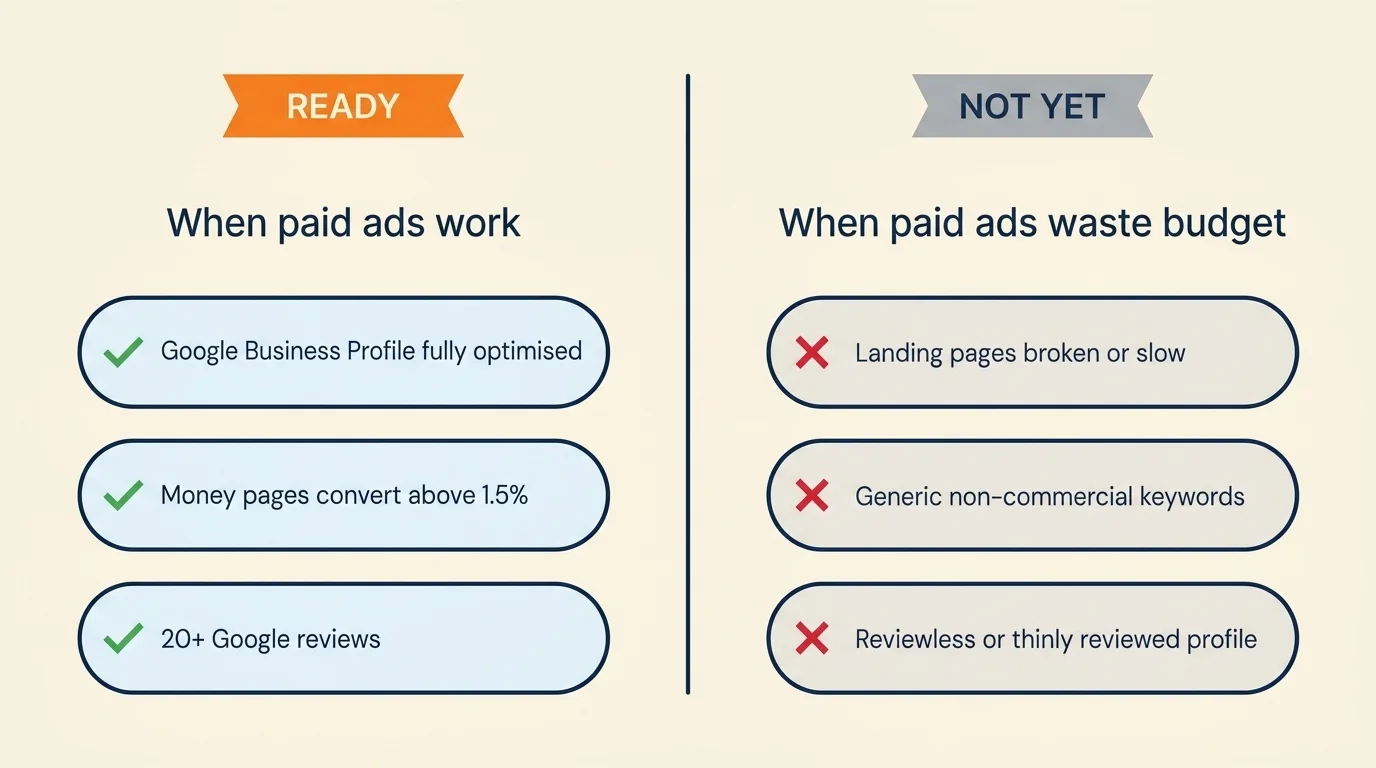
Search ads are running at 45% SMB adoption against social ads at 56% per LocaliQ — the gap is not the differentiator most articles claim. The differentiator is whether you have the organic and local foundations in place first. Paid ads on top of broken landing pages, weak GBP profiles, and a list of generic keywords cost more and convert less than the same spend invested into the foundations.
The decision rule that has held up across cycles: do not run paid search until your Google Business Profile is fully optimised, your top three money pages convert at over 1.5% on organic traffic, and you have at least 20 reviews on Google. Below those thresholds, paid traffic lands on a leaky bucket and you are paying to fill it faster than it leaks.
When the foundations are in place, start with $500-1,000/month on a single channel — Google Ads for high-intent service queries, Meta Ads for visual product categories — for a minimum of two months before judging the result. Anything shorter is noise.
What I'd check in the next hour
Most of what is written above will take a quarter to compound. None of it will pay back this week. So if you are reading this and want one thing to do before lunch tomorrow, here it is.
Open Google Search Console. Filter to the last 28 days. Sort your queries by clicks. Look at the top ten. For each one, ask: is this a query that, if I ranked higher on it, would actually move revenue — or is it a query that brings traffic without buyers? In about half the small businesses I have audited over the years, the top-ten organic queries are skewing toward informational long-tail traffic that does not convert, and the money queries are sitting on page two with three clicks a week.
The fix for that is not more content. The fix is stronger internal links pointing at your money pages from your existing blog posts, plus one rewritten title tag on each money page that pulls the exact-match commercial query into the first 60 characters. Both changes can be made before the weekend. Both are reversible. Both have produced more measurable lift, in my experience, than any marketing tactic in the rest of this article.
Pick the one money page that is closest to ranking on the most valuable query. Audit its internal links. Update its title tag. Re-check Search Console in two weeks. The rest of this guide will still be here.
Frequently Asked Questions
Most US small businesses run on under $1,000/month for marketing, with about 40% planning to increase budgets in 2026 (LocaliQ). A practical baseline is 7-10% of revenue, allocated across local SEO and Google Business Profile (free), AI-assisted content, email marketing ($20-$50/mo for tools), and a small Google Ads or Meta Ads budget once organic foundations are in place.
For most small businesses in 2026, the highest-ROI channels are local SEO (Google Business Profile + reviews), email marketing to your existing customer list, AI-assisted content marketing for organic discovery, and a small targeted paid campaign on Google or Meta. Customer referrals — now the #1 lead source for 83% of SMBs — should be systematized alongside these.
Yes — and most now do. Only 34% of SMBs work with agencies in 2026 (down from 60% in 2025), as AI tools have made content, design, and email automation accessible to solo operators. Agencies still make sense above ~$5,000/month in spend or when local SEO and paid ads compete in dense markets.
A practical 2026 stack: ChatGPT or Claude for content drafting and customer-email writing, Canva AI or Adobe Express for design, Jasper or HubSpot AI for marketing campaigns, Klaviyo's AI features for email targeting, and Surfer SEO or Frase for SEO content briefs. Total cost typically $1,500-$2,500/year with 3-4 month payback.
Local SEO helps your business show up for 'near me' searches and in Google's local map pack. The fundamentals are an optimized Google Business Profile (categories, photos, hours, services), a steady review acquisition cadence, consistent NAP (name/address/phone) citations across directories, and location-relevant content. For most brick-and-mortar SMBs, it outperforms paid ads on cost-per-customer.
Paid ads (Google, Meta) can drive leads within days when configured well. SEO and content marketing typically take 3-6 months to compound. Email marketing builds value over weeks as your list grows. The cheapest fast wins in 2026 are Google Business Profile optimization and review acquisition — measurable lift in 30-60 days.
It depends on your audience and content capacity. SMB investment in TikTok dropped from 34% to 22% in 2026 due to platform uncertainty (LocaliQ), and Facebook (90% SMB usage) plus Instagram (74%) are again the SMB core. TikTok is worth it if your customers are Gen Z, but it's no longer a default.
SEO is one of the highest-ROI channels for small businesses because organic traffic is recurring, not pay-per-click. Ranking pages for 'seo for small business' regularly cite ROI multiples of 5-10× over 12 months, but it requires 3-6 months of content + technical work before results compound.
GEO is optimizing your content so AI platforms (ChatGPT, Perplexity, Google AI Overviews) cite it. Roughly 9.7% of B2B and 11.4% of B2C revenue is now AI-influenced. For SMBs, the practical wins are clear authorship signals (real expert bylines), structured data/schema markup, FAQ-style content, and earning brand mentions across reputable sites — same fundamentals as good SEO, with extra emphasis on entity authority.
Critical: 61% of online users are more likely to contact a business with a mobile-optimized site. Google also uses mobile-first indexing, meaning your mobile site is what's ranked. At minimum, ensure fast load times (under 3 seconds), tap-friendly buttons, click-to-call links, and a one-screen contact form.