
E-commerce Domination: Strategies for Amplifying Sales and Conversions


Ecommerce conversion optimization in 2026 is mostly a benchmarks problem. Most teams I talk to either don't know what a good conversion rate looks like for their category, don't know how much of their traffic isn't converting because of fixable checkout friction, or both. The tactics that move the number have not changed dramatically — checkout shortening, mobile parity, recovery emails, trust signals, BNPL, AI-personalized merchandising — but the data on what they're worth has. This guide pairs the current numbers with the playbook, vendor-neutrally, and points out where 2025-2026 actually broke from the older guides still ranking for these terms.

What's a good ecommerce conversion rate in 2026?
Start with the question every CRO project actually begins with, even when nobody says it out loud. There isn't one good answer; there's seven, segmented by what you sell.
| Industry vertical | Median conversion rate (Shopify, Feb 2026) |
|---|---|
| Food and beverage | 6.22% |
| Beauty and personal care | 4.94% |
| Multi-brand retail | 3.93% |
| Pet care | 3.28% |
| Fashion and apparel | 3.06% |
| Home and furniture | 1.41% |
| Luxury and jewelry | 0.94% |
Source: Shopify ecommerce conversion rate benchmarks, February 2026 update. Cross-platform aggregates put the global mean lower: Statista's Q3 2025 reading is 1.6%, Dynamic Yield reports 2.95%.
The number worth holding alongside any of those is the device split. Desktop converts at roughly 3.9%; mobile at roughly 1.8%. Mobile carries 70-73% of the traffic in most catalogues. That is the largest under-monetised audience most ecommerce businesses have, and a useful starting place for any CRO project that doesn't already have a clear hypothesis. The vertical you sell in tells you what's achievable; the device split tells you where the slack is.
A practical rule of thumb: anything above 3% on desktop and 2% on mobile is broadly healthy for most categories. What matters more than the headline number is improvement against your own prior baseline — and against the right industry comp, not the global mean.
User experience: where the lift actually lives
User experience optimisation is the bucket every CRO programme touches first, partly because it produces compounding gains across the rest of the funnel and partly because most ecommerce sites genuinely do have something easy to fix. The substance worth attending to is short.
Personalised product recommendations. Behaviour-based merchandising — recently-viewed, "customers like you also bought", category affinity — is where AI personalisation earns its keep. McKinsey's industry data puts the average revenue lift from AI personalisation in the 10-15% range, with best-case readings closer to 25%; companies deploying personalisation engines earn roughly 40% more revenue than non-adopters and see customer-retention gains of 10-15%. The fastest measurable wins are PLP and homepage personalisation and dynamic upsell during checkout. Pick a category of vendor (recommendation engine, on-site search AI, conversational assistant) and shortlist by integration cost rather than feature counts.
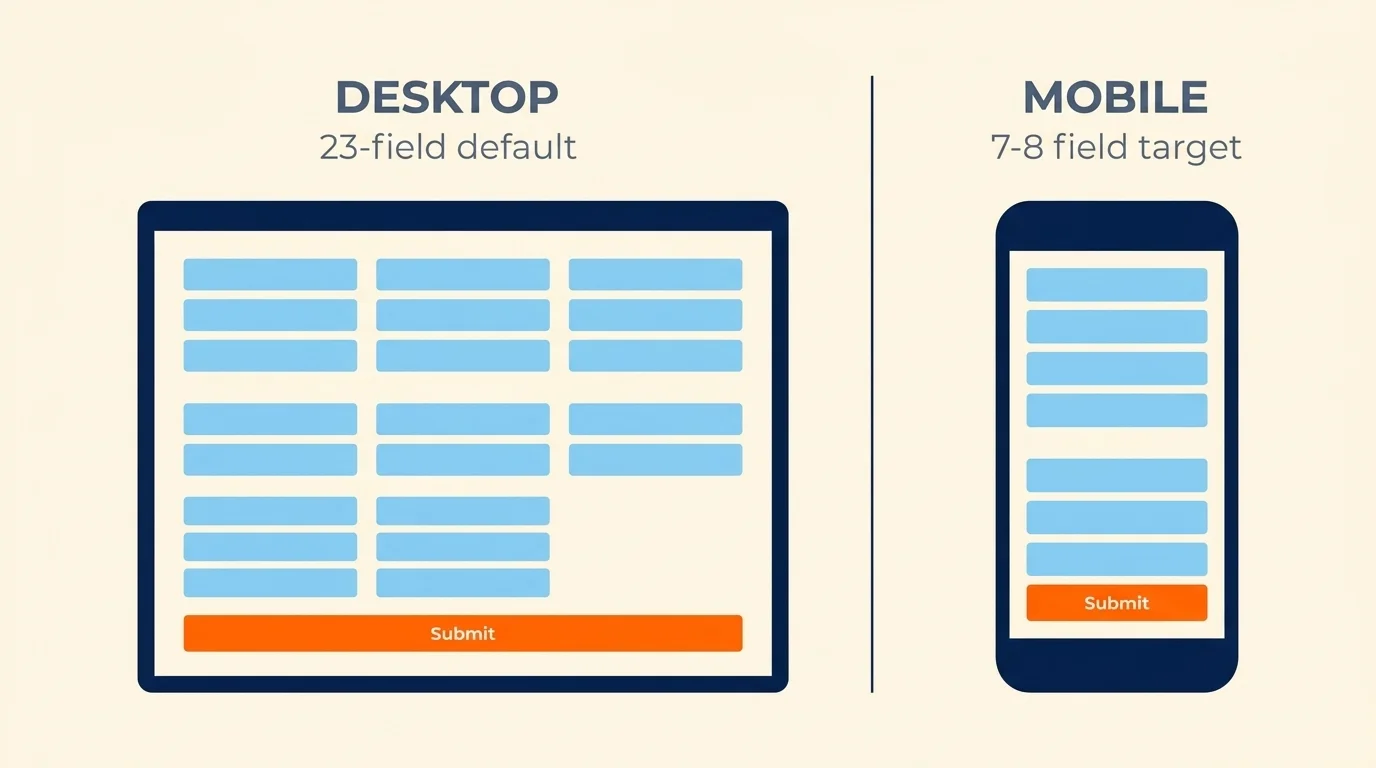
Streamlined checkout. Most sites still ask for too much. Baymard's 2025 audit puts the average US checkout at 23.48 form elements; their evidence-based optimal is 12-14 elements (around 7-8 fields). Halve the form, default to guest checkout, autofill what you can, and surface shipping costs before the cart page rather than after.
Responsive and intuitive design. This is now table stakes, but it has consequences. If your PDP layout reflows badly on a mid-range Android, the mobile conversion rate cited above is partly your design's fault. Tap targets, sticky add-to-cart on long mobile pages, image weight, and Core Web Vitals — particularly LCP under 2.5 seconds — are the parts of "responsive" that show up in the conversion number.
Omnichannel consistency. For brands operating across owned site, marketplace, social storefront, and physical retail, the unit of trust is increasingly cross-channel. Buy online, return in store; cart persistence across devices; loyalty balance visible everywhere. These are not novelty features any more; they are the baseline customers compare against, and they will quietly affect repeat-purchase rate more than any specific on-site optimisation.
Closing the mobile-conversion gap
Mobile is where the gap between traffic and revenue is largest and where most teams haven't done the work to close it. Repeating the number: roughly 70-73% of ecommerce traffic, 1.8% conversion, vs 3.9% on desktop. There is no single fix; there are four habits.
One-click and stored payment. On Shopify, Shop Pay is the most-used variant; Apple Pay, Google Pay, and PayPal One Touch are equivalent levers elsewhere. The lift is real but conditioned on the customer base — repeat purchasers benefit most.
Mobile checkout-form reduction. The 23-field default checkout is even more punitive on a thumb-keyboard. The 7-8 field target Baymard cites is a mobile-first target in practice, not just a desktop one.
Mobile-first BNPL placement. BNPL works hardest on AOVs above $75-100 (more on this below), and on mobile a "4 payments of $X" line on the PDP can be more persuasive than the headline price.
Performance. Sub-second time-to-interactive on the PDP, deferred image loading, and a stripped-down mobile cart layout. The order of magnitude that page-speed work delivers on mobile is consistently larger than what equivalent work delivers on desktop.
The mobile-conversion gap is not a single optimisation; it's a five-quarter programme. But the first quarter of it usually pays for the rest.
Cart abandonment: the largest fixable line item
Cart abandonment deserves its own section because the documented size of the loss is bigger than anything else on this page. Baymard's 2025 update puts the average cart-abandonment rate at 71.72%; mobile sits at 85.65%, desktop at 69.75%. The recoverable revenue from better checkout design alone is estimated at $260B across the US and EU, representing a +35.26% conversion-rate uplift available on the table.
The causes are not mysterious. Excluding the "just browsing" cohort, Baymard's tracked reasons in 2025 are: extra costs at checkout (shipping, taxes, fees) 39%; delivery too slow 21%; trust concerns with credit-card entry 19%; forced account creation 19%; checkout too long or complicated 18%. Notice that four of the five are design choices, not consumer behaviour. The site is causing them.
The corresponding fix list, in priority order:
- Show all-in pricing on the product page — including shipping options and any applicable tax. Surprise costs at checkout is the single largest cause and the easiest to remove.
- Offer guest checkout by default; make account creation a post-purchase option.
- Reduce form fields to Baymard's 12-14 element / 7-8 field target. Autofill addresses, pre-select sensible defaults, hide rarely-used fields behind expanders.
- Add visible trust signals at the credit-card field — recognisable payment-network logos, security badge, plain-language data-handling reassurance.
- Quote a delivery date, not a delivery window where possible, and make expedited options visible without requiring a click.
- Implement an abandoned-cart recovery flow — email at the 1-hour mark, SMS at 24 hours if you have consent, with a clear cart-restore link and, for higher AOV categories, a small recovery incentive that doesn't train customers to abandon.
Most of these are unglamorous. They also collectively account for more recoverable revenue than any of the more interesting optimisations on this page.
BNPL as a CRO lever, not just a payment option
Buy Now, Pay Later has shifted in two years from "nice-to-have payment method" to a measurable conversion lever, with documented numbers that justify the integration cost on their own. Global BNPL transactions are projected at $560.1B in 2025, up 13.7% year-on-year, with BNPL now holding 5-6% of global ecommerce payment-method share. Merchant-side, the typical lift from offering BNPL is around +30% conversion and up to +50% AOV, with the largest gains on AOVs over $75-100. Black Friday 2025 BNPL volume reached $747.5M, up 8.9% year-on-year; Klarna's November volume grew 45% YoY.
For Shopify merchants, Shop Pay Installments is the lowest-friction default. Klarna, Afterpay, and Affirm cover wider geographies and category specialisations. The relevant editorial point is to surface the "4 payments of $X" line at the PDP and cart, not only at the final checkout step — most of the lift comes from changing the perceived price during consideration, not from offering the option after the customer has already committed.
Agentic commerce: the shift voice commerce never delivered
The previous version of this article had a subsection on voice commerce, written when "buy via Alexa" looked like the inflection point. It did not turn out to be. The actual inflection point arrived as agentic commerce, and it is reorganising the discoverability layer of ecommerce more meaningfully than mobile did.
The short timeline: in September 2025, OpenAI and Stripe shipped the Agentic Commerce Protocol (ACP) and Instant Checkout inside ChatGPT — a feed-driven flow where a customer could search inside ChatGPT, see product cards, and complete checkout without leaving the chat. In January 2026, Google announced the coalition-backed Universal Commerce Protocol (UCP) for AI Mode and Gemini. In March 2026, OpenAI retired the original Instant Checkout flow in favour of dedicated retailer apps inside ChatGPT. The mechanism is still being negotiated; the direction is settled.
The implication for CRO is unambiguous. 73% of consumers already use AI somewhere in the shopping journey and Morgan Stanley projects that nearly half of online shoppers will use AI shopping agents by 2030, accounting for roughly 25% of their spending. Agents discover products through structured feeds and schema, not blog posts. The work that compounds in 2026:
- Product feed completeness and freshness across Google Shopping, Bing/Microsoft Shopping, TikTok Shop, and Meta Catalogue.
- Robust Product, Offer, AggregateRating, and FAQ schema on PDPs.
- A clean, supported checkout API that supports ACP-style flows.
- Server-side conversion tracking so attribution survives the AI-referred buyer who never visits your site.
This is not a SEO/CRO afterthought; it is becoming the primary discovery channel for a measurable slice of buyers. Get the feed-and-schema layer right, and you will be ready for whichever specific protocol ends up dominant.

Social commerce, briefly
Adjacent but worth a paragraph. US social commerce hit $87.02B in 2025, up 21.5% year-on-year, and is on track to surpass $100B in 2026. TikTok Shop alone captured 18.2% of US social commerce in 2025 with US sales of $15.82B (+108% YoY) and $64.3B global GMV; its 4.7% conversion rate runs roughly 2.6x Facebook Shops and 2.2x Instagram Shopping. For brands with a younger audience and an established creator footprint, the question is no longer whether to be on TikTok Shop; it's whether the operations side — fulfilment, returns, content cadence — can keep up.
Retention and loyalty: the bit nobody finishes
Retention is the part of every CRO programme that gets started in Q1 and quietly downgraded by Q3. It also tends to be where the strongest documented merchant numbers come from. The Yotpo customer case studies that turn up on most CRO listicles — Goodr at +38% repeat sales, ThirdLove at +65% AOV, Princess Polly at +112% AOV, Revolution Beauty reporting an 8x ROI on the loyalty programme itself — are illustrative rather than universal, and they share a pattern. They are not discount programmes pretending to be loyalty programmes.
The structural levers that hold up in 2026:
- Tiered rewards keyed to behaviour, not just spend — reviews submitted, content shared, second purchase within a category, referral made. Pure spend tiers train the wrong behaviour.
- Subscription and replenishment for any consumable category, with sensible default cadences and easy pause/skip controls. The conversion to subscription is itself a CRO step.
- Community access as a tier benefit — early product access, restricted-membership content, founder Q&As. The Goodr / Princess Polly model relies on this layer for the repeat-purchase number more than on the discount itself.
- Loyalty balance visible during checkout, redeemable in one click. If a customer has to do work to use a reward, the reward is not doing its job.
The one thing not to do is treat the loyalty programme as a discount channel. That is the trap most retention programmes fall into and the reason the rest of this list is more important than the rewards table itself.
Common mistakes I keep watching teams make
Closing with the section I'd write first if I were redoing this guide tomorrow. None of these are clever; all of them are still common.
- Charging shipping cost surprise at the final step. 39% of abandonments cite this and the fix is on the PDP, not in the checkout.
- Forcing account creation before purchase. 19% of abandonments. Guest checkout exists for a reason.
- Treating mobile as a smaller desktop. Mobile traffic share is 70-73%; mobile conversion rate is roughly half desktop. Do the design work.
- Running a 23-field checkout because it was always 23 fields. The Baymard 12-14 element target is achievable on almost every category.
- Pricing loyalty as discount. It depresses margin without producing the behaviour change retention rewards should be paying for.
- Ignoring the AI shopping layer because the protocols are still moving. The feed and schema work is mostly the same work regardless of which specific protocol ends up dominant; defer it at your peril.
- Optimising a 1.8% mobile conversion rate by changing the homepage hero. It is almost never the hero. It is almost always the checkout, the form-field count, the surprise costs at the cart, or the page speed.
The patient, practical version of CRO is: measure your own number against the right vertical benchmark, fix the largest fixable line item first (usually cart abandonment), and then build the slower compounding levers — personalisation, BNPL placement, agentic discovery readiness, loyalty — on top. There is no single trick. There are six or seven boring habits that, together, account for most of the gap between an average site and a good one.
Frequently Asked Questions
The global average sits between 1.6% (Statista, Q3 2025) and 2.95% (Dynamic Yield), with Shopify stores typically converting at 2.5-3%. By industry the spread is wide: food and beverage averages 6.22%, beauty and personal care 4.94%, multi-brand retail 3.93%, fashion 3.06%, home and furniture 1.41%, and luxury and jewelry 0.94%. Anything above 3% on desktop or 2% on mobile is solid for most categories — what matters more than the headline number is improvement over your own prior baseline.
The documented 2025 cart-abandonment rate is 71.72% (Baymard Institute), with mobile at 85.65%. The four biggest fixable causes are surprise costs at checkout (39% of abandoners), slow delivery (21%), trust concerns with credit-card info (19%), and forced account creation (19%). The fastest wins are showing all-in pricing on the product page, enabling guest checkout, cutting form fields from the US default of 23 to Baymard's optimal 12-14, and adding an abandoned-cart email plus SMS recovery flow.
Yes — merchants offering BNPL typically see around 30% higher conversion and up to 50% higher average order value. Black Friday 2025 BNPL volume reached $747.5M (+8.9% YoY), with Klarna's November volume up 45% YoY. The biggest lifts come on AOVs above $75-100; for Shopify merchants, Shop Pay Installments is the lowest-friction option, with Klarna, Afterpay, and Affirm covering wider geographies and category specialties.
AI shopping agents discover products through structured product feeds, schema markup, and checkout APIs — not through long-form content. OpenAI and Stripe launched the Agentic Commerce Protocol in September 2025; Google announced the Universal Commerce Protocol in January 2026. 73% of consumers already use AI somewhere in the shopping journey. To stay discoverable, prioritize complete and current product feeds, robust Product schema, server-side conversion tracking, and a checkout API that agents can transact against — Morgan Stanley projects roughly 25% of online spend will flow through AI agents by 2030.