Email Marketing Revolution: Crafting Compelling Campaigns for Enhanced Engagement


Email marketing in 2026 is in an unusual position. The discipline still delivers the canonical 36:1 ROI Litmus has been reporting for several years, and the centre of gravity has shifted toward email marketing automation rather than the broadcast newsletter — fewer sends, sharper triggers, more revenue per recipient. But the three things that defined the 2024-2025 stretch — Gmail and Yahoo's bulk-sender enforcement, Apple Mail Privacy Protection's quiet poisoning of open-rate data, and generative AI getting embedded inside every major ESP — have changed enough of the underlying practice that a 2023-era guide isn't quite useful anymore. The "future-forward" framing the original version of this piece used has aged badly, mostly because the future arrived.
This is a present-tense version. What works, what's mandatory, what to measure, and a few things that didn't pan out the way the conference circuit suggested.
Effective email design: the interactive layer that actually shipped
The previous version of this article led with AR and VR in email as the design story to watch. They never materialized at scale. The technology that did — the part you can actually use this quarter — is interactive content via AMP for Email and modern CSS.
Interactive AMP-for-Email content shows 520% higher engagement than static equivalents in 2025-2026 benchmarks, and 97% of marketers used at least one interactive element in 2025. The practical interactive vocabulary in 2026 is fairly settled:
- In-email polls, surveys, and rating widgets — single-tap, no destination page required.
- Image carousels on the PDP-equivalent product showcase emails.
- Expandable accordions to compress long-form newsletter content without dropping it.
- AMP forms for in-email RSVPs, preference updates, and short feedback loops.
The two design constraints that haven't changed: mobile rendering still dominates open behaviour, and dark-mode handling is still a real production cost. Build for mobile-first card layouts, test rendering across Apple Mail, Gmail, and Outlook before sending anything important, and accept that AR-in-email is a deck slide rather than a production tactic for the foreseeable future.
Personalization and segmentation: where the lift actually comes from
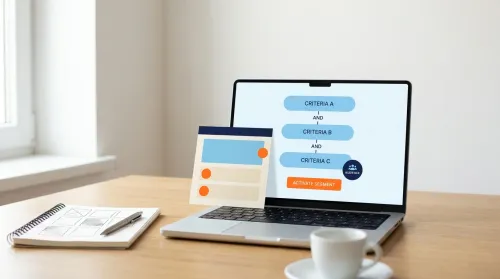
Personalization in 2026 is less about first-name tokens and more about delivering the right message to the right slice of the list. Segmented and triggered campaigns generate 760% more revenue than non-segmented broadcasts, which is the single most-cited stat in the cluster and, unusually, one that holds up across multiple benchmark sources.
The six-to-eight segmentation criteria worth using
Most "segment your list" advice never gets specific. These are the criteria that actually move click-through and revenue per recipient in 2026, drawn across consumer and B2B programmes:
- Recency — last open, last click, last purchase
- Frequency — opens or purchases in the last 30/90/180 days
- Monetary value — total spend, AOV band
- Lifecycle stage — new subscriber, engaged, lapsing, dormant, won-back
- Engagement tier — interaction quartile against the rest of the list
- Source channel — how the contact joined the list (gated content, referral, store purchase, social capture)
- Device class — mobile-only, desktop-only, mixed
- Content-topic affinity — categories or topics they've opened or clicked into
AI-driven segmentation programs report +18% to +45% revenue per recipient versus demographic-only segmentation, and the production cost of running the AI version in 2026 has come down substantially because every major ESP ships predictive-segment features by default.
Subject lines that earn the open
Five formulas, drawn from a few thousand reviewed A/B tests, that consistently win in 2026:
| Formula | Pattern | Best send context |
|---|---|---|
| Curiosity | "We didn't expect this from your last order" | Re-engagement, post-purchase |
| Benefit | "Save 20 minutes on your next campaign brief" | Newsletter, lead nurture |
| Social proof | "Why 12,000 marketers switched to weekly briefs" | Welcome, content-led brands |
| Urgency | "Closing tonight, no codes left" | Promo, BFCM |
| Personalization | "Mehmet, your Tuesday product brief is here" | Triggered, lifecycle |
The 2026 length rules: under 50 characters for mobile rendering; under 25 characters tends to win on raw opens and clicks; 25-35 characters wins more conversions. Use at most one emoji — emoji-free triggered emails outperform emoji-heavy ones in Attentive's published A/B data. For e-commerce, product-name personalization tokens consistently outperform first-name tokens.
AI-generated subject lines lift open rate by approximately +26% versus manually written controls; the higher-leverage use of AI here isn't writing the line, it's the variant generation for A/B testing.
Email marketing automation in 2026
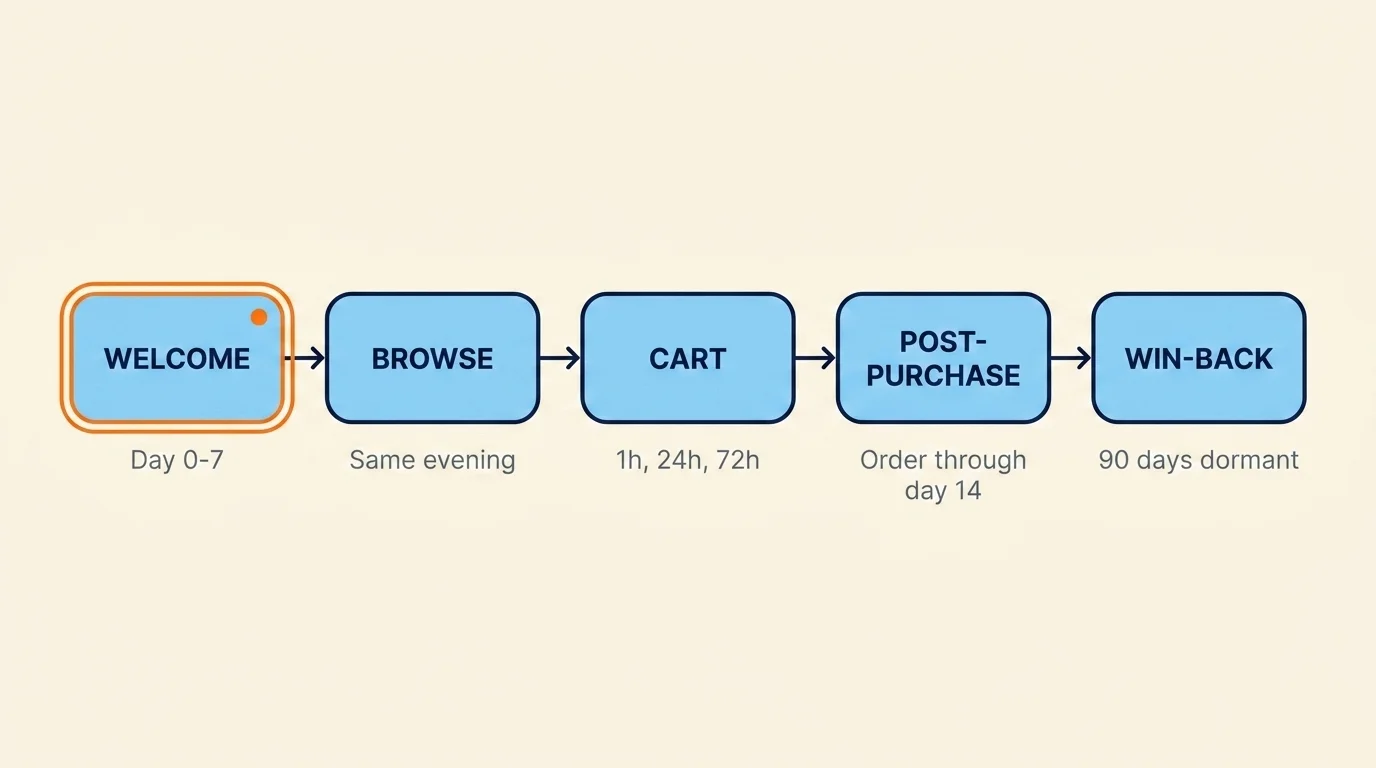
Automation is where 2025 really broke from 2024. The pattern that wins in 2026 is fewer, sharper triggered flows rather than larger broadcast lists. Five flows do most of the work for most programmes; almost everything else is variation on top of these.
The five flows every programme needs
- Welcome series — three emails over the first seven days. Brand context (day 0), reason-to-stay (day 2), call-to-action (day 5).
- Browse abandonment — one to two emails when a logged-in or cookie-identified subscriber views a product or category without converting. Time-of-day matters; same evening usually beats next morning.
- Cart abandonment — three emails: 1-hour, 24-hour, 72-hour. The first should be a no-discount reminder; reserve incentives for the third send to avoid training repeat abandoners.
- Post-purchase — two to three emails: order confirmation (transactional, but the open rate is unmatched), shipping update, and a value-add cross-sell or care-content send 7-14 days after delivery.
- Win-back — two to three emails for subscribers who've gone 90 days without an open or 180 days without a purchase. Last send should ask permission rather than continue sending blind.
The equivalent automation builder by platform: Klaviyo Flow for e-commerce-heavy stacks, HubSpot Workflow for CRM-native programmes, Mailchimp Customer Journey for broad-SMB use, ActiveCampaign Automation for deeper logic-branching programmes, Brevo Workflows for budget-conscious senders. None of these are interchangeable on cost or feature depth, but the flow shapes above translate across all of them.
Deliverability and compliance: the part that breaks programmes silently
This is the section that, if you skim, will be the most expensive omission. The Gmail/Yahoo/Microsoft enforcement of the past two years has changed deliverability from "best practice" to "if you don't do this, you stop reaching the inbox".
The 2024-2025 enforcement timeline
- February 2024: Gmail and Yahoo's bulk-sender rules took effect for any sender dispatching 5,000+ messages per day to Gmail or Yahoo personal accounts. The mandatory minimum: SPF, DKIM, and DMARC published (
p=noneacceptable), spam complaint rate kept under 0.3%, and an RFC 8058 one-click list-unsubscribe header honored within two business days. - April 2024: Gmail moved to percentage-based rejection of non-compliant traffic.
- May 2, 2025: Microsoft joined the same regime for outlook.com, hotmail.com, and live.com — same 5,000/day threshold, same DMARC requirement.
- November 2025: Gmail escalated to permanent rejection of non-compliant traffic. 4xx delays are no longer the worst-case; outright rejection is.
The 2026 data on what compliance is worth: fully authenticated domains achieve approximately 89% inbox placement, compared with roughly 44% for un-authenticated senders — a 2x delta driven almost entirely by the SPF/DKIM/DMARC stack.
The compliance checklist
If you operate a list above ~1,000 subscribers, you should be able to answer "yes" to every item below. If you can't, your deliverability ceiling is lower than it needs to be.
- SPF record published, listing your sending ESP and any auxiliary senders (transactional provider, support helpdesk, internal mail). Use
~allrather than?allat minimum. - DKIM signing enabled on your sending domain with a key length of at least 1024 bits (2048 preferred), and key rotation scheduled at least annually.
- DMARC record at
p=quarantineminimum.p=noneis enough to satisfy Gmail/Yahoo entry, butp=quarantineis required for BIMI eligibility and is the realistic 2026 standard. - RFC 8058 one-click list-unsubscribe header on every marketing/promotional send (transactional excluded). Unsubscribes honored inside two business days.
- Spam complaint rate under 0.3% measured against Gmail Postmaster Tools or equivalent. Above this, throttling starts; well above it, hard rejections follow.
- BIMI for brands willing to invest in a Verified Mark Certificate — adoption climbed +340% YoY through 2025 for a reason, namely the verified-logo placement in supporting clients.
The plain-English version of what happens if you don't do this: your sends to the largest consumer mailbox providers are rejected, your sender reputation degrades quickly, and the recovery takes substantially longer than the prevention.
Metrics in the post-Apple-MPP era
The 2024-2025 inflection in metrics has been quieter than the deliverability one but has changed reporting more than any single tactical shift. Apple Mail accounts for approximately 46% of email-client market share, and Apple's Mail Privacy Protection pre-fetches images regardless of whether the recipient opens the message — which means open rate as a metric is now structurally inflated and not particularly useful for fine-grained optimization.
The practical rule in 2026: stop using open rate as the primary KPI. Click rate, click-to-open rate (CTOR), and revenue per recipient are the metrics that survive MPP and reward the work you do on segmentation and creative.
2026 industry benchmarks
The MailerLite 2025-2026 benchmark dataset, aggregating 3.6M campaigns across 181K accounts (December 2024 - November 2025), gives the cleanest current medians:
| Metric | Median across all industries (MailerLite 2025-26) |
|---|---|
| Open rate | 43.46% (MPP-inflated — treat as directional) |
| Click rate | 2.09% |
| Click-to-open rate (CTOR) | 6.81% |
| Unsubscribe rate | 0.22% (keep under 0.3%) |
Industry breakouts from the same dataset, useful as targets:
| Industry | Open | Click | CTOR |
|---|---|---|---|
| Non-profit | 52.38% | 2.90% | 8.24% |
| Health & Fitness | 47.81% | 1.45% | 4.45% |
| Consulting | 45.96% | 2.41% | 7.67% |
| Legal | 42.58% | 4.90% | 14.72% |
| Manufacturing | 37.36% | 4.22% | 14.82% |
| E-commerce | 32.67% | 1.07% | 4.01% |
The pattern worth noticing: e-commerce open rates are the lowest in the table but click numbers depend heavily on which segment is being mailed. Lifecycle-segmented sends to engaged buyers clear CTOR well above the table median; a broadcast send to a dormant list rarely will.
AI in email: the 2026 reality
64% of marketers used AI in email by 2026, up from a low-double-digit base in 2023, and 33% expect more than half of their email operations to be AI-driven by year-end 2026, with 11% expecting more than 75%. The integration story has played out faster inside the ESPs than as a standalone tool category.
The four ESP archetypes worth knowing in 2026:
| ESP archetype | Representative platform | AI capability that matters in 2026 |
|---|---|---|
| E-commerce-native | Klaviyo | Predictive CLV, churn-risk segments, dynamic product blocks |
| CRM-native | HubSpot | CRM-aware send-time and personalization across email/website/sales touch |
| Broad-purpose SMB | Mailchimp / Brevo | Creative Assistant (subject lines, design suggestions), send-time picks |
| Automation-heavy | ActiveCampaign | Branching logic with AI lead scoring inside automation flows |
Across all four, brands integrating AI throughout the email programme report +41% click-through and +20% conversion lifts. The production-time effect is even more notable: in 2023, 51% of teams needed two or more weeks per email; in 2026, only 6% still do. The discipline has not become trivial — but the labor curve has flattened.
Closing
Email marketing in 2026 is mostly a question of doing five or six things in the right order: authenticating the sending domain, segmenting the list properly, building five reliable triggered flows, writing subject lines that respect mobile rendering, and measuring the right metrics in the post-MPP world. The "revolutionary" framing the previous version of this piece reached for has aged out; the substance underneath has not. The teams getting 36:1 ROI in 2026 are doing the basics carefully. The teams that aren't are usually missing one of two or three specific items on the deliverability checklist.
There is no email marketing revolution. There is a discipline that quietly continues to outperform every other digital channel when run by people who pay attention to what changed last year and what didn't.
Frequently Asked Questions
The MailerLite 2025-2026 dataset (3.6M campaigns) puts the all-industry medians at 43.46% open rate, 2.09% click rate, 6.81% click-to-open rate (CTOR), and 0.22% unsubscribe rate. Open rate is inflated by Apple Mail Privacy Protection — treat it as directional and use click rate and CTOR as the reliable indicators. Industry benchmarks vary widely: non-profits average 52.38% open / 8.24% CTOR while e-commerce sits at 32.67% open / 4.01% CTOR. Anything above the median in your own vertical is a healthy starting point.
If you send 5,000+ messages per day to Gmail or Yahoo personal accounts, you must publish SPF, DKIM, and a DMARC record (p=none minimum), keep your spam complaint rate under 0.3%, and offer a one-click list-unsubscribe (RFC 8058) honored within two business days. Gmail moved to permanent rejection of non-compliant traffic in November 2025; Microsoft joined the same regime on May 2, 2025 for outlook.com, hotmail.com, and live.com. Fully authenticated domains achieve ~89% inbox placement versus ~44% for un-authenticated senders.
Five flows do most of the work in 2026: a 3-email welcome series over the first seven days; a 1-2 email browse-abandonment flow; a 3-email cart-abandonment sequence (1-hour, 24-hour, 72-hour); a 2-3 email post-purchase flow; and a 2-3 email win-back flow for subscribers at 90+ days without an open. Segmented and triggered campaigns generate roughly 760% more revenue than non-segmented broadcasts. The same flow shapes work across Klaviyo Flow, Mailchimp Customer Journey, HubSpot Workflow, ActiveCampaign Automation, and Brevo Workflows.
AI-generated subject lines lift open rate by about 26% versus manually written controls, AI-driven segmentation delivers 18-45% higher revenue per recipient than demographic segmentation, and brands integrating AI across their email programs report +41% click-through and +20% conversion. 64% of marketers used AI in email by 2026 and 33% expect more than half their email operations to be AI-driven by year-end. Every major ESP — Mailchimp, Klaviyo, HubSpot, ActiveCampaign — now ships AI features inside the platform.
Five formulas consistently win: curiosity, benefit, social proof, urgency, and personalization. Length rules: under 50 characters for mobile rendering, under 25 characters for opens and clicks, and 25-35 characters for conversions. Use at most one emoji — emoji-free triggered emails outperform emoji-heavy ones. For e-commerce, product-name personalization tokens outperform first-name tokens, and personalized subject lines lift open rate by approximately 26%.