Influencer Marketing Mastery: Strategies for Driving Brand Awareness and Customer Trust


Influencer marketing strategies in 2026 belong to a creative-services discipline, not a trend cycle. The industry crossed $30B in 2024 and reached roughly $33B in 2025; 87.49% of brand panellists in the Influencer Marketing Hub 2026 report expect their influencer budget to grow this year, and 72.22% expect that growth to be 50% or more. 66.33% of those programmes are now run entirely in-house, which is to say: the work has stopped being "find an agency, sign a contract, hope for vibes" and started being a recognisable part of the brand-marketing function — with the briefs, contracts, KPIs, and compliance obligations that implies.
This piece is a working strategy guide for that reality. Tier choice, partnership shape, ROI math, TikTok Shop as a 2026 channel, and the FTC rules that have become genuinely punitive over the past eighteen months. The tactics that worked in 2023 still mostly work in 2026; the lazy versions of them no longer do.
The tier taxonomy, and why it matters more than reach
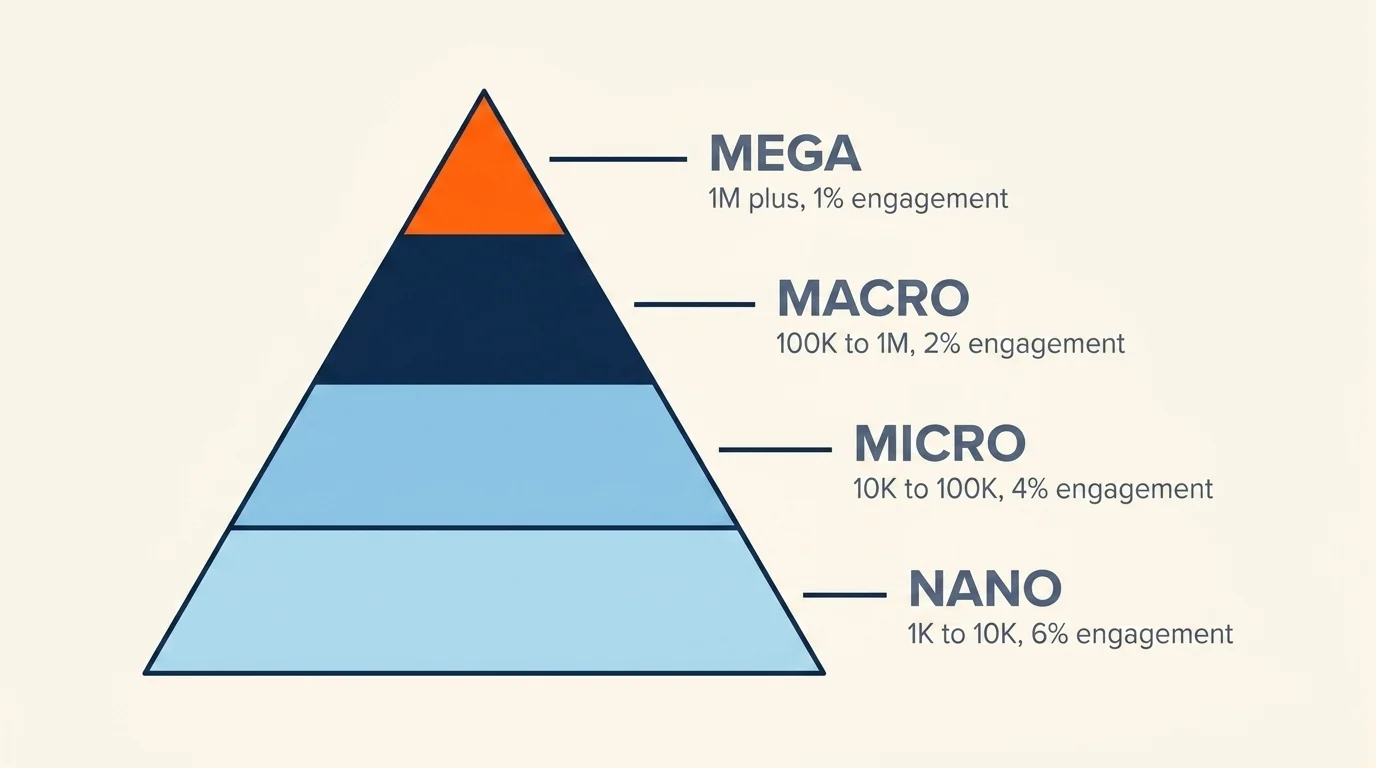
The single biggest mental upgrade for anyone running an influencer programme in 2026 is to stop thinking about a creator's follower count and start thinking about which tier they sit in. Tier is shorthand for a bundle of behaviours: engagement, content shape, audience trust, and price. The numbers are settled enough now that you can plan against them.
| Tier | Follower range | Typical engagement rate (Instagram) | Typical CPE |
|---|---|---|---|
| Nano | 1K - 10K | ~6.23% | $0.10 - $0.50 |
| Micro | 10K - 100K | ~3.86% | $0.50 - $2.00 |
| Macro | 100K - 1M | ~1.5% - 2.5% | $2.00 - $5.00 |
| Mega / Celebrity | 1M+ | ~0.5% - 1.21% | $5.00+ |
Sources: Archive.com 2026 micro-influencer engagement statistics, Post Affiliate Pro 2026 nano/mega comparison, OwlClaw 2026 CPE benchmarks.
What the numbers actually say is that engagement scales inversely with size, and that nano- and micro-tier campaigns earn more attention per dollar — substantially more. A Northwestern University 2026 study found micro-influencers deliver roughly 37% higher ROI than macro-influencers in most categories, and nano conversion rates run 2-3x higher than macro campaigns. Brands now partner with micro-influencers about ten times more often than with mega-influencers, and the 2026 budget panel confirms it: more than 51% of brands plan to expand nano spend and 52.83% plan to expand micro spend, while macro is essentially flat.
The practical implication for brief writing is to design the campaign around the tier, not against the tier. A nano programme is many creators, modest budgets per creator, high-trust micro-audiences, and the brand getting out of the creative way. A macro or mega programme is a single hero piece with production polish and a wider awareness arc. They are not interchangeable, and a programme that tries to do both at once usually does neither well.
Identifying the right creators
Tier choice narrows the field. The next part is selection, which is where most programmes spend more time than they should and still get the wrong answer. The criteria worth taking seriously:
- Audience-brand fit, measured by demographic and topical overlap with the campaign's target — not just total follower count.
- Engagement quality, measured by comment depth and saves/share ratio rather than headline engagement rate (which is gameable).
- Brand-safety history — past collaborations, controversies, the categories the creator has previously worked in.
- Aesthetic consistency — does the creator's existing feed sit comfortably alongside your brand's identity without an awkward seam.
- Communication style — the way someone replies to a brief during the discovery phase is the way they will reply to revision rounds during production. Pay attention to it.
Most platform-level influencer-marketing tools — Aspire, Grin, CreatorIQ, Upfluence, Mavrck — can surface candidates against the first three criteria at scale. The last two require human review, and there isn't a shortcut for it. Allocate selection time accordingly.
Building partnerships that survive contact with the brief
The "authentic partnership" advice in older influencer guides was correct in direction but vague in substance. The 2026 version has hardened around a few specific contract and process choices.
Creative freedom inside a real brief. Brand teams that hand the creator a script and a deck rarely get a piece of content that performs. Brand teams that hand the creator a moodboard, three non-negotiables (e.g. product on-screen for at least eight seconds, hashtag set, brand mention by name), and trust on everything else routinely outperform. The creator knows their audience better than you do; protect what's structurally important and let the rest go.
Content-rights clauses in the original contract. Aspire's 2026 State of Influencer Marketing reports that 77% of brands now repurpose creator content in paid ads, and 67% bake content-usage rights into the original creator contract. The brands that don't do this end up paying twice — first for the post, then for the rights to amplify it — and usually less favourably the second time around.
Exclusivity windows, not exclusivity contracts. A 30-day non-compete in the same product category is reasonable. A six-month exclusivity that prevents a creator from working with non-competing brands is not, and the creators worth working with will refuse it.
FTC compliance as a contract warranty. Make compliant disclosure a clause in the agreement, not a request in a follow-up email. The reasons for this become unambiguous in the next section.
Compensation that respects production. A flat fee plus an affiliate or amplification rev-share aligned to the campaign's primary KPI is now the most common structure, and it survives renegotiation more gracefully than a flat fee alone.
TikTok Shop and the creator-affiliate model
This deserves its own section because it has changed the shape of the discipline more than anything else in the past eighteen months. TikTok Shop GMV reached roughly $66B in 2025 and is forecast at $87B+ in 2026, with an average conversion rate of about 4.7% — roughly twice the rate of traditional ecommerce. 32% of brands surveyed by Aspire already sell on TikTok Shop, and another 25% plan to; TikTok appears in 31% of brand influencer plans for 2026, while every other platform clusters at 8-15%.
The mechanism that matters: TikTok Shop affiliate creators function as a distributed storefront. Commission tiers run from 10% to 50%, with most categories baseline at 10-15%, and over 100,000 US creators are enrolled in the affiliate program. The economics are different from traditional sponsorship: instead of paying upfront fees for a single video, brands pay commission on attributed sales, which is genuinely performance-aligned.
The complementary paid lever on TikTok is Spark Ads — paid amplification of an existing creator post. The 77% paid-amplification stat above is largely powered by Spark Ads, because the economics consistently beat traditional whitelisted-creator spend in social-commerce contexts. The practical playbook for a 2026 TikTok programme is usually: small flat fee + affiliate commission + Spark Ads budget on the top-performing organic posts.
This is not a fit for every brand. Consideration categories with long sales cycles still belong to other tactics. But for any product with an impulse-purchase shape — beauty, accessories, snacks, home decor, low-AOV apparel — TikTok Shop is now the most operationally interesting channel in influencer marketing.
Measuring ROI: the EMV formula and a worked example
Most ROI sections in competing guides list KPIs without ever giving you the math. The Earned Media Value formula that most large agencies use, expressed plainly:
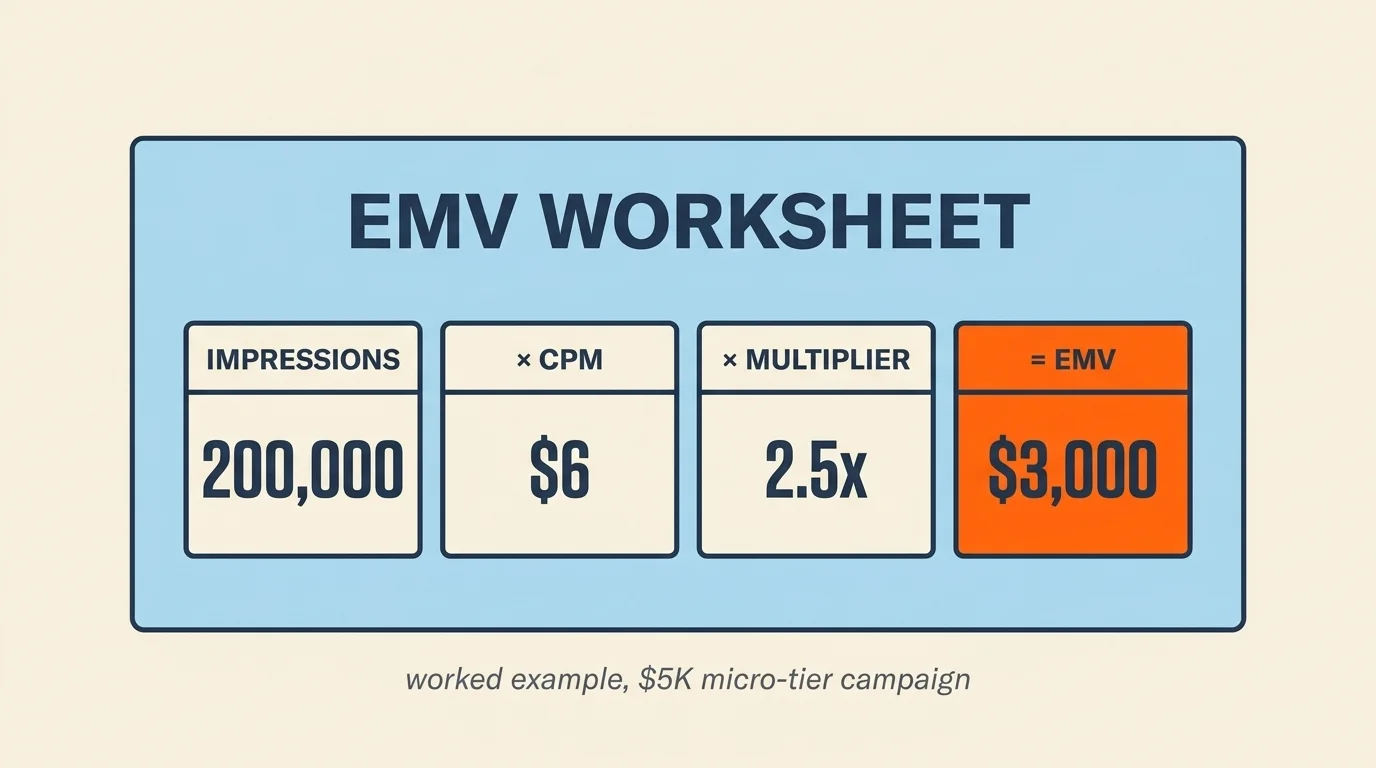
EMV = Impressions × CPM × Engagement Multiplier
Where the Engagement Multiplier is roughly the campaign's engagement rate divided by the platform's organic baseline engagement rate. CPM benchmarks worth knowing in 2026: TikTok roughly $2-$6, Instagram $3-$8, YouTube $5-$25.
A worked example. Say you run a $5,000 micro-influencer campaign on Instagram across five creators with combined reach of 250,000 followers and an average engagement rate of 4% — the micro-tier benchmark above. Approximate impressions of 200,000 (working on a conservative ~80% organic reach), Instagram CPM of $6 (middle of the range), and an engagement multiplier of roughly 2.5x (4% engagement against a 1.5% Instagram baseline) gives an EMV of roughly:
200,000 × ($6 / 1,000) × 2.5 = $3,000
Add affiliate-attributed sales (track via UTM links and creator-specific promo codes), repurposed content rights value (if you'd otherwise have paid for production), and any earned-traffic value, and the total return for the campaign typically lands in the $30K-$40K band on a $5K spend — which is consistent with the industry-cited average of roughly $6.50 returned per $1 spent and the nano/micro tier-specific evidence that the cleanest ROI lives at the smaller tiers.
A few measurement habits worth installing:
- Creator-specific UTM parameters on every link in every creator post. This is the only reliable way to attribute platform-side traffic.
- Unique promo codes per creator — cheap, customer-friendly, and unambiguous for attribution.
- Pre/post brand-lift surveys for awareness campaigns where direct attribution is structurally hard.
- 30-day cohort retention of buyers acquired through each creator — the macro-vs-nano comparison falls apart fast if you only look at first-purchase rate.
Navigating FTC rules in 2026
This is the section that has changed the most in recent years and the one most older guides still treat as a hand-wave. The 2026 reality is materially stricter.
The framework. Influencer endorsements remain governed by the FTC's Endorsement Guides, promulgated under 16 CFR Part 255. The rule the older version of this article cited — disclose paid relationships with #ad — is incomplete. The current standard is that disclosures must be clear, conspicuous, and unavoidable to an ordinary, reasonable consumer. Burying #ad in a stack of hashtags at the end of a caption no longer qualifies.
The 2024 fake-reviews rule. In August 2024 the FTC finalized 16 CFR Part 465 banning the creation, sale, and dissemination of fake reviews and testimonials, including those generated by AI. Civil penalties under this rule reach up to $51,744 per violation, and the FTC has explicitly stated that brands and agencies are jointly liable with the influencers they hire. The financial exposure has moved from theoretical to substantial.
The AI double-disclosure requirement
The newer obligation worth knowing. Content that uses AI avatars, virtual influencers (Aitana López, Lil Miquela, others), AI-voiced endorsements, or AI-generated likenesses requires a "double disclosure" — both that the content is sponsored AND that AI was used to create the endorsement. #ad covers the first half; it does nothing about the second.
The practical guidance the FTC has given is that the AI disclosure must be in the same field of visibility as the sponsored disclosure and as easy to find. The realistic 2026 stance: assume any AI-generated or AI-assisted endorsement carries the heightened disclosure obligation, even when uncertain about the boundary. 86% of creators report using generative AI in their workflow somewhere; the boundary is genuinely fuzzy.
A short brand-side compliance checklist
What to actually hand the creator alongside the brief:
- Disclosure language: "Paid partnership with Brand" or equivalent, placed before or alongside the primary CTA and in the same visual register. No buried hashtags.
- Platform-native disclosure: turn on the platform's built-in paid-partnership tag (Instagram, TikTok, YouTube all support this). Use it in addition to in-content disclosure, not instead of.
- AI disclosure, where applicable: explicit mention that AI was used to generate or significantly alter the endorsement content.
- No fabricated reviews or testimonials, AI-generated or otherwise. This is the line the August 2024 rule draws and it is not gentle about it.
- Compliance warranty in the contract: a clause stating that the creator's content will satisfy current FTC Endorsement Guides and Part 465, and that the brand reserves the right to require correction.
The compliance work is not glamorous. It is also the part of the discipline whose cost of failure has risen most sharply.
Closing
A 2026 influencer marketing strategy is mostly five decisions made deliberately: which tier, which platform, which contract shape, which measurement model, which compliance posture. None of them are intuitions. All of them have benchmarks. The brands that treat the discipline as a creative-services function with the same rigor they apply to a print campaign or a brand film tend to produce work that performs and survives the inevitable post-campaign scrutiny. The brands that treat it as a vibes-driven traffic shortcut produce neither.
There is no mastery to it, exactly. There is the work of doing the brief properly, choosing the right tier, writing a contract that protects both sides, measuring with discipline, and disclosing what needs disclosing. The 2026 part is just that the cost of skipping any of those steps has gone up.
Frequently Asked Questions
Nano (1K-10K followers), micro (10K-100K), macro (100K-1M), and mega or celebrity (1M+) describe follower tiers. Engagement scales inversely with size — nano hits roughly 6.23% on Instagram while mega sits at 0.5-1.21% — so nano and micro typically deliver 2-3x higher ROI per dollar despite reaching fewer people. A 2026 Northwestern University study found micro-influencers deliver about 37% higher ROI than macro-influencers in most categories.
Use Earned Media Value (EMV): EMV = Impressions x CPM x Engagement Multiplier. Track it against campaign cost using promo codes, UTM links, and platform-native attribution. Industry benchmark sits around $6.50 returned for every $1 spent in 2026, with nano and micro tiers leading the average. CPM benchmarks: TikTok roughly $2-$6, Instagram $3-$8, YouTube $5-$25.
Disclosures must be clear, conspicuous, and unavoidable — '#ad' buried in a caption no longer qualifies. Under the August 2024 fake-reviews rule (16 CFR Part 465), violations can cost up to $51,744 each, and brands are jointly liable with creators. AI-generated or virtual-influencer content requires double disclosure — both that it is sponsored and that AI was used to create the endorsement.
TikTok Shop GMV is forecast to grow from $66B in 2025 to $87B+ in 2026, and 32% of brands already sell on the platform. Affiliate commissions run 10-50% (10-15% baseline) and 100,000+ US creators are enrolled. The 4.7% average conversion rate beats traditional e-commerce, and amplifying creator content with Spark Ads typically out-performs paying for new sponsored posts. Impulse-purchase categories — beauty, accessories, snacks, decor, sub-$50 apparel — are the strongest fit.