
Interactive Content Marketing: Engaging Audiences with Quizzes, Polls, and Interactive Experiences


Interactive content marketing has crossed the line from "differentiator" to "table stakes" since this article first ran in early 2024. 62% of businesses now have interactive content in their strategy, up from roughly half that two years earlier. The numbers underneath the trend are unambiguous: interactive formats drive a 52.6% engagement rate vs. static content, and buyers spend 13 minutes on interactive content versus 8.5 minutes on static; 65% of marketers report stronger ROI from interactive vs. traditional formats; 44.4% of marketers using interactive content report a successful strategy versus 39.9% of those who don't.
The previous version of this article walked through the concept. The current version below works through what's actually shipping — named brand examples, the platforms doing the work, the AI shift that arrived in the last eighteen months, and a measurement framework that connects engagement to revenue rather than to itself.

The interactive content types that actually ship in 2026
A working taxonomy is more useful than another listicle of "twenty types of interactive content." The categories that genuinely produce results in 2026, with a named brand example and a recommended tool category for each:
| Type | Named example | Recommended tool category |
|---|---|---|
| Personality quiz | Warby Parker frame-style quiz | Outgrow, Typeform, Interact |
| Product-match quiz | Il Makiage POWERMATCH | Outgrow, involve.me, Octane AI |
| Assessment / ROI calculator | B2B vendor maturity assessments | Outgrow, Calconic, ScoreApp |
| Interactive infographic | Long-form scrollytelling data stories | Flourish, Infogram, Ceros, Shorthand |
| Shoppable video | Feelunique product carousels in video | Whatmore, Firework, Bambuser |
| AR product try-on | Sephora Virtual Artist; IKEA Place | Snap AR Lenses, 8th Wall, Meta Spark |
| Interactive ebook / report | Annual research reports with embedded charts | Foleon, FlippingBook, Shorthand |
| Branching video | Decision-tree explainer videos | Mindstamp, Wirewax, HiHaHo |
| Live poll / Q&A | Instagram Stories poll, LinkedIn poll | Native platform tools |
| Gamified microsite | Edinburgh Zoo's interactive campaigns | Riddle, Ceros, custom build |
Sources for the named examples: WordStream's 2026 interactive-content roundup and Shorthand's 9-example showcase. The repeated pattern across all of them: a clear single goal per asset (qualify a lead, recommend a product, demonstrate a concept), a short completion time, and an explicit next step at the end.
The categories that haven't aged as well, despite a lot of conference-deck attention: full-AR brand worlds without a clear next step, deeply branching choose-your-own-adventure pieces that exceed a few minutes, and "interactive whitepapers" that are mostly PDFs with hyperlinks. They produce decent dwell time and not much else.
AI-generated interactive content: the 2026 shift
The single biggest change in the past eighteen months has been the move from "we'll build the quiz manually" to "we'll describe the quiz and the platform will draft it." Outgrow, involve.me, Interact, and Typeform each now ship plain-text-prompt generators that produce questions, branching logic, and result pages from a brief, and the platforms surface AI optimization suggestions after the first ~100 completions — recommendations on question order, drop-off prevention, and result-page copy.
What this changes operationally: the time cost of shipping a working quiz dropped from days to roughly one to two hours, which means small teams can run an interactive programme without having to build the assets themselves. The shape of the work shifts to brief writing, audience segmentation, and post-completion follow-up — i.e. the marketing layer, not the production layer.
What it doesn't change: a poorly-briefed AI-generated quiz is still a poorly-briefed quiz. The platforms are good at producing the structure; they are not yet a substitute for the strategic thinking about who you are trying to reach and what you want them to do next.
Tools matrix: pick the right platform for the job
A vendor-neutral way to pick. The platforms below ship the bulk of what most marketing teams need in 2026.
| Platform | Free tier | AI generation | Best for | Native integrations |
|---|---|---|---|---|
| Outgrow | Trial | Yes | B2B funnels, calculators, assessments | HubSpot, Salesforce, Mailchimp |
| Typeform | Yes | Yes | Design-led standalone quizzes & forms | HubSpot, Slack, Zapier, Salesforce |
| involve.me | Yes | Yes | Fast lead-gen quizzes with templates | Mailchimp, Klaviyo, HubSpot, Zapier |
| Interact | Yes | Yes | Personality and recommendation quizzes | ConvertKit, Mailchimp, HubSpot |
| Ceros | No | Limited | Premium-design interactive microsites | Marketo, Pardot, HubSpot |
| Shorthand | Yes | No | Scrollytelling long-form editorial | Embedding-based |
| Visme | Yes | Limited | Templates-led DIY across formats | Mailchimp, HubSpot, Salesforce |
| Mindstamp | Trial | Yes | Interactive and branching video | Vimeo, YouTube, Zapier |
| Whatmore | Demo | Limited | Shoppable video on PDPs | Shopify, BigCommerce, Magento |
The selection criteria worth applying, in order of priority: which CRM or ESP does the platform integrate with natively (and is that the one you already use), can it ship the specific asset type you actually need, and does its pricing scale with your volume rather than punishing it. The AI capability question is now a default-yes for everything except Shorthand and Visme — it's no longer a differentiator on its own.
Lead generation quizzes: the highest-leverage interactive asset
If a team can only build one interactive asset, it should usually be a lead-generation quiz. Quiz completion rates average around 65%, and about 40% of quiz starters convert into a lead — numbers that hold across consumer and B2B contexts and that beat almost any other content format on a per-impression basis.
Three quiz patterns that consistently work:
The personality quiz. Warby Parker's frame-style quiz is the canonical example. The mechanism: ask 5-8 lifestyle and preference questions, return a personality-style result, recommend a small set of products that fit. Works for considered-purchase consumer categories.
The product-match quiz. Il Makiage's POWERMATCH foundation-shade quiz is the canonical example. Mechanism: ask 6-12 specific physical and preference questions, run them through a recommendation engine, return one or two specific products with a clear path to purchase. Higher conversion than personality quizzes; harder to brief because the logic must actually reflect product capabilities.
The B2B assessment-to-demo. Mechanism: ask 8-15 questions about the prospect's current state in a category, return a maturity score with named gaps, and offer a tailored demo or audit conversation as the next step. Highest-cost-per-lead pattern in the table, also the highest-quality leads for considered B2B sales.
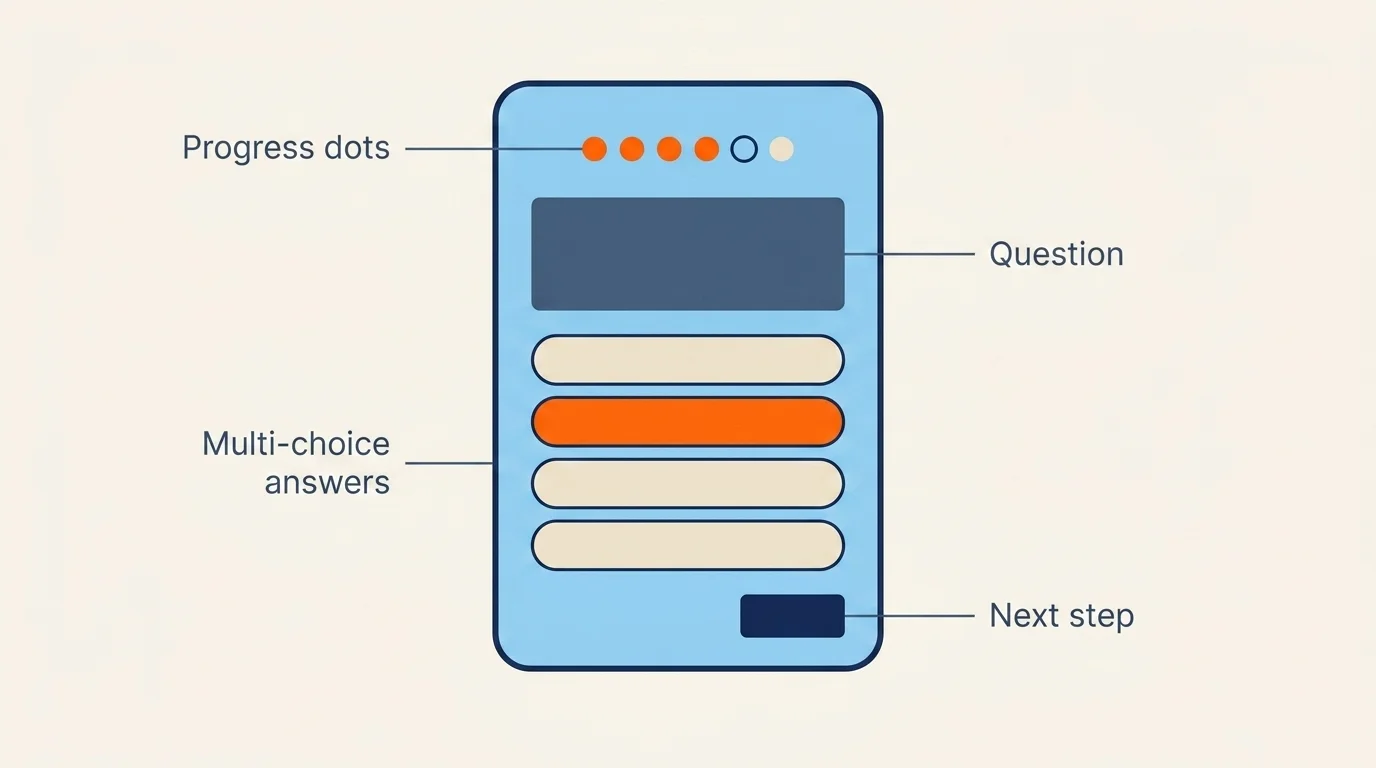
The common architecture across all three: a short question set, an immediately useful result (not a discount code), and a single clear next step. Quizzes that ask twenty questions and then dump the user back to the home page underperform every other pattern.
Shoppable interactive content for e-commerce
The fastest-growing category in 2026 is shoppable interactive content, particularly shoppable video. The economics now justify the build cost in most consumer categories. Shoppable video lifts purchase intent 9x versus standard video, and product detail pages with shoppable video convert at 3x the rate of static-image PDPs. The named results that have started to circulate in industry write-ups are similar: beauty retailer Feelunique reported a 40% engagement increase and a 4x conversion lift after deploying shoppable interactive video, and Sephora's Virtual Artist AR makeup try-on drove a 48% conversion increase.
The 2026 shape of the discipline:
- Shoppable video on PDPs — the largest-impact placement. Whatmore, Firework, and Bambuser ship this as a Shopify-native or platform-agnostic embed.
- AR product try-on — apparel, beauty, eyewear, furniture. Sephora and IKEA Place set the bar; web-based AR (no app download) removed the friction that limited earlier adoption.
- Live shopping with embedded polls — popular on TikTok and Instagram Live, increasingly viable on owned commerce sites. The poll mechanic creates a reason to stay.
- In-video product hotspots — clickable product cards inside video, branching to the product page. Less production-heavy than full shoppable video; useful on YouTube and embedded video.
This category is the clearest 2025-2026 break from older "interactive content" coverage, which mostly treated commerce as outside scope. In 2026 the commerce layer is increasingly the point.
Social-native interactive content
The platforms have invested in interactive primitives that most teams under-use. Instagram poll and quiz stickers, TikTok's Voting Sticker (launched July 2025 as the first first-party interactive ad unit on TikTok), LinkedIn polls, YouTube polls — all free, all native, all consistently outperform their static equivalents.
The engagement-rate context matters here. TikTok's average engagement rate in 2025 sat at 3.70%, up 49% YoY, versus Instagram's 0.48% — roughly 7x higher. Interactive stickers and the new Voting Sticker compound that gap. The practical implication is that a small interactive-stickers programme on TikTok will outperform a much larger static-post programme on Instagram on per-impression engagement.
This is the lowest-cost-to-test interactive lever available to most teams. Two interactive posts a week on each owned channel, measured against the equivalent static-post baseline for a month, is enough to determine whether the lift is real for a given audience.
A closed-loop measurement framework
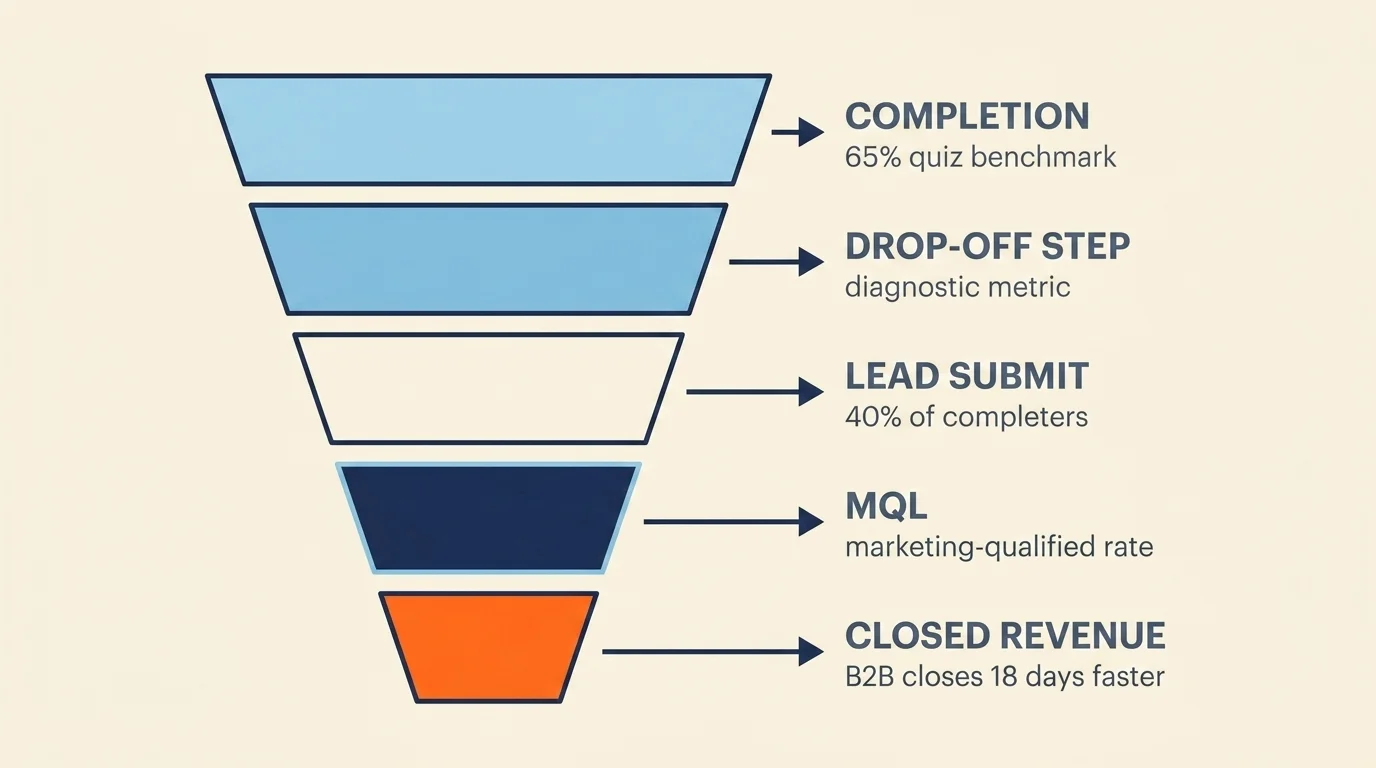
Most interactive-content programmes fail not at production but at attribution. The framework that connects engagement to revenue is a five-metric funnel:
- Completion rate — share of starters who reach the end of the asset. Quiz benchmark ~65%; interactive video benchmark ~91% versus ~50% for standard video.
- Drop-off step — which question or moment users abandon. The diagnostic metric: if completion is low, the answer is here.
- Lead-form submit rate — share of completers who provide contact data. Quiz benchmark ~40%.
- MQL rate — share of submitted leads that meet your marketing-qualified definition.
- Closed-revenue-with-asset — revenue from deals where the buyer engaged with at least one interactive asset. B2B deals with at least one interactive asset close on average 18 days faster than static-only deals.
The first two are platform-native; most quiz tools ship them by default. The last three require integration with the CRM, which is the work most programmes underinvest in. Quiz-platform → CRM via UTM parameters and webhook is now table stakes; quiz-platform → CRM → revenue-system close-loop attribution is what separates a programme that ships from a programme that defends its budget.
78% of B2B procurement decision-makers report preferring interactive formats for vendor education, and the 18-day faster-close stat is reliable enough that a B2B programme can be financially justified on it alone if the measurement layer is connected.
A note on accessibility (post-EAA)
The European Accessibility Act entered enforcement in June 2025, and iframed quizzes, polls, and AR experiences must now be keyboard-reachable, focus-trappable, and screen-reader-labelled to meet WCAG 2.2 AA for B2C digital products in the EU. Outgrow, Typeform, and Interact ship compliant defaults; custom-built JavaScript quizzes and decorative-only AR experiences usually do not. The practical guidance is to default to a managed platform for interactive assets that touch EU audiences, and to spec accessibility into any custom build from the start rather than retrofitting.
Closing
The honest version of where interactive content marketing sits in 2026 is that it works, the tooling is finally easy, the AI generation has removed most of the production friction, and the measurement-to-revenue layer is the part most programmes still skip. There is no shortcut to the last one. Pick one quiz or assessment, ship it on Outgrow or Typeform inside an afternoon, wire its results into the CRM properly, and measure against the five-step funnel above for ninety days. Then add a second format. The teams that do this end up with a programme. The teams that publish "interactive content matters" thinkpieces end up with a draft folder.
Frequently Asked Questions
Interactive quizzes and polls drive a 52.6% engagement rate versus static content, with buyers spending 13 minutes on interactive versus 8.5 minutes on static. Quizzes average a 65% completion rate and about 40% of completers convert into leads. Beyond engagement, they capture first-party data — preferences, intent signals, qualifying criteria — that fuels personalization, lead scoring, and faster sales cycles (B2B deals with at least one interactive asset close 18 days faster).
Track a five-metric funnel: completion rate (benchmark roughly 65% for quizzes, 91% for interactive video), drop-off step, lead-form submit rate (about 40% of completers), MQL rate, and closed-revenue-with-asset. Deals where the buyer engaged with at least one interactive asset close on average 18 days faster than static-only deals.
Outgrow, involve.me, Interact, and Typeform each generate quizzes from a plain-text prompt — questions, branching logic, and result pages — and surface AI optimization suggestions after the first ~100 completions. Choose Outgrow for B2B funnels and calculators, Typeform for design-led standalone quizzes, involve.me or Interact for fast lead-gen quizzes with templates.
Yes. Shoppable video lifts purchase intent 9x versus standard video, and product detail pages with shoppable video convert at 3x the rate of static-image PDPs. Beauty retailer Feelunique reported a 40% engagement increase and 4x conversion lift after deploying shoppable interactive video; Sephora's AR Virtual Artist drove a 48% conversion increase. The video commerce market is projected to reach $55B by 2027.