Meme Marketing Mastery: Riding the Viral Waves of Internet Culture


Two brands launched a meme inside the same fortnight last February. One of them ran a fake mascot funeral and pulled 1.7 billion impressions across socials, a 25,560 per cent spike in brand mentions on launch day, and the largest single-quarter daily-active-user growth in the company's history. The other shipped a topical reaction post inside the same trending format, on the same platforms, and earned roughly the silence its team had been earning all year. Both teams had used the word "meme" in the brief. Only one of them was doing meme marketing.
This is the question the rest of the article is going to keep coming back to: what was the actual craft decision underneath the campaign that worked, and would your team have made it? Searches for "meme marketing" are down forty-seven per cent year over year and the tactic is being absorbed into the broader vocabulary of creator-led, platform-native content. That does not mean it stops working — Duolingo's Dead Duo campaign ran in February 2025, well inside the decline curve, and it worked spectacularly. It means the practice has to be done properly or not at all. Below is the format taxonomy, six brand examples worth studying, a brief template you can actually use on a Tuesday morning, the eight metrics you should be reading on Wednesday, and a sober list of the situations where the right answer is not to do it.
The three formats brand memes actually come in
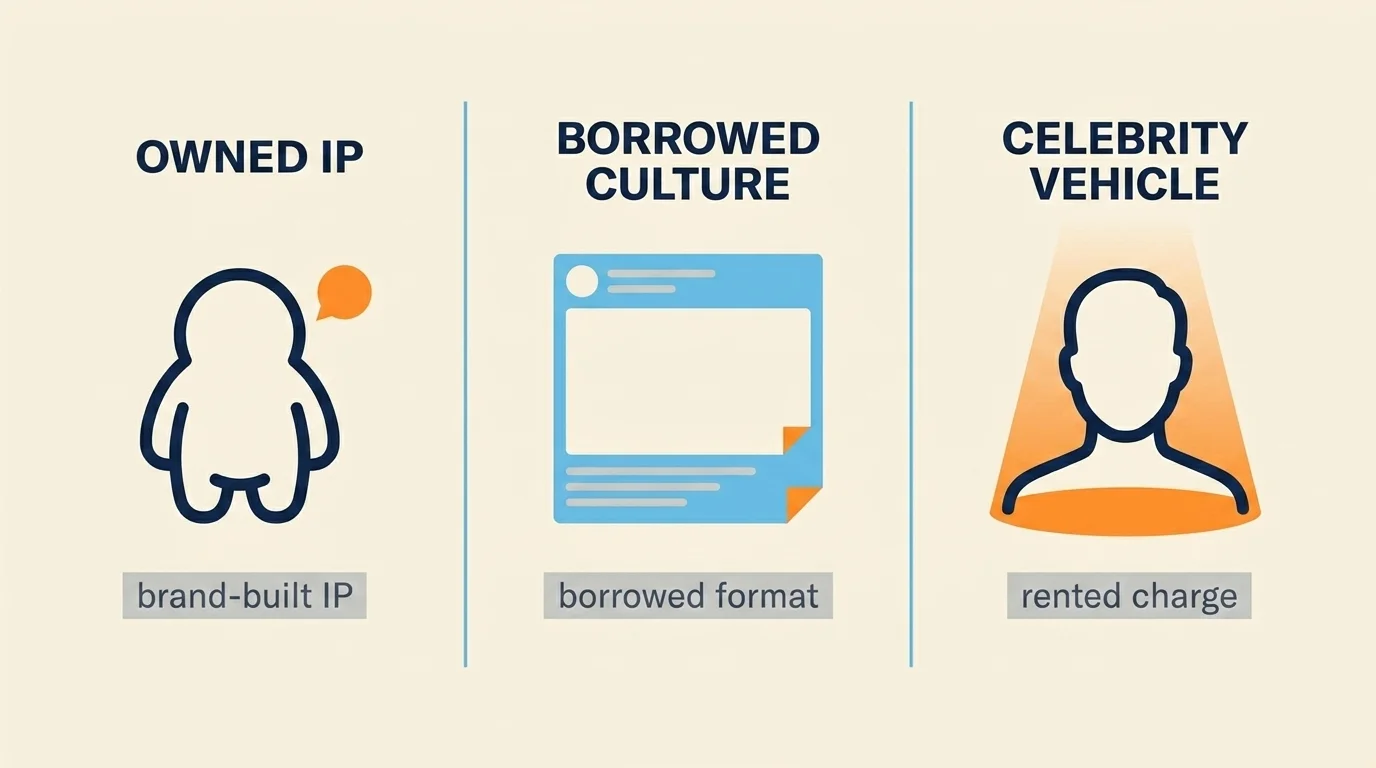
The industry talks about "meme marketing" as a single thing. It is not. It is three distinct disciplines pretending to be one, and the misunderstanding is how most of the bad work gets greenlit.
Owned-IP memes. The brand has a character, a mascot, a recurring asset, or a codified voice it has spent years building. The meme is generated from inside that intellectual property. Duolingo's owl is the textbook case — Duo had been a self-aware character for three years before the death stunt, which is the only reason the death stunt did not feel like a corporate tantrum. Slim Jim's account-as-character is another. The cost is the years of upfront character work. The payoff is that the brand never has to ride somebody else's joke, and the meme stays defensibly theirs.
Borrowed-culture memes. The brand sits inside an existing format the internet has already validated — a template, a reaction shot, a tonal moment — and contributes a line, a screenshot, a reply. Wendy's Twitter roasts are the canonical version: the format already existed, Wendy's brought the brand voice and the speed. The cost is being one of fifty brands trying to ride the same wave; the payoff, when it lands, is the appearance of being culturally fluent without owning the IP yourself. The risk is the four-second window in which everybody else is doing exactly the same thing.
Celebrity-vehicle memes. The brand pays a person whose presence is already meme-shaped to be the engine of the campaign. American Eagle's 2025 Sydney Sweeney spot is the recent example — the campaign was engineered to be screenshotted and re-circulated, with the celebrity carrying the cultural charge the brand could not have generated on its own. The cost is the talent budget, the contract complexity, and the risk that the celebrity has opinions nobody screened for. The payoff is the fastest path to the meme economy for brands that have not done the character work.
Each of these has a different risk profile, a different unit cost, and a different replay value. Most of the bad meme campaigns I have seen failed at the brief stage because the team treated all three as the same thing and made a strategic choice for one of them while executing for another. Decide which one you are doing before anybody opens Figma.
Meme marketing examples worth studying in 2026
There are six campaigns I keep returning to in pitch meetings. Each one runs a different mechanic. Pick the one whose mechanic your brand is actually built for, not the one whose vibe you like best.
Duolingo — The Dead Duo teardown (February 2025)
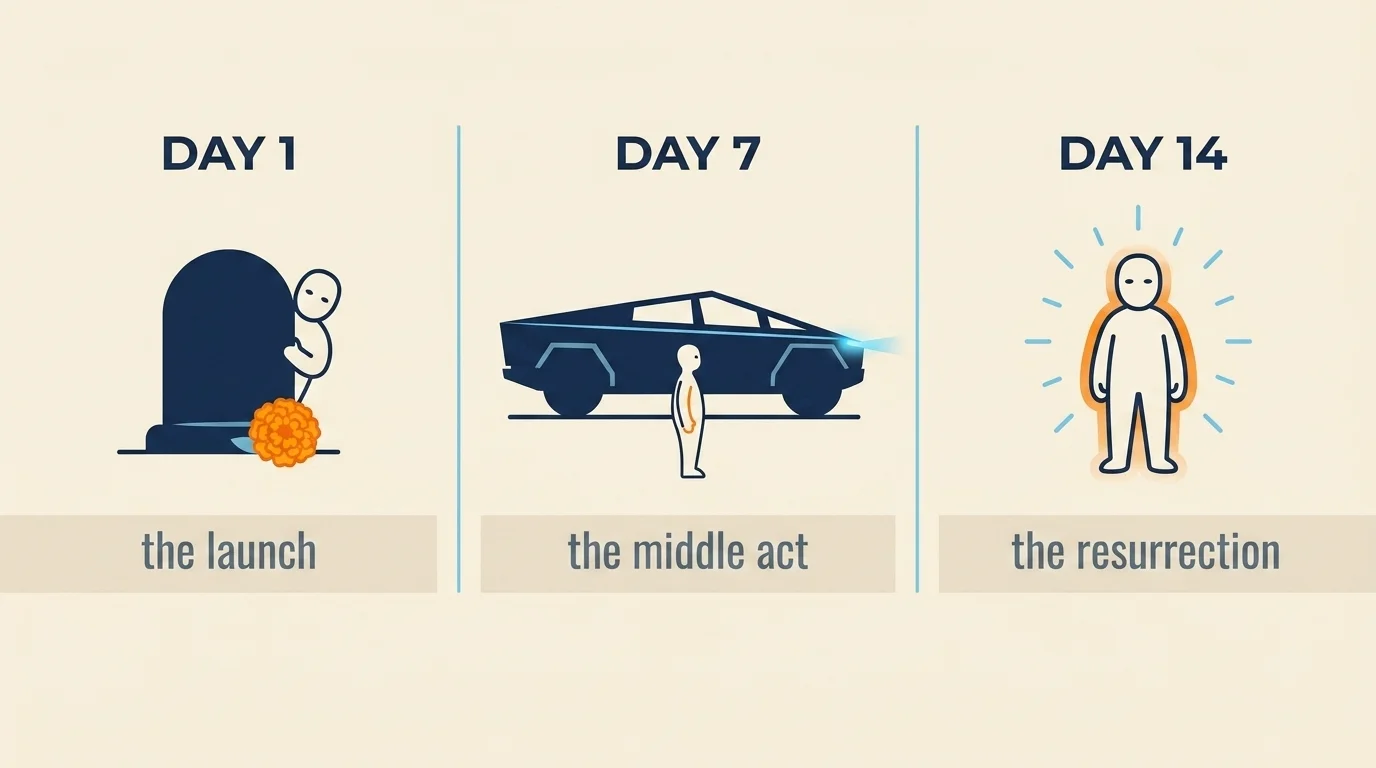
Between 11 February and 24 February 2025, Duolingo killed its owl mascot on every channel where it had a presence — in-app push, X, TikTok, Instagram — kept the bit alive for two weeks, then resurrected him. The numbers, per Fast Company and Meltwater: 1.7 billion impressions across socials over the two-week arc, a single launch post that hit 144 million views on X and twenty thousand comments on TikTok, a 25,560 per cent spike in brand mentions on day one, roughly 580,000 total mentions across the window, and the #ripduo hashtag used 45,000 times. Dua Lipa re-shared the bit organically and added 22 million views and around 667,000 engagement actions to the X total on her name alone. Duolingo posted its largest single-quarter DAU growth in company history that quarter, which the team credited to the campaign in subsequent PR coverage.
The craft decision is not "kill the mascot." It is the two-week structural arc. The launch was day one. The Cybertruck-driver reveal — deliberately ambiguous about who was at fault — was the middle act that kept the bit alive into week two. The in-app integration meant the joke compounded for every Duolingo user opening the app for their daily streak. The resurrection on the 24th gave the bit a closing beat with a punchline. Most brand meme campaigns are a single post. This was a serialised story across fourteen days, in three acts, with a payoff. That is owned-IP work, and the IP is the only reason it was possible.
Wendy's — The roast format, still working a decade in
Wendy's Twitter roasts (search volume for "wendys twitter" sits at 3,600 a month — readers go directly to the brand, not to articles about the tactic) are the borrowed-culture archetype: the platform already had a reply-format roast culture, the brand brought a voice that could land inside it. The craft decision here is not the roast itself; it is the brand's willingness to maintain a single voice across years of community managers, a tone bible thick enough to survive personnel changes. The roasts work because the voice is consistent. The moment it stops being consistent — when a new social manager pulls a punch or pushes too far — the format collapses.
Ryanair — The TikTok era of self-deprecation
Ryanair's 2024–2025 TikTok work is the example I use for the brands who feel they cannot do meme marketing because their product is famously bad. Ryanair leans into the bad — small seats, paid bags, the gate-staff stare — and the leaning-in is the joke. The craft principle is earned distinctiveness through the thing your competitors run away from. Most airlines pretend they are luxury experiences. Ryanair admits what it is, in the platform-native voice the audience is already speaking. The result is a meme practice that costs almost nothing in talent and which competitors structurally cannot copy without admitting things their brands forbid them to admit.
Slim Jim — The recurring meme-account model
Slim Jim runs its Instagram like a meme account first and a brand second. Posts go up regardless of whether there is a product moment. The brand pays a consistent rent inside the meme ecosystem. The craft decision is the willingness to publish content that has nothing to do with the product, on the theory that being a participant in the culture is worth more long-term than being a billboard for it. This works precisely because the product is famously dumb-fun snack food. It would be career-ending at a private bank.
Fevicol (India) — Bollywood breakup memes, +30 per cent recall
India's Fevicol adhesive brand spent 2025 repurposing Bollywood breakup moments into recurring satirical romance memes — reportedly lifting brand recall by thirty per cent in Q2 2025. The reason this matters is that every other competitor article on this topic cites the same five American Twitter brands. The mechanic is genuinely portable: a regional adhesive brand reading the local cultural calendar and operating inside it with the same discipline Wendy's brought to American Twitter. Borrowed-culture memes work in any culture; you have to know which culture you are borrowing from.
American Eagle × Sydney Sweeney — Manufactured meme moment
The 2025 American Eagle × Sydney Sweeney campaign is the celebrity-vehicle case. The work was constructed, frame by frame, to be screenshotted and re-shared — the talent, the wardrobe, the visual references all chosen for memetic charge rather than narrative content. The contrast with Duolingo is instructive: Duo's death cost the salary of an internal social team plus mascot suit logistics, and the IP was owned forever. The American Eagle campaign cost celebrity rates and rented the cultural charge for one season. Both work. They are not the same product.
The 48 to 72 hour meme brief
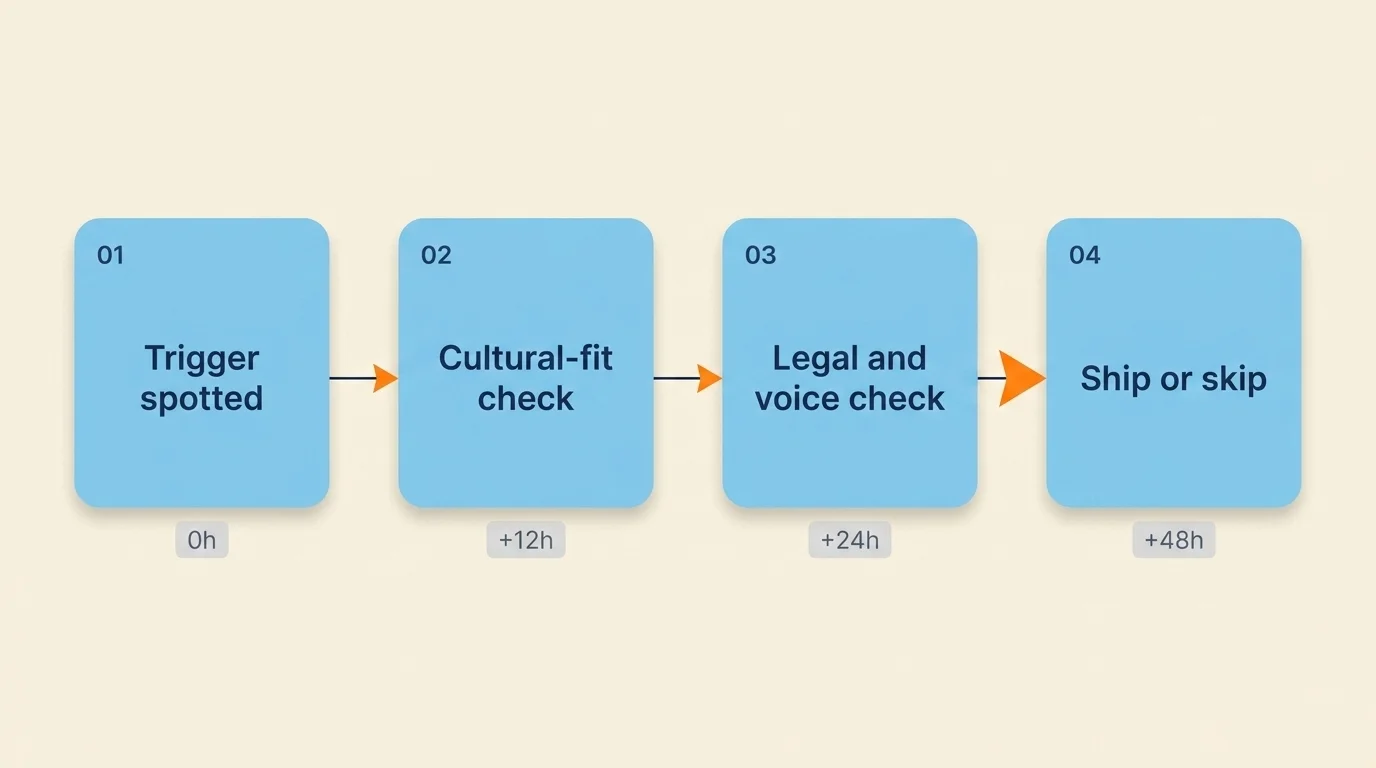
Most internal teams cannot ship a borrowed-culture meme inside the window in which the format is still funny. Memes have roughly forty-eight to seventy-two hours of peak before they over-saturate. By the time the average enterprise team has routed a draft through legal, brand, and account management, the format is dead and the post reads as embarrassing late-arrival. The fix is a one-page brief that exists before any specific meme appears, so the loop can run on a Tuesday morning without an emergency stand-up.
The template, four boxes wide:
- Trigger spotted. Which cultural moment, which platform, which timestamp. Who flagged it. Screenshot of the format in the wild.
- Cultural-fit check. Does our brand voice already have permission to be in this conversation? If a member of the audience saw us in this format, would they think "of course they're here" or "why are they here"? If the answer is the second one, stop.
- Legal and brand-voice check. Template licensing, IP risk, fair use, AI-generated assets disclosure (see below). Pre-approved tone parameters. One named approver, not a committee. One named deadline, in hours.
- Ship or skip. A single decision, with a name attached. If the ship decision takes longer than four hours, skip — the four hours you spent deciding were the four hours the format had left.
A brief that respects the window is the whole game. If three of the four steps above routinely take longer than twenty-four hours at your organisation, you do not have a meme marketing problem; you have an operations problem dressed up as a creative one.
How to measure meme marketing without lying to yourself
Gartner reports that only twenty-one per cent of marketers can accurately measure content ROI. Inside that twenty-one per cent, almost nobody publishes the stack they actually use. Most reporting on meme campaigns is a single screenshot of the view count, which is the marketing equivalent of measuring a restaurant by counting how many people walked past the window.
The eight metrics worth reading, in roughly the order they tell you something useful:
- Impressions. The lazy number. Useful as a denominator, not a verdict. Duolingo's 1.7 billion only mattered because of what came next.
- Mention velocity. Brand mentions per hour during and immediately after the campaign, compared with the baseline. Duolingo's 25,560 per cent spike on day one is the cleanest version of this; it is also why mention velocity is the closest single metric to "did this break out of paid distribution."
- Hashtag adoption rate. How many times the audience created the campaign hashtag without being asked. #ripduo hit 45,000 organic uses. A hashtag the audience does not adopt is just a brand asset.
- Share-to-view ratio. Shares divided by views. A high view count with a low share rate is a paid push, not a meme. Memes propagate by being passed on; if the audience is not passing it on, you bought reach and called it culture.
- Comment sentiment delta. The shift in average comment sentiment from baseline. A meme that lifts views but tanks sentiment is a reputation problem, not a marketing win.
- Branded-search lift. Increase in branded search volume in the two weeks after the campaign. The single hardest number to fake. If people are typing your brand name into Google after the campaign, the meme did the work of an ad.
- Follower velocity. New followers per day during and immediately after. Useful as a leading indicator of audience expansion; less reliable than branded search.
- DAU or MAU lift. When the meme ties to a product moment, the only metric that matters in the end. Duolingo's Q1 2025 DAU record is what made the campaign a business event, not a PR event.
Publish the stack in the brief, before the campaign goes out. Decide what good looks like for each metric in advance. The reporting deck that arrives a week after a meme campaign and starts with a view count is the deck that gets the next budget cut.
Where memes fit inside the creator economy
TikTok's 2026 global ad revenue is projected at $34.8 billion — over $17 billion in the US alone — and ninety-two per cent of marketers say they will be using both macro creators (100K–500K) and micro creators (5K–100K) inside the year. Search volume for "creator marketing" is rising at the same time "meme marketing" is decaying. Pulse Advertising's 2026 report goes further and notes that the brands described as "memetic" in 2024 — Ryanair, Rhode — are now described as "brain rot content creators." The vocabulary moved. The work did not.
What this means, practically, is that meme marketing is no longer a separate discipline you opt into. It is a tactic inside the broader practice of platform-native, creator-led content. The brief that used to say "make a meme" now says "produce a piece of short-form, platform-native content that earns its own redistribution." Meme advertising — the paid version of the same instinct — sits inside that brief, with search volume for the term up twenty-four per cent year over year inside the broader category decline.
The implication for budget: stop ringfencing a "meme line" separately from the creator line. They are the same line. The creators you pay to make platform-native content for you are the people who already understand the meme format better than your agency does; the right brief asks them to make work that might be a meme rather than work that has to be a meme. The freedom to fail at memeness is the condition under which meme work succeeds.
When not to do this at all
The honest version of the playbook is that for most brands, on most days, the answer is no. There are four situations in which I tell clients to walk away from the meme brief entirely.
B2B enterprise with senior buyer personas. If your buyer is a CIO making a seven-figure procurement decision, a meme campaign reads as unserious in exactly the moment your sales cycle requires you to read as serious. The exception is B2B brands whose audience is itself marketers — those can earn standing by being self-aware about the medium. Everyone else damages equity.
Regulated industries. Financial services, healthcare, pharma. The legal review window alone makes the forty-eight-hour brief impossible, and the disclosure requirements turn most memes into something between a press release and a footnote. Worth knowing what the discipline is; not worth attempting unless your compliance team has signed a separate document agreeing to expedited review for clearly bounded content categories.
Brands without a codified voice. A meme is a high-confidence single line in a voice the audience already trusts. If the audience does not know what your brand sounds like, a meme will not teach them — it will make you sound like someone borrowing a friend's catchphrase at a party. The pre-requisite work is the brand-voice document. Do that first.
Anyone arriving more than forty-eight hours after format peak. This is the most common failure mode and the easiest to spot. If three competitors have already posted in the format, the format is dead. The fifth brand to ride a meme is not riding a meme; it is wearing somebody else's costume to a party that ended yesterday.
Memes in the AI disclosure era
One more category-of-no, because the rules changed in 2025. New York's Synthetic Performer Disclosure Bill passed in June 2025, requiring conspicuous disclosure of AI-generated talent in ads. The IAB followed in January 2026 with its AI Transparency & Disclosure Framework, built on C2PA machine-readable provenance metadata. TikTok now requires AI disclosure on realistic synthetic content. None of this existed when most brand teams set up their meme-generation tooling.
The upside is that disclosure is not a virality tax: eMarketer's 2026 brand-safety FAQ reports that seventy-three per cent of Gen Z and millennials say clear AI disclosures either increase or do not change their purchase likelihood. The audience is not punishing transparency. They are punishing the brands that get caught hiding it. If your meme practice uses AI-generated faces, voices, or talent likenesses, the disclosure work is part of the brief now, not an afterthought to it.
Here is the question I ask before any meme campaign ships: if we stripped the meme format off this idea and showed it to the audience as a plain post, would the brand still earn the right to be in the conversation? If the answer is yes, the meme is a delivery vehicle for something true. Send it. If the answer is no — if the meme is the only thing making the post interesting — what you have is not a campaign. It is a costume. And the audience can tell the difference faster than your reporting deck can.
Frequently Asked Questions
Yes, when the brand voice is codified before the memes start. Duolingo's February 2025 Dead Duo campaign generated 1.7 billion impressions across socials and the company's largest single-quarter daily-active-user growth ever — but only because Duo had been built into a self-aware character for three years before the death stunt. Brands without a codified voice usually produce content that reads as cringe corporate meme attempts.
Duolingo (owned-IP mascot), Wendy's (Twitter roast format), Ryanair (TikTok self-deprecating), Slim Jim (recurring meme-account approach), Fevicol in India (Bollywood breakup format), and American Eagle x Sydney Sweeney (celebrity-vehicle). Each runs a different mechanic — owned IP, borrowed culture or celebrity vehicle — and the brand fit decides which mechanic is replicable for you.
Use a stack of eight metrics, not one: impressions, mention velocity, hashtag adoption rate, share-to-view ratio, comment sentiment delta, branded-search lift, follower velocity, and (when memes tie to a product moment) DAU or MAU lift. Gartner reports only twenty-one per cent of marketers can accurately measure content ROI, so publishing the stack upfront — and deciding what good looks like before the campaign ships — is itself a competitive advantage.
One reactive post inside a 48 to 72 hour cultural window using an existing template, not custom creative, routed through a one-page brief: trigger spotted, cultural-fit check, legal and brand-voice check, ship-or-skip decision with one named approver. If three of those four steps take longer than 24 hours at your organisation, skip the meme — the format will be dead before you publish.
Usually no. B2B enterprise with senior buyer personas, regulated industries like financial services and healthcare and pharma, brands without a codified voice, and brands arriving more than 48 hours after format peak typically damage brand equity rather than build it. The exception is B2B brands whose audience is itself marketers — those can earn standing by being self-aware about the medium.
Yes, in many cases. New York's Synthetic Performer Disclosure Bill (June 2025) requires conspicuous disclosure of AI-generated talent in ads, the IAB published its AI Transparency & Disclosure Framework in January 2026 using C2PA provenance metadata, and TikTok requires AI disclosure on realistic synthetic content. Disclosure is not a virality tax: eMarketer reports 73 per cent of Gen Z and millennials say clear AI disclosures either increase or don't change purchase likelihood.