Digital Marketing Demystified: Your Essential Guide to Reaching Your Target Audience


65% of marketers report having "high-quality data" about their audience — which is to say 35% of marketing teams are running campaigns on weak segmentation signal and reporting the resulting spend efficiency as fact. The interesting question is not whether your audience targeting is good. It is whether the data underneath it is good enough to know.
This is a 2026 guide on how to reach your target audience, written for the marketer who has watched a "high-confidence" segment definition collapse the moment it met a holdout group. The frame: a 7-step playbook where each step has a measurement question attached. Steps that cannot answer their measurement question are not finished, no matter how good the slides look.
I will name tools specifically, walk through the post-iOS-17 attribution reality most articles still skip, and close with the one Search Console–scale change you can ship this Monday.
Step 1: Define the Audience by Behaviour, Not Demographics
The 2014 playbook started with "who is the customer" defined by age, income, and ZIP code. The 2026 playbook starts with "what does the customer do" — purchase frequency, page-depth, time-to-second-visit, response to specific creative styles. Demographic personas have not died, but they have been demoted to a secondary signal.
The reason is simple: the demographic-first persona produces segments with high internal variance. Two thirty-five-year-old women with $80K incomes might convert at radically different rates depending on how they arrived at the site, what they did in their first session, and whether they opened the first email. The behavioural-first persona produces segments with lower internal variance — and therefore higher signal-to-noise on creative testing.
80% of consumers report wanting personalised experiences, and 75% of consumers are more likely to buy from brands delivering personalised content. The directional read is robust. The magnitude read requires the same caveat I would apply to any consumer-survey data: stated preference is not observed behaviour, and the lift number you should price into your business case is the one you measure under randomised assignment, not the one the survey reports.
The cleanest 2026 segmentation looks like this: three behavioural cohorts at session start (new visitor / engaged returning visitor / customer), one demographic overlay if the data is clean enough to support it, and one intent overlay (search-derived, content-engagement-derived). Five-cohort segmentation is the ceiling for most teams; ten-cohort segmentation typically over-fits and produces segments too small to drive statistically reliable creative tests.
Step 2: Build the Persona From First-Party Behaviour
Most articles on customer profiling are still recommending personas built from external survey data and demographic assumptions. The 2026 build looks different.
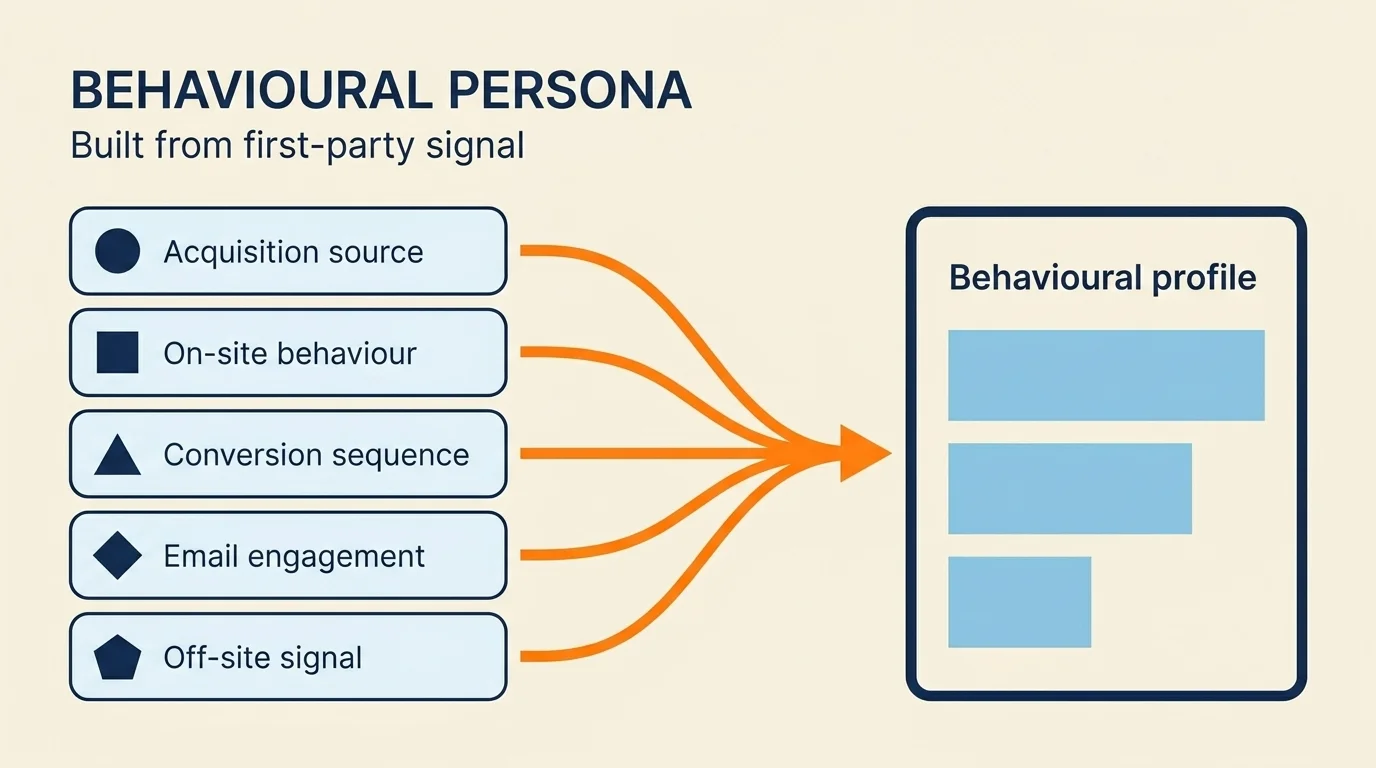
The starter template — the one most teams under-use because it lives inside their existing tools rather than in a downloadable PDF:
- Acquisition source distribution. What share of the segment came from organic search, paid social, email, direct, referral? GA4 traffic-acquisition reports answer this directly.
- Top three on-site behaviours. Pages viewed in first session, average time on key product pages, exit-intent triggers. Available in GA4 events plus session recordings (Hotjar, Microsoft Clarity).
- Conversion event sequence. What is the typical event chain (view product → add to cart → checkout) and where does it break down? GA4 funnel reports.
- Email engagement profile. Open rate, click depth, lapsed-cohort behaviour. Klaviyo, Mailchimp, and HubSpot all expose this natively.
- Off-site signal. What communities is this segment in? Reddit and niche-forum mentions of your brand or category — Reddit search alone covers most of this for free in 2026.
Brands using first-party data for hyper-personalisation report 30-50% engagement boosts. Read that range carefully. The 30% lower bound is conservative and survives most holdout designs. The 50% upper bound usually comes from case-study cherries with the strongest segment-fit. Plan for the lower bound; treat the upper bound as upside.
Step 3: Channel Selection by Audience and Funnel Stage
Multi-channel marketing has been mistranslated by a generation of articles into "be everywhere." Being everywhere is the surest way to be nowhere meaningfully. The 2026 channel doctrine is closer to "pick one Discovery platform and one Authority platform, master both, then expand."
The decision shape, by audience-funnel cell:
- Gen Z, awareness stage: TikTok or Instagram Reels for Discovery; brand-led short-form video, creator partnerships, social-search optimisation. 36% of marketers now actively target Gen Z, up from 34% in 2023 — the share is rising, but creative tone is platform-specific.
- Millennial, awareness stage: Instagram + YouTube for Discovery; long-form video and creator content carry. 72% of marketers target Millennials.
- B2B, awareness stage: LinkedIn + organic search. The Authority platform pair is well-established; community-driven Substack and niche newsletters now sit alongside.
- Any cohort, consideration stage: Email + on-site content + retargeting. The retargeting layer must use server-side conversion events post iOS 17, not pixel-only.
- Any cohort, conversion stage: Branded search, email reactivation, abandoned-cart automation, paid search defence on competitor terms.
Multi-channel marketing has roughly 1,000 monthly searches with KD 25 — the term is searched primarily by marketers shopping for orchestration tools (HubSpot, Klaviyo, Iterable, Customer.io, Salesforce Marketing Cloud). The tooling matters less than the channel-stage match. Most teams pick the tool first and the strategy second; the result is a fully-instrumented multi-channel programme that promotes incoherent messaging consistently.
Step 4: AI-Powered Listening, Reddit-First Edition
The phrase "social listening" carries 5,400 monthly searches and a $74 CPC in 2026 — that CPC reflects how much enterprises are willing to pay for the answer. The traditional answer was a Brandwatch or Sprinklr subscription. The 2026 answer extends to a Reddit-first AI-listening stack.
The shift: the most candid, longitudinal source of how your audience actually talks about your category is no longer Twitter or Facebook brand mentions. It is Reddit threads, niche Discord servers, Substack comment sections, and YouTube comment sections — all of which are now queryable through AI tools that can summarise sentiment, surface unmet needs, and flag emerging objections at meaningful scale.
The practical 2026 stack:
- Reddit search + ChatGPT or Claude analysis — free for the search part, $20-30/mo for the LLM. Pull the last 90 days of posts mentioning your category, paste them into the LLM, ask it to summarise themes and flag the top three unmet needs. The signal-to-noise is meaningfully higher than equivalent paid social listening tools at the small-business level.
- Brandwatch / Sprinklr / Talkwalker — for enterprise teams with budgets above $25K/year, these still pay for themselves through structured trend tracking and competitive benchmarking.
- Sparktoro — the underused middle tier; an audience research tool that maps where your defined audience actually spends attention online.
The cleaner read of "what does my audience care about right now" comes from this stack, refreshed monthly. The dishonest read comes from a brand-mention dashboard that surfaces only the conversations explicit enough to tag the brand handle — which is to say, the smallest and least representative slice of the discourse.
Step 5: Privacy-First Means Trust Becomes a Growth Lever
76% of consumers say they will pay premium prices for brands they trust with their personal data. That stat moves the privacy conversation from a compliance cost line in the legal budget to a margin-expansion lever in the marketing budget — a meaningful reframe most marketing leaders have not yet absorbed.
The strategy implication: every data-collection event your audience consents to is now a conversion event with downstream revenue value, not just a compliance checkpoint. Treat email opt-ins, account creations, and preference-centre updates as conversion-tier events in your analytics. Optimise the conversion rate on those events with the same rigour you optimise the conversion rate on purchases.
The technical implication: server-side tag management (server-side GTM, Tealium, Snowplow) plus consent-based identity resolution. The brands extracting the 30-50% engagement lift from first-party data are the ones with this infrastructure in place. The brands waiting for a "cookieless future deadline" that has now been pushed indefinitely are the ones still flat-footed.
Step 6: Creative That Converts at Scale (DCO)
Static creative is a museum piece for any audience-reach programme above $5,000/month in paid spend. Dynamic Creative Optimisation drives 30-50% engagement lift over static ads, and the production cost has collapsed: AI tools generate creative variants at near-zero marginal cost, and platform-native DCO (Meta Advantage+, Google Performance Max) automates the variant selection.
AI-driven ads achieve roughly 41% higher conversion rates than traditional targeting, and automated segments lift conversion by 25-40% versus manual rule-based targeting. Treat both numbers with the same scepticism: the lifts are reported by tool vendors and AI marketing solution providers; the cleanest holdout-grounded estimate of incremental lift will land lower. The directional read still favours AI segmentation and DCO, but the magnitude in your business case should be the conservative end of the range, not the headline.
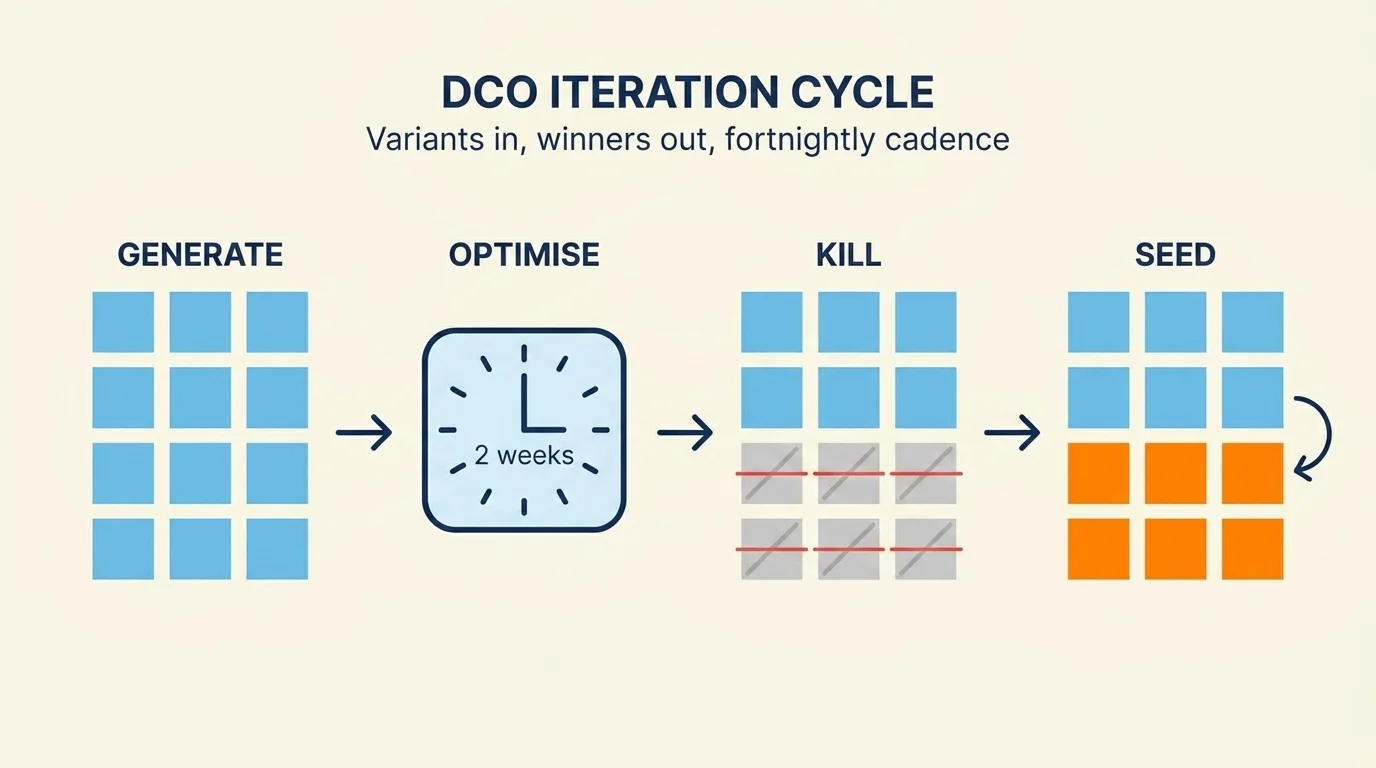
The practical creative-iteration cadence in 2026: produce 8-12 creative variants per campaign at launch, let the platform optimise for two weeks, kill the bottom half, regenerate four new variants from the top performers, repeat. This is the AI-augmented version of the classic ad-test discipline; the cycle time has compressed from quarterly to fortnightly because the production cost is no longer the constraint.
Step 7: Measurement Without Lying to Yourself
This is the step the rest of the playbook is in service of. Conversion rate optimisation carries 2,900 monthly searches and remains the most-Googled marketing measurement topic — and the most-misused.
The post-iOS-17 reality is that pixel-based attribution has fractured. Apple's Link Tracking Protection strips tracking parameters from URLs in Safari Private Browsing, Mail, and Messages — meaning a meaningful share of conversions arrive at your site with no attribution payload attached. Pixel-based ad-network attribution simply cannot see these conversions; the dashboard under-reports the true conversion count, and the gap is not constant across audiences.
Three approaches replace pixel-based attribution, and they are not interchangeable:
- Server-side event tracking (server-side GTM, Conversions API) — captures the conversion event server-side and pushes it to ad platforms with first-party identifiers. The deterministic floor of attribution.
- GA4 modeled conversions — uses GA4's machine-learning models to estimate the conversions pixel attribution missed. Useful when paired with deterministic data; misleading when reported as the only number.
- Marketing mix modelling — the channel-level incrementality estimate that does not depend on user-level identifiers at all. Worth the investment above $50K/month in paid media; not worth the overhead below that.
The dishonest measurement: take the platform's attributed conversion count, divide by spend, declare a ROAS, and put the number on a slide. Anyone selling you measurement with two-decimal-place precision in 2026 is selling you confidence theatre. The honest measurement reports a deterministic floor (server-side events), an inferred ceiling (GA4 modeled or MMM), and a confidence interval that contains the truth.
CRO is having a methodological renaissance for the same reason: the tests run on broken attribution stacks were systematically over-stating their wins. Re-running the same tests on cleaner attribution often produces lifts in the 5-15% range where the original reported 25-40%. The directional answers do not change; the magnitudes do; the budget allocations should follow.
What you can ship this Monday
The 7-step playbook above will take a quarter to compound. None of it pays back this week. So if you are going to do exactly one thing on Monday, do this:
Open GA4. Pick three high-intent conversion events (purchase, lead-form-submit, qualified-trial-start). For each event, check whether server-side tagging is firing on top of the existing client-side pixel. If it is not, your attribution is leaking — and the segment-targeting decisions you have made over the past two quarters are based on under-counted conversion data. The fix is a one-day GTM configuration change. The downstream effect is months of cleaner segmentation data feeding every step of this playbook.
The single most expensive measurement metric in 2026 is the one that is right but missing 30% of the conversions. Before you optimise for the audience, fix the count. The rest of the playbook waits.
Pick one conversion event. Audit the server-side tag. Re-baseline against the new count. The next quarter of audience-targeting decisions starts there.
Frequently Asked Questions
Combine three signals: GA4 demographic + behavioral data, AI-powered listening on Reddit and niche communities, and direct customer interviews. The 2024 playbook of 'build a persona from demographics' is incomplete in a privacy-first world — first-party behavioral data must drive the segment definition.
A target market is the broad set of buyers your product serves (e.g., 'small business owners in North America'). A target audience is the specific subset you actively try to reach with a given campaign (e.g., 'first-time SaaS buyers at 10-50 person companies'). Markets are strategic; audiences are tactical.
AI segmentation tools cluster customers on signals humans miss, lifting conversion rates by 25-40% versus manual rule-based targeting (M1-Project, 2026). They also generate dynamic creative variants (DCO) that boost engagement 30-50% over static ads (Smartly, 2026). Treat the magnitudes as vendor-reported ranges; the directional read is solid.
Pick one Discovery platform (TikTok, Instagram Reels, or Reddit) and one Authority platform (LinkedIn or your blog). Master both before adding a third. Use first-party data from email and on-site behavior — no paid tools required for the first 90 days.
Marketing built on first-party (consented) data instead of third-party cookies. PwC reports 76% of consumers will pay premium prices for brands they trust with personal data — privacy is now a growth lever, not just a compliance cost.
Layer three approaches: server-side event tracking (server-side GTM, Conversions API) for the deterministic floor; GA4 modeled conversions for the inferred ceiling; and Marketing Mix Modelling above $50K/month in paid spend for channel-level incrementality. Reporting a single ROAS with two-decimal precision is confidence theatre — report the range.