Social Media Mastery: Building a Strong Online Presence through Effective Strategies


Two beauty brands ran the same social media strategy this quarter — fifteen-second cutdowns, same platform, same audience. One performed. The other did not. The one that worked opened on a hand — just a hand, unretouched, in a kitchen — and the product appeared at the five-second mark as a natural consequence of what the hand was doing. The one that did not work opened on a logo, held for a beat, and cut to the product on a plinth with studio lighting. The craft difference is almost embarrassing to name: one of them let the viewer earn the product, and the other demanded to be recognised. Ninety per cent of what we call social media strategy is really that — who is doing the work, the viewer or the brand.
This is a 2026 social media strategy guide for the marketer who has noticed that the platform list changed, the engagement benchmarks moved, and the playbook your agency is still pitching has not been updated since 2022. The numbers worth keeping in front of you while you read it: 5.66 billion people are active on social media globally and spend roughly 2.5 hours a day there; $219 billion in global social ad spend in 2026, about a third of all digital ad spend; the Jan 2025 TikTok dark period (21 hours offline) and the deal that followed made platform diversification a documented business risk, not an abstract one.
What follows is platform playbooks with named cadences, the engagement benchmarks you actually need, the influencer reframe that most articles still miss, and a measurement section that refuses to describe a campaign as "viral" without naming what it earned. Closing with one question to take into the next creative review.
Engagement Benchmarks for 2026
Before the platform tour, the numbers most articles dance around. Sourced and dated:
| Platform | 2026 Engagement Rate | Format Note |
|---|---|---|
| TikTok | 3.70% (+49% YoY) | Highest; format-agnostic engagement |
| 3.85% (organic) | Highest organic; rewards dwell time | |
| YouTube Shorts | 3.7% | vs long-form YouTube at 1.8% |
| Instagram (overall) | 1.62% | Reels 2.35%, Carousels 1.87%, single Images 0.94% |
| Facebook brand pages | 0.07% | Continued decline; paid is the only meaningful Facebook play |
| X (formerly Twitter) | 0.05% | Engagement collapsed post-rebrand and policy shifts |
Read these as a craft brief, not a beauty contest. TikTok and LinkedIn are the two surfaces where organic still converts attention into engagement at a rate worth the production effort. Reels are the format-of-record on Instagram. YouTube Shorts is closing the gap on TikTok faster than most teams have absorbed. Facebook and X are paid-only at brand scale; treating them as organic channels is producing the disappointing engagement numbers people are then complaining about on LinkedIn.
Platform Playbooks: Where the Work Actually Differs
The phrase "platform-specific tactics" keeps getting written, and almost nobody actually writes platform-specific tactics. Here is what each surface actually rewards in 2026.
TikTok and YouTube Shorts: the sound-off, thumb-ready discipline
The whole discipline of short form is the discipline of respecting the sound-off, thumb-ready viewer who owes you nothing. The first second is the entire ad; if the viewer is not curious by frame 30, the rest of the spot does not matter. Lead with a hand, a face, a movement, or a question. Lead with a logo and you have lost.
The TikTok creative principle that ports cleanly to Shorts: the platform rewards completion rate, not view count. A 15-second video that 70% of viewers finish outranks a 60-second video that 20% finish, almost always. Cut early; cut hard. Ask of every spot what it would lose if you cut the last four seconds. Roughly seven times out of ten, the honest answer is nothing — the spot earned its ending around the eleven-second mark and then spent four seconds holding a logo lockup that nobody is still watching. Cut them.
Cadence anchor: TikTok's meaningful-lift floor is 2-5 posts per week, scaling up to 1-4 per day for max algorithmic favour, per Buffer's analysis of 11M+ posts. Most brands posting once a fortnight from a corporate account are below the threshold where the algorithm recognises them at all.
Instagram Reels: the format that actually works on Instagram
Instagram has effectively become a Reels app with a feed bolted on. Reels engagement averages 2.35%, against 1.87% for Carousels and 0.94% for single-image posts. Single-image posts are a near-vestigial format on Instagram in 2026; if your team is still shipping product photos with captions as their default Instagram post, that is the first thing to audit out.
Cadence anchor: 3-5 feed posts per week, plus 2-4 Reels, plus daily Stories is the meaningful-lift band. Returns diminish past five feed posts per week — more is not better.
LinkedIn: the surface most B2B teams are still under-investing in
LinkedIn organic engagement at 3.85% is the second-highest of any major platform — higher than Instagram, higher than YouTube Shorts, higher than virtually any non-TikTok surface. The reason: LinkedIn rewards dwell time, and the audience is on the platform with longer attention windows than TikTok or Instagram users. A 1,200-word post by a known author with a clear point of view will out-engage a polished short-form video, in most B2B categories.
Cadence anchor: 3-5 posts per week, mixing personal-voice posts from named authors with company-page posts. The personal-voice posts will outperform the company-page posts roughly 4x in reach, every time. This is uncomfortable for brand-safety teams; it is also true.
X (formerly Twitter): a paid surface for most brands
I will not dance around it. X's organic engagement sits at roughly 0.05% for brand accounts; the platform has lost most of its journalistic and brand-safety appeal since the 2023 rebrand and the 2025 fact-checking exit. There are still niche communities where X is the right channel — finance Twitter, sports Twitter, certain tech subcultures — but for most brand teams, X is now a paid channel for narrow targeting, not an organic surface to invest in. Stop scheduling daily X posts as part of your content calendar; the engagement rate is telling you something.
Threads, Bluesky, and the Substack pivot
Three emerging surfaces worth tracking, with different roles:
- Threads — 400M monthly active users as of August 2025, 115M mobile daily actives. At this scale it is no longer "emerging." Threads brings scale; the algorithm and discoverability are still being calibrated. Worth a 1-2 post/day cadence as a mid-effort presence channel.
- Bluesky — 41.4M users by end of 2025, projected 50M by late 2026. Bluesky brings trust. Use it as a tone-and-voice sandbox before scaling content to Threads or LinkedIn. Lower stakes, higher engagement quality on the conversations that do happen.
- Substack has quietly pivoted from newsletter platform to social platform — feed, profiles, Notes, and inbox. For thought-leadership content, Substack is now a meaningful distribution surface, not just an email tool.
The diversification matrix
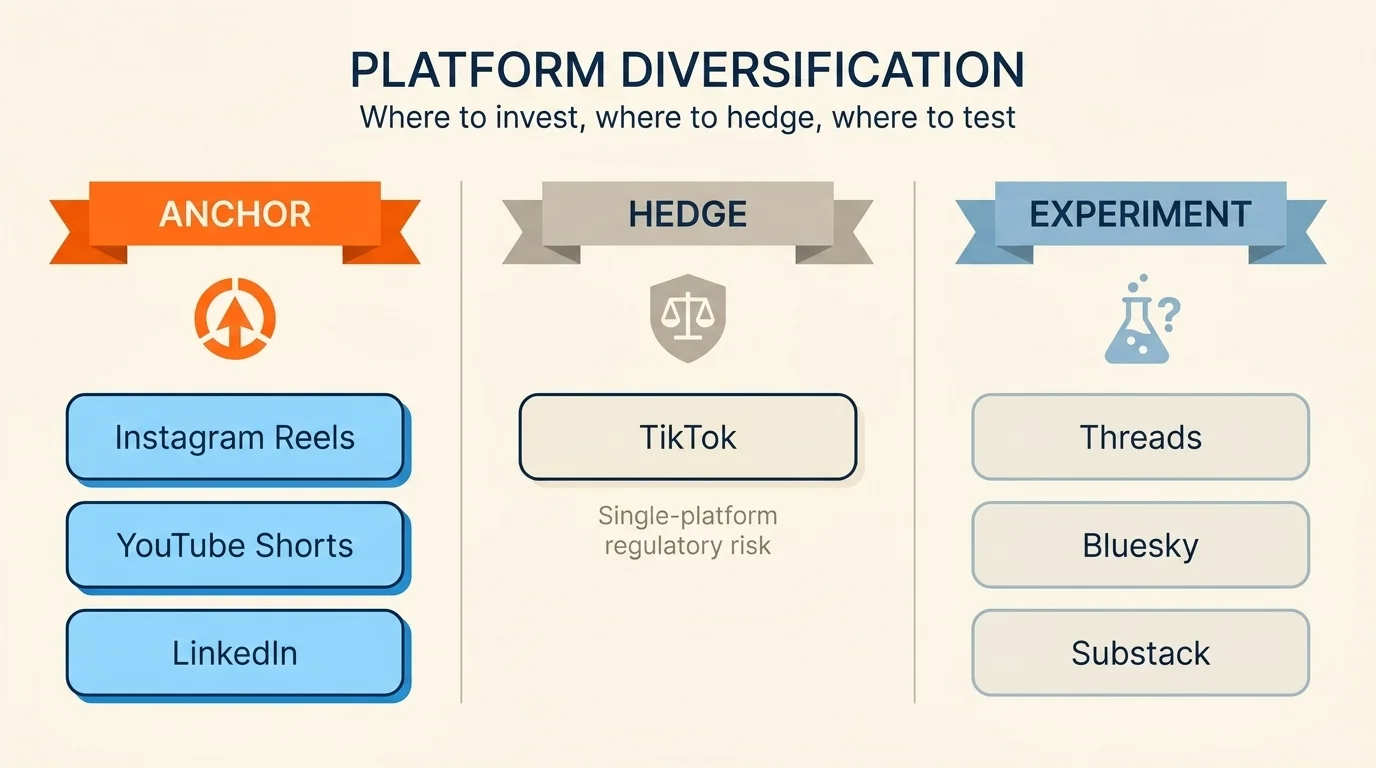
The 2025 TikTok dark period and the negotiated deal that followed made platform dependence a documented risk. The honest 2026 answer:
- Anchor channels (consistent investment): Instagram Reels, YouTube Shorts, LinkedIn. These are the surfaces with stable distribution mechanics.
- Hedge channels (active presence, not single-platform dependence): TikTok. The audience is real and the engagement is the highest of any surface, but the regulatory risk is too documented to anchor a brand strategy on.
- Experiment channels (low-cost presence): Threads, Bluesky, Substack. Test tone, test community, do not over-invest until any of them prove anchor-grade.
Posting Cadence Cheat Sheet
The single most-asked question and the one most articles refuse to answer. Defaults, all per-week unless noted:
- Instagram: 3-5 feed posts + 2-4 Reels + daily Stories
- TikTok: 2-5 floor → up to 1-4/day ceiling
- LinkedIn: 3-5
- X: 1-3/day (paid only, in most cases)
- Threads: 1-2/day
- Bluesky: 1-3/day
- YouTube Shorts: 3-5/week minimum for algorithm recognition
Use platform-native analytics to override these defaults for your specific audience. The defaults are what most teams should land near, not where they should stop.
Influencer Marketing Strategy in 2026: The Three Things It Actually Is
Influencer marketing is not one discipline, it is three, and the industry keeps pretending they are the same one.
The first is paid distribution with a human face — you are renting eyeballs and a voice the audience already trusts, and the creator is largely executing your concept. The second is co-creation — the creator actually shapes the work, the brand shows up in something the creator would have made anyway. The third is endorsement, which is the oldest and the most boring of the three, and the one most likely to embarrass both parties when the creator turns out to have opinions the brand did not screen for. When a deal goes sideways, it is almost always because someone sold it as co-creation and paid for it as endorsement, or vice versa. The paperwork and the craft have to agree on which of the three this actually is.
The 2026 economics, briefly: influencer marketing now averages $5.78 ROI per $1 spent industry-wide, with top campaigns hitting $18-20. Read those numbers carefully — they are aggregates across categories with materially different unit economics, and the methodology behind a "ROI" claim varies wildly across the studies that produced them. The cleaner read of the trend: brands using nano (<10K followers) and micro (10K-100K) influencers report roughly 11× better ROI than brands using macro/celebrity creators, and 73% of brands now prefer micro/mid-tier partnerships. The math has tipped decisively away from celebrity reach and toward niche authenticity at scale.
The under-reported 2026 shift: employee advocacy now ranks ahead of influencers and CEOs for brand authenticity in trust scoring. Your engineering lead's LinkedIn post about the product carries more credibility, in 2026, than the macro creator on retainer. This does not mean cancel the creator programme; it means add a structured employee-advocacy channel alongside it. The two compound; neither replaces the other.
Social Commerce: TikTok Shop and the In-App Purchase Era
This is the section the 2024 version of this article did not have because the category was too small to mention. It is no longer.
TikTok Shop GMV reached $66B globally in 2025 and is projected to hit $112.2B in 2026; US TikTok Shop GMV grew 108% YoY to $15.82B. TikTok Shop's conversion rate is 4.7%, against Instagram Shopping at 2.1% and Facebook Shops at 1.8%. 78% of social commerce purchases now happen without leaving the platform — the in-app checkout flow is no longer a friction-tax compared to redirecting to a brand site, in many cases it is the better experience.
For ecommerce brands above $1M annual revenue, this is no longer a future bet. The practical 2026 entry points are TikTok Shop (highest conversion, regulatory hedge required), Instagram Shopping (broader audience, weaker conversion), and Facebook Shops (largely vestigial — most Facebook commerce volume now flows through Marketplace, not Shops). Each requires distinct setup; product schema and creator-content rights are the common ground across all three.
Community Engagement Strategy in the Community-Notes Era
Three-quarters of consumers expect a brand response within 24 hours, and the response window is one of the most reliably linked variables to repeat purchase rate across studies. The community engagement question in 2026 is not whether to respond; it is who is empowered to respond on the brand's behalf, with what guardrails, in what voice.
Two 2026 shifts changed the brand-safety math here. First, Meta dropped third-party fact-checking in January 2025 and moved to X-style Community Notes; Meta is now leaning on advertiser brand-safety tools rather than editorial moderation, which means brand teams need to do their own brand-adjacency screening. Second, AI-generated comments and replies are now common enough that any community manager who is not auditing their inbound for synthetic engagement is making decisions on contaminated data.
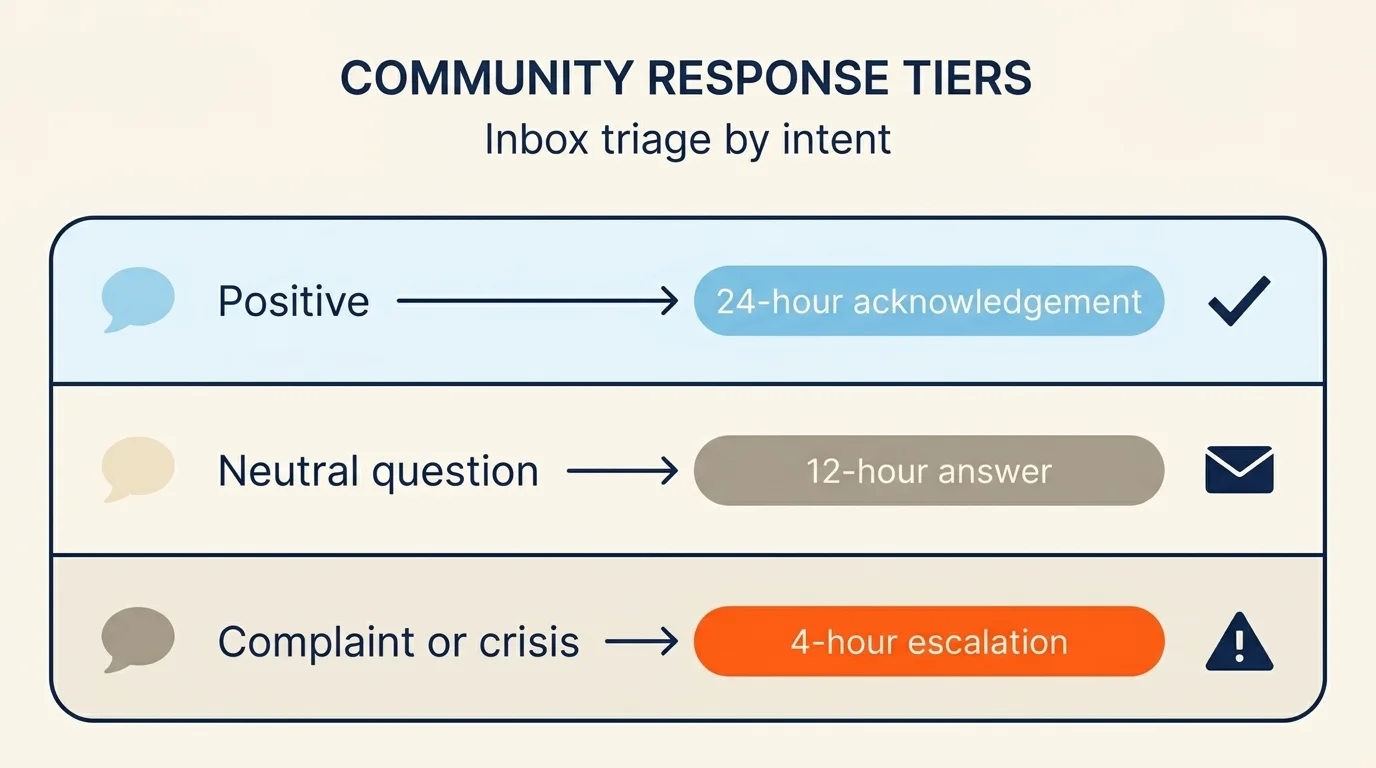
The 2026 community engagement playbook, in practical terms: define a tiered response policy (positive comments get acknowledged within 24 hours, neutral or product questions get answered within 12 hours, complaints get escalated within 4 hours), give the community manager pre-approved language for the top ten predictable scenarios, and audit your inbound monthly for synthetic patterns. None of these tactics are exotic. All of them compound.
AI for Social Media: Augmented vs Generated
97% of marketing leaders say AI proficiency is essential in 2026, and that headline number papers over the actual operational question, which is not whether to use AI but where the line falls.
The line, briefly: audiences who identify content as AI-generated drop engagement by 12% on average. AI-augmented content — AI-assisted ideation, AI-aided editing, AI-optimised cutdowns, all human-finished — shows no measurable engagement penalty in the same dataset. Two craft principles fall out of this:
- AI is a workflow tool, not the final voice. Use it for the scaffolding (briefs, drafts, variant generation, captions, scheduling) and edit it like a human. Pages that read as if AI shipped them get penalised by audiences and increasingly flagged by platforms. The distinction is detectable, by humans and by algorithms. Pretend otherwise at your engagement rate's expense.
- Comply with the platform labelling. TikTok auto-labels via C2PA Content Credentials (over 1.3 billion videos labelled to date); Meta requires self-declaration; the EU AI Act Article 50 mandatory labelling requirement starts in August 2026. The cheapest 2026 brand-safety move is to label compliantly even where it is not yet required — the alternative is finding out later that an unlabelled AI-augmented spot ran in a market that quietly required disclosure.
The practical 2026 AI stack for a brand social team: ChatGPT or Claude for caption drafts and ideation; Canva Magic Studio for visual variants; Opus Clip for short-form video cutdowns; Sprout Social or Hootsuite for AI-assisted scheduling and listening; Meta Advantage+ and TikTok's algorithmic creative for paid optimisation. Total cost typically $100-300/month for a small brand team; payback in a quarter if the workflow is rebuilt around it.
Measurement Without Vanity
I never describe a campaign as "going viral" without saying what it actually earned in sales, brand lift, or distribution. The post that gets quoted in the agency Slack and reposted to LinkedIn for clout is rarely the post that produced revenue — and the marketers who confuse the two are the ones who get surprised when the quarterly review comes in flat.
The metrics that actually matter, in rough order:
- Conversion rate by platform-source — your CRM/analytics, segmented by traffic source. The honest measurement question is which platform actually produced revenue, not which post had the highest reach.
- Engagement rate against platform benchmark — not in the abstract. A 2% Instagram Reels engagement rate is below the 2.35% benchmark and is therefore underperforming, regardless of what the dashboard called "good."
- Branded search lift — Google Trends or Search Console, query-by-query. Strong social-creative campaigns produce a measurable spike in branded search within 7-14 days. If yours did not, the creative did not move the needle, regardless of the like count.
- Content rights and reuse value — a creator post that costs $300 and produces top-quartile engagement, then runs as paid creative for three months, is worth meaningfully more than a one-shot post at the same engagement rate. Negotiate 90-day usage rights at minimum.
- Influencer ROAS by tier — track nano, micro, and macro separately. Treating them as one ROAS line item hides the fact that the macro tier is dragging the average down on most programmes.
The named tools that earn their seat for measurement: Sprout Social or Hootsuite (cross-platform analytics), GA4 (conversion attribution and source tracking), Meta Business Suite (paid + organic Meta), Buffer or Metricool for SMB-scale scheduling and reporting. Anyone selling you a single "social ROAS" number with two-decimal precision is selling you confidence theatre. Report a range, name the methodology, and document what would falsify it.
Build Your Online Presence in 30 Days
For solopreneurs and SMB owners reading this — a 30-day starter playbook, not a 90-day strategy:
- Week 1: pick one anchor platform (TikTok or Instagram for product/lifestyle, LinkedIn for B2B/services, YouTube Shorts for evergreen reach). Audit competitor profiles for top-performing post formats.
- Week 2: ship 8-12 pieces of content at the platform's meaningful-lift cadence. Do not optimise yet. Volume produces signal.
- Week 3: review platform-native analytics. Identify top-quartile and bottom-quartile posts. Re-create the format that worked, kill the formats that did not.
- Week 4: layer in basic community engagement (reply to every comment within 24 hours, DM the top three followers, resurface the top-performing post as a paid promotion at minimum spend).
The two metrics to watch: engagement rate and saved/share count. Follower count is the slowest-moving signal; saves and shares move first.
Ask your team this in the next review
Most of the playbook above will take a quarter to produce results. None of it pays back this week. So if you are reading this and want one thing to do before your next creative review, ask your team this:
What would this campaign lose if you cut the four seconds before the logo lockup? In roughly seven out of ten cases, the honest answer is nothing — and you get those four seconds back to use at the start, where the viewer is still deciding whether to give you their attention.
The whole discipline of the short form is the discipline of respecting the sound-off, thumb-ready viewer who owes you nothing. If you keep that viewer in mind, you tend to make better work for the people who are paying attention too. Pick one piece of content this week, audit the last four seconds, and cut anything that is not earning them. The rest of the strategy — the platforms, the cadence, the AI stack, the influencer programme — works better when the work itself is sharper.
Frequently Asked Questions
Optimal cadences (Buffer/Hopper 2026 data): Instagram 3-5 feed posts/week plus 2-4 Reels and daily Stories; TikTok 2-5 posts/week as the meaningful-lift floor, scaling to 1-4/day for max algorithmic favor; LinkedIn 3-5/week; X 1-3/day; Threads 1-2/day; Bluesky 1-3/day.
2026 platform averages: TikTok 3.70% (highest, +49% YoY), LinkedIn 3.85% organic, YouTube Shorts 3.7%, Instagram Reels 2.35%, Instagram overall 1.62%, Facebook brand pages 0.07%, X 0.05%. Above-platform-average is 'good'; above-industry-vertical-average is excellent.
Depends on audience: TikTok and Instagram Reels for product discovery (78% of social-commerce purchases happen in-app); LinkedIn for B2B and thought-leadership; YouTube Shorts for evergreen reach; Threads for scale; Bluesky for tone-testing and community trust. Most SMBs anchor on 2 platforms and experiment on a third.
Track engagement rate, click-through rate, conversion rate, cost per acquisition, social commerce GMV, and customer lifetime value from social-attributed leads. Use Sprout Social, Hootsuite, Meta Business Suite, or Google Analytics 4 attribution. Influencer marketing currently averages $5.78 ROI per $1 spent (Influencer Marketing Hub 2026).
Yes for ROI. Brands using nano (<10K) and micro (10K-100K) influencers report 11× better ROI than macro/celebrity partnerships, and 73% of brands now prefer micro/mid-tier partnerships.
Pick 1-2 anchor platforms aligned with your audience, post consistently for 90 days at platform-specific cadences, repurpose top-performing content into a 30-day content calendar, focus on community engagement (replies, DMs, Stories) over follower count, and measure engagement rate not vanity metrics.
Times vary by platform and audience timezone, but tested defaults: Instagram weekdays 9-11am and 7-9pm; TikTok 6-10am and 7-11pm; LinkedIn weekdays 8-10am; X 9am-3pm. Use platform native analytics to find your specific audience's active hours and override defaults.
Less than they were. Instagram's 2024-2025 algorithm updates de-prioritized hashtags in favor of caption keywords and visual SEO; LinkedIn still uses them for topic clustering; TikTok uses them weakly compared to caption text and on-screen overlays. Use 3-5 highly relevant hashtags max, not 30.
Audiences who identify content as AI-generated drop engagement by 12% on average (Sprout Social 2026), but AI-augmented content (AI-assisted ideation, editing, optimization with human-finished output) shows no measurable penalty. Use AI for workflows, never as the final voice. Comply with TikTok C2PA labels and Meta self-declaration; EU AI Act Article 50 mandatory labeling begins August 2026.
Diversify platform exposure. The Jan 2025 dark period (21 hours offline) and ongoing deadline extensions through 2025-2026 prove single-platform dependence is a documented business risk. The 2026 best practice: anchor content on Reels, Shorts, and LinkedIn; treat TikTok as a hedge channel; experiment on Threads, Bluesky, and Substack.