
Brand Strategy


Most brand strategy guides open with a neat definition and a logo, then stop — which is a problem, because the definition is precisely the part a search engine now answers before anyone clicks. So let me spend the click on what the tidy guides leave out. A brand strategy is not a mood board, and it is not a mission statement commissioned to sit in a deck; it is a set of commitments a company can be held to. In eleven years of sitting in sign-off meetings, I learned that the strategies which survived contact with a sceptical journalist, a regulator, or a customer who felt misled were the ones built as commitments rather than slogans. This guide covers the whole discipline — a clear definition, the seven elements, the four types, the 4 C's framework, a step-by-step build process, three analysed examples, and a checklist you can copy — plus the one thing most top results skip: what a modern, purpose-led brand strategy actually looks like in 2026, honest limits included.
What is brand strategy?
A brand strategy is a long-term plan that defines what a brand stands for — its purpose, positioning, personality, and promise — and how those are communicated consistently across every touchpoint to reach and retain a target audience. It is the plan; everything you can see, the logo included, is its execution.
Why write it down at all? Because a documented strategy is what lets four different people in four different meetings make the same decision without asking you. It creates differentiation in a crowded category, consistency across every touchpoint a customer meets, trust that accrues when the experience matches the promise, and brand value that compounds — slowly, and then all at once — precisely because it did not change every quarter.
The distinction worth holding onto is that strategy is the plan and tactics are its execution. The plan comes first. A logo, a palette, a campaign — those are downstream of a decision about what the brand is for. Reverse that order and you get a handsome identity attached to nothing in particular.
Brand strategy vs. brand identity
These two get conflated constantly, so let me be precise. Brand strategy is the long-term plan — the why and the how, the positioning and the promise. Brand identity is its visible expression: the logo, the colours, the typography, the tone of voice. Strategy is the decision; identity is the evidence of it. If the identity is doing work the strategy never briefed, you have a design exercise rather than a brand.
Why purpose now defines modern brand strategy — and its honest limits
Purpose has moved from a differentiator to table stakes — it earns a brand the right to compete but no longer wins the game alone.
I learned that difference from the inside. Years ago I sat in a Tuesday-afternoon meeting where four of us pulled a planned campaign because the claim at its centre rested on carbon offsets the company had not yet purchased. Nobody was fired, and nobody issued a press release about their own good judgement; the claim simply returned a quarter later, narrower and defensible. That is what purpose-as-table-stakes feels like in practice — not a marketing opportunity to seize, but a standard you either meet quietly or fail in public.
The case for building strategy around purpose is not sentimental; it is measurable, provided you are honest about what the measurements do and do not prove. McKinsey reports that roughly two-thirds of US consumers' buying choices are shaped by their social values. Analysis by McKinsey and NielsenIQ of some 600,000 products found that those making ESG-related claims grew about 28% cumulatively over five years against 20% for those making none — a correlation, not proof of causation, and worth stating as such rather than laundering into a promise. And PwC's 2024 Voice of the Consumer survey found consumers say they will pay 9.7% more for sustainably produced goods.
Now the part the incumbent guides omit. The enthusiasm has limits, and a serious strategy plans for them. Brand Finance's Sustainability Perceptions Index 2026 found sustainability's influence on choice fell in 24 of 48 sectors this cycle, down from 38 the cycle before — a decline that is real but decelerating. The say-do gap, the distance between what people claim they want and what they actually buy, narrowed from 34% in 2022 to 19% in 2026, and yet more than 60% of consumers still put price and value first. As Brand Finance's Robert Haigh put it, the continued decline in 2026 was "less pronounced than in 2025, suggesting limits to the so-called 'ESG backlash.'"
You will also meet the figure that 88% of consumers are more likely to support a brand they perceive as authentic — a Stackla number from 2021, old enough to treat with care, and built on a word I will not let stand on its own. "Authentic" is not a strategy; it is a verdict a customer returns after the fact, and only if the boundary of your claim holds up to a fifteen-minute examination. Which scope of emissions does the claim cover? Does it stop at the factory gate or include the supply chain? Which standard is the certification body actually auditing against? Purpose earns trust when it is operational — visible in the product, the pricing, and the disclosure — and it quietly erodes trust when it is a slogan bolted to an unchanged business. That erosion, not the regulator's fine, is the real cost of greenwashing, and it is why purpose belongs in the strategy rather than in the campaign. The sustainable marketing category is where that plays out in detail.
The 7 elements every brand strategy needs
The seven key elements of a brand strategy are purpose, target audience, positioning, brand values, messaging, visual identity, and consistency.
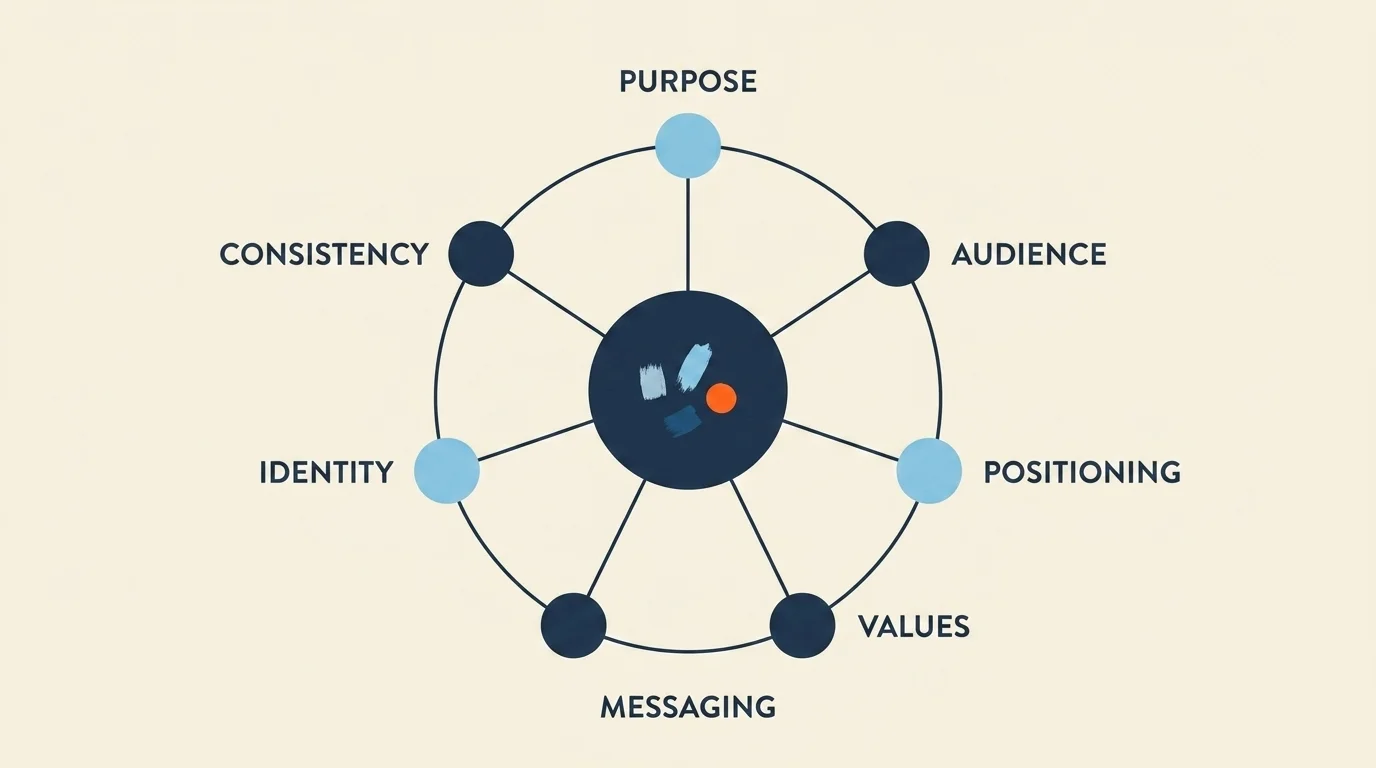
Taken one at a time:
- Purpose — why the brand exists beyond profit; the commitment everything else has to serve.
- Target audience — the specific people you are for, defined precisely enough to exclude the people you are not.
- Positioning — the space you occupy in the customer's mind relative to the alternatives.
- Brand values — the principles you will hold when they cost you something. The test of a value is whether it survives a bad quarter, which is also where the purpose pillar above stops being decoration and starts being strategy.
- Messaging — what you say, and, more revealingly, what you refuse to claim.
- Visual identity — the logo, colour, and typography that make the brand recognisable; the expression, not the substance.
- Consistency — the discipline of making the same promise across every touchpoint, for years, until it compounds into trust.
Note the number: seven. Google and its AI Overview reward named modules like this because they are extractable, but the older reason to keep a strategy to seven parts is the one a board paper obeys — a strategy a team cannot hold in its head is a strategy it will not use.
The 4 types of brand strategy
The four common types of brand strategy are line or brand extension, multi-brand, new-brand, and co-branding — architecture choices about how your products and audiences relate.
- Line or brand extension — stretch one trusted brand across new products; use it when the existing equity credibly transfers.
- Multi-brand — run several distinct brands under one company; use it when audiences or price tiers should not touch.
- New-brand — launch a fresh brand from nothing; use it when nothing you already own fits the new market.
- Co-branding — partner two brands on a single offer; use it when each lends the other something it lacks.
Hold onto one distinction: these are brand-architecture decisions — where a brand sits relative to your other brands — not the whole strategy. They live inside the framework below; they do not replace it. Choosing wrongly here is expensive in a specific way: a line extension that stretches a brand past what customers will actually believe dilutes the very equity you were borrowing, and a needless new brand spends years buying recognition you already owned. The type you pick is a bet on how much trust will transfer from one name to another, so place it deliberately rather than by default.
The 4 C's framework: Company, Category, Consumer, Culture
The 4 C's — Company, Category, Consumer, and Culture — assess a brand from four angles so that it stays relevant today and adaptable tomorrow.
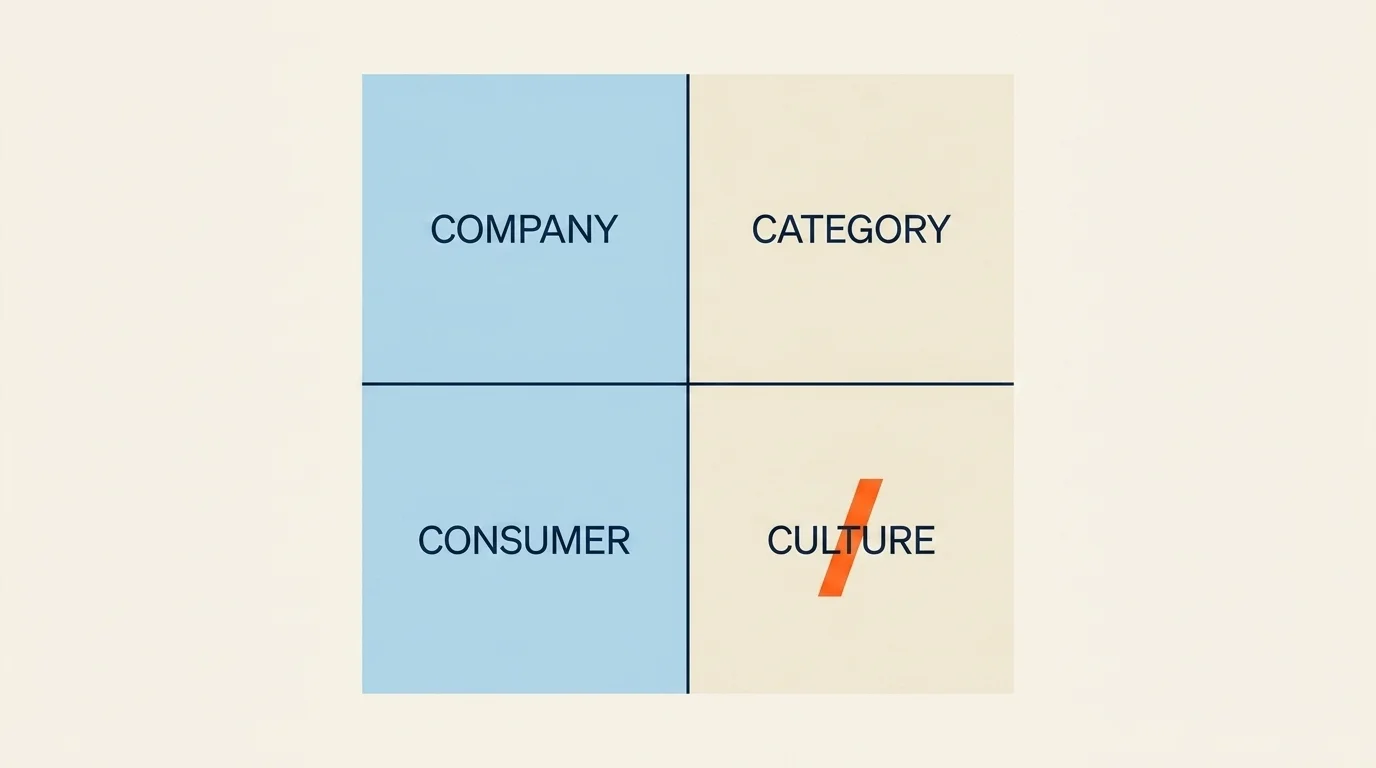
- Company — your own capabilities, assets, and the promise you can actually keep.
- Category — the competitive set and the codes customers expect you to obey or deliberately break.
- Consumer — the real needs, frictions, and values of the people you serve.
- Culture — the wider moment your brand is stepping into, which moves faster than any of the other three.
The reason I favour the 4 C's over older, internal-only models is that Culture is a first-class input rather than an afterthought. Practitioners now position the framework explicitly as a way to design brands that are relevant to today's challenges and adaptable to a sustainable future — which is the bridge between the table-stakes purpose discussion above and the mechanics of actually building the thing.
How to build a brand strategy, step by step
Here is the sequence I would run, in order. Skipping steps is how you end up with a visual identity in search of a reason to exist.
Step 1: Research your market and audience
Before you decide what you stand for, map what already exists. Audit the category codes, the competitors' claims, and the specific audience you intend to serve — the 4 C's are your checklist here. Most weak strategies are not badly executed; they are confidently aimed at a market that was never examined.
Step 2: Define your purpose, mission, and values
State why the brand exists in a sentence you would be willing to defend to a journalist, not only to a boardroom. Make the purpose operational — anchored to something real in the product or the supply chain — because a purpose you cannot evidence is a liability rather than an asset. This is the step where the honest limits from earlier become a design constraint: claim only what you can show.
Step 3: Set your positioning and point of difference
Decide the one space you will own against the alternatives, and accept that owning it means being legible to some people and invisible to others. Refusing to choose — trying to be the sensible option for everyone — is the most common failure I see, and it is usually a failure of nerve dressed up as breadth.
Step 4: Shape personality, voice, and messaging
Give the brand a consistent character and a consistent way of speaking, and decide what you will never claim as firmly as what you will. A brand voice is a governance document as much as a creative one: it is the thing a junior writer reaches for when nobody senior is in the room.
Step 5: Build visual identity and brand guidelines
Only now do you design the logo, palette, typography, and the guidelines that keep them consistent. Doing this first is the classic inversion — the beautiful identity attached to nothing — and it is why so many rebrands change how a company looks without changing anything a customer would notice.
Step 6: Launch, measure, and stay consistent
Ship it, then hold it. Consistency across touchpoints and over time is where trust compounds; it is also where most strategies quietly die, because holding a line is less exciting than redrawing one. Keep the purpose from Step 2 visible in what you measure, or it will drift back into decoration the moment a quarter goes badly.
Brand strategy examples that work
A brand strategy example is a purpose-led brand like Patagonia or The North Face that aligns its products, messaging, and values around a single clear mission.
Consider three, and notice that in each case the strategy is legible in what the company does, not only in what it says.
Patagonia built its strategy around an environmental mission and then operationalised it — in materials, in repair programmes, in a willingness to tell customers to buy less. That coherence is why it ranks among the US sustainability-perception leaders in Brand Finance's 2026 index. The claim is credible because the product and the claim agree, and a customer would have to work hard to catch them disagreeing.
The North Face, the other US sustainability-perception leader in the same index, earns the perception the same way: the claim and the action stay close enough that a sceptic cannot easily prise them apart. Neither brand is selling a logo in the bottom-right corner; each is selling a promise it keeps often enough to be believed.
Google is the counterweight example, holding the highest Sustainability Perceptions Value in that index at $41.9 billion — proof that this is not only an outdoor-apparel phenomenon, and that scale and perceived responsibility can coexist when the operations back the story.
What unites them is not a slogan. It is that each aligned products, messaging, and values around one mission and then held it long enough to be trusted. Purpose earns trust through consistency; that is the whole lesson, and you can see more of it across the sustainable marketing category.
Your brand strategy template and checklist
You do not need a consultant to begin; you need a single page. Here is the checklist I would hand a founder with ten minutes, current for 2026:
- A purpose you can evidence (Step 2), stated in one sentence you would defend to a journalist.
- The specific audience you are for — and the one you are deliberately not.
- Positioning: the single space you own against the alternatives.
- The seven elements, each with a one-line answer: purpose, audience, positioning, values, messaging, visual identity, consistency.
- Your brand-architecture choice from the four types.
- A pass through the 4 C's — Company, Category, Consumer, Culture — with Culture and sustainability treated as live inputs, not decoration.
- One measurable way you will keep the purpose operational after launch.
Copy it, fill it in, and revisit it once a year rather than once a quarter — the compounding only works if the plan holds still. For the next step, keep reading the sustainable marketing guides.
In closing
A brand strategy is not the logo and it is not the launch; it is the durable, foundational decision about what you stand for, built through the seven elements, chosen among the four types, pressure-tested against the 4 C's, and delivered through a repeatable process you can hold in your head. The modern edge is not more talk about purpose. It is operational purpose — evidenced in the product, the pricing, and the disclosure — that earns trust through consistency rather than slogans. Use the checklist to draft yours this week, and then put one honest question to your team: which of our claims would actually survive a fifteen-minute examination?
Frequently Asked Questions
The seven key elements of brand strategy are purpose, target audience, positioning, brand values, messaging, visual identity, and consistency. Together these components create a cohesive, trusted brand: purpose and values set what you stand for, positioning and messaging set how you say it, and consistency across every touchpoint is what turns the plan into trust over time.
The 4 C's of brand strategy are Company, Category, Consumer, and Culture. It is a four-angle lens for assessing a brand: your own capabilities (Company), the competitive set and its codes (Category), the real needs of the people you serve (Consumer), and the wider moment you are stepping into (Culture) — keeping the brand relevant today and adaptable to a sustainable future.
The four common branding strategies, or types, are line/brand extension, multi-brand, new-brand, and co-branding. You choose between them by how you want products and audiences to relate: stretching one trusted brand, running several distinct brands, launching a fresh one, or partnering two brands so each lends the other something it lacks. They are architecture choices inside the strategy, not the strategy itself.
An example of a brand strategy is a purpose-led brand like Patagonia or The North Face — the US sustainability-perception leaders in Brand Finance's 2026 index — that aligns its products, messaging, and values around one clear mission. The strategy is credible because the actions and the claims agree, which is how purpose earns lasting consumer trust rather than a passing campaign lift.
The difference between brand strategy and brand identity is plan versus expression. Brand strategy is the long-term plan — the why and the how, the positioning and the promise a brand commits to. Brand identity is its visible expression: the logo, colours, typography, and voice. Strategy is the decision; identity is the evidence of it. The plan comes first, and the identity carries it out.