
Digital Technologies


Ask most people to define digital technologies and they reach for something abstract and vaguely corporate — cloud, big data, a slide in a boardroom. Then they check the definition on the phone they are holding, which is itself the answer. You woke to a phone alarm, scrolled an AI-curated feed, and paid for coffee with a tap, all before breakfast. That is the category, in use, before you had a name for it. The scale is not abstract either: 6.04 billion people, 73.2% of humanity, were online in 2026. This is a plain-English explainer — what digital technology actually is, its main types, the everyday examples you already use, and why it matters — with no course to sell you at the end. I have spent enough years watching the gap between what a technology demo promises and what it does on an ordinary phone to keep this grounded in the second one.
What Are Digital Technologies?
Digital technologies are electronic tools, systems, and devices that create, store, and process data as binary code — the 0s and 1s — from smartphones and cloud services to artificial intelligence.
That is the whole definition, and it is worth having in one clean sentence because most sources bury it. "Digital technology meaning" and "what is digital technology" are the same question, and the answer turns on that binary encoding: information reduced to two states a machine can store, process, and transmit without losing quality. That is also the line that separates digital from analog, where a signal is a continuous physical wave — a vinyl groove, a film negative — that degrades a little with every copy.
In practice the category resolves into five core areas that keep recurring, whatever list you read:
- Artificial intelligence and machine learning — software that learns from data rather than following fixed rules.
- Cloud computing — storage and processing that lives on someone else's servers, reached over the internet.
- The Internet of Things (IoT) — everyday objects with a chip and a connection.
- 5G and networks — the mobile plumbing that moves the data around.
- Cybersecurity — the tools that keep all of the above from being trivially broken into.
Hold that list. The rest of this guide is really just those five showing up in your day.
A Digital Day in 2026 — Where the Tech Actually Shows Up in Your Life
The fastest way to make an abstract category concrete is to watch it run for a day. Here is one ordinary 2026 morning, tagged with what is actually happening underneath.
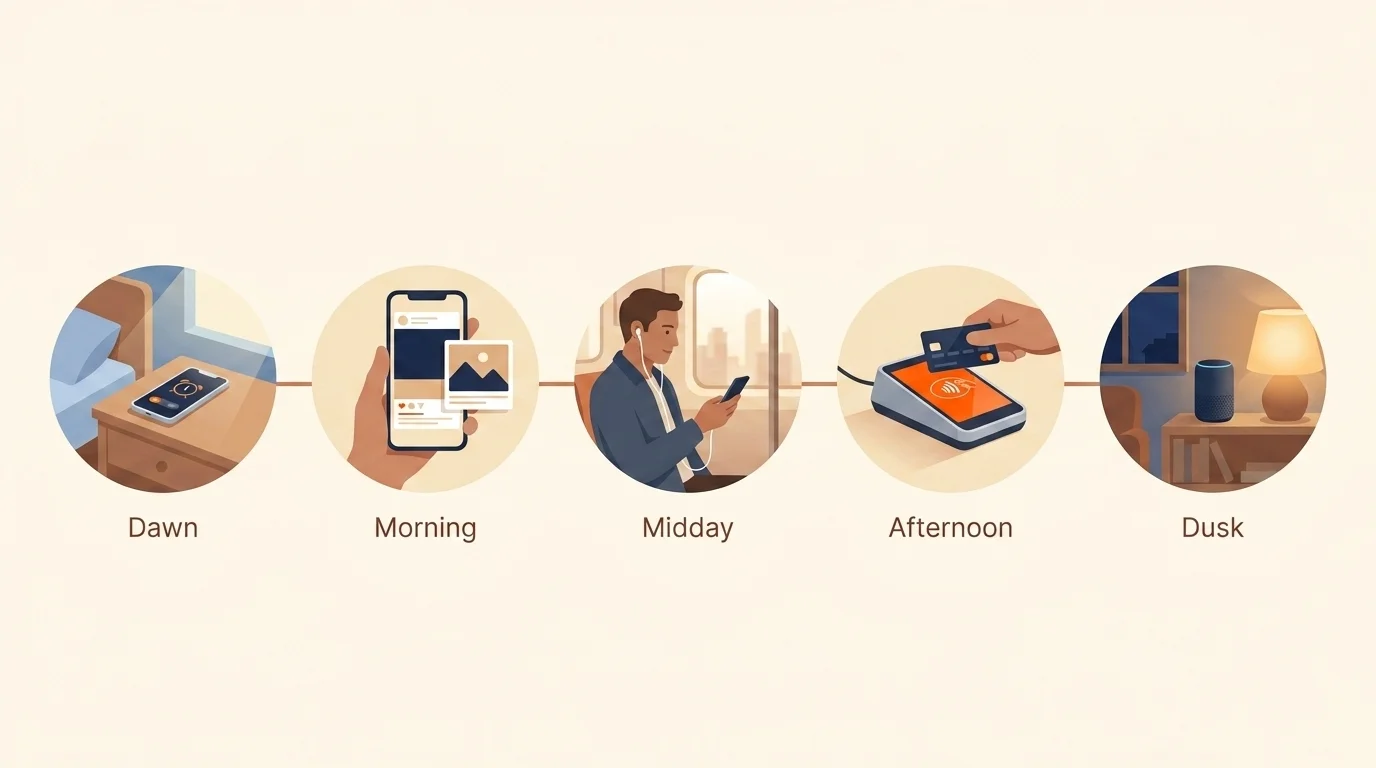
The alarm is a phone, which means the first digital technology of the day is a pocket computer that, in about three-quarters of new handsets, now ships with on-device AI — the thing quietly optimising your battery and your photos. You open a feed, and an algorithm decides the order; that is machine learning doing product recommendation on a news app. On the commute you stream something and it plays without buffering, because more than half of mobile connections now run on 5G — the promise that used to be a demo and is now just the default signal. You tap a card to pay, which is fintech and cryptography pretending to be a wave of the wrist. You get home to a house holding, on current estimates, 15 to 20 connected devices — part of the 18.8 billion IoT devices worldwide, up about 13% year on year.
None of those numbers is a census, and I would treat the tidy ones — "three-quarters of phones," "15 to 20 devices" — as well-sourced estimates rather than counted facts. But the direction is not in question, and that is the actual point: the technology stopped being the headline and became the infrastructure, which is the stage where you stop noticing it is there. If you want the same walk through other corners of daily life, that is most of what our digital lifestyle guides do.
What Are the Main Types of Digital Technology?
The main types of digital technology are artificial intelligence, cloud computing, the Internet of Things, 5G networks, cybersecurity, and computing hardware. Enterprise write-ups slice this into "operational technology" and "business technology" and a dozen other labels; ignore those. Here is the version that maps to what you actually touch.
- Artificial intelligence and machine learning. Now the category's defining member — Deloitte's 2026 read puts AI at the centre of gravity, not one item on a list. It curates your feed, finishes your sentences, and cleans up your photos.
- Cloud computing. Your files, photos, and streaming libraries live on remote servers, not on your device. It is so standard that 94% of enterprises use cloud services and over 60% of corporate data now sits in the cloud — and your personal life runs the same way.
- The Internet of Things. Connected objects: speakers, watches, doorbells. The 2026 shift worth noting is that they have moved from "connected" to "intelligent," analysing and acting rather than just reporting.
- 5G and networks. The mobile infrastructure that moved cloud-heavy tasks from premium to default.
- Cybersecurity. The locks, keys, and alarms for everything above — the part nobody thinks about until it fails.
- Computing hardware and wearables. The physical layer: phones, laptops, and the watch reading your heart rate.
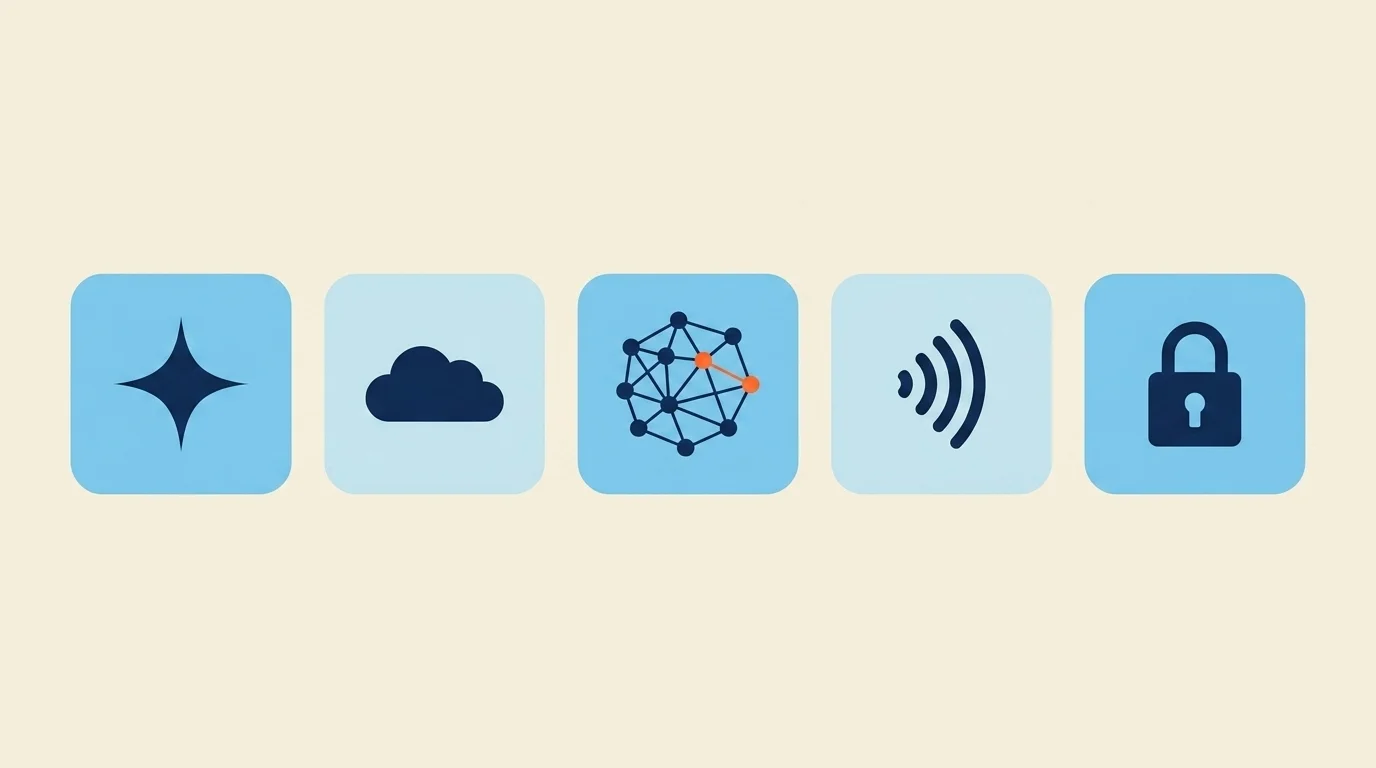
Notice that the interesting ones are converging. AI runs in the cloud, arrives over 5G, and increasingly executes on the device in your pocket. The types are less a taxonomy than a stack.
What Are Examples of Digital Technologies?
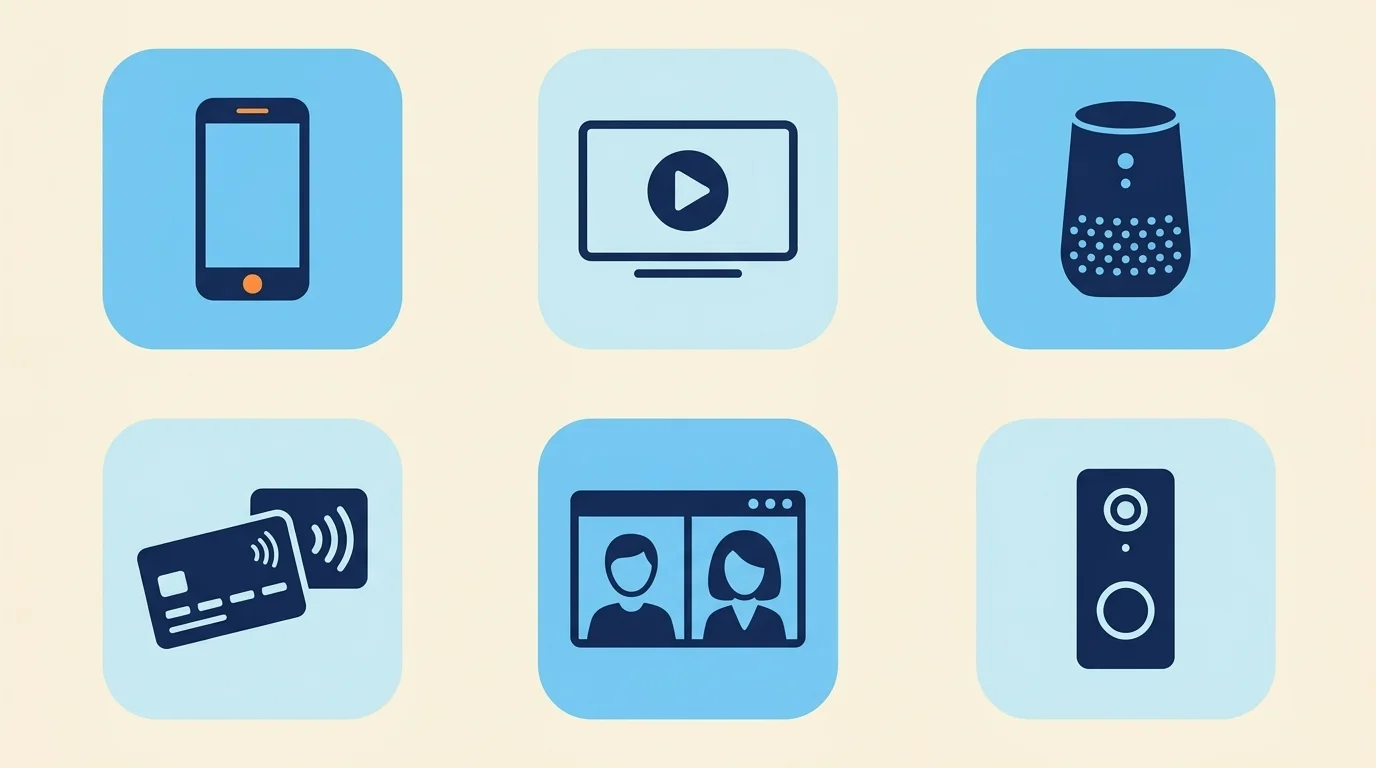
Everyday examples of digital technologies include smartphones, streaming apps like Netflix and Spotify, digital cameras, video-calling apps, smart-home devices, and contactless payments. The reason the definition feels slippery is that the best single example folds most of the others into one object.
That object is the smartphone — a camera, a wallet, a television, a games console, and an assistant that also happens to make calls. Streaming (Netflix, Spotify, YouTube) replaced scheduled broadcast with on-demand everything. Computational photography is why a phone camera now beats the dedicated compact you owned a decade ago: the lens is mediocre and the software is extraordinary. Video calls turned "keeping in touch" and "going to work" into the same gesture. Smart-home devices — the speaker, the thermostat, the doorbell — are that 15-to-20-per-home figure made concrete. And contactless payments are the everyday face of fintech: a tap that hides a chain of cryptography most people will never see, and do not need to.
One more, lightly: telehealth and wearable health tracking put a clinic appointment and a heart-rate monitor in the same pocket — a genuinely useful example, and one I would not oversell. For more of these, tool by tool, our digital lifestyle guides go deeper.
Why Digital Technology Matters in Everyday Life
Digital technology matters because it powers how most people now communicate, work, bank, learn, and relax — with 73% of humanity online in 2026. Strip out the boardroom framing and the payoff is ordinary and large.
Three pillars carry most of it. Communication: distance stopped being the constraint it once was — 5.66 billion people, about 69% of the world, are on social media, which is a reach figure, not a verdict on how the time is spent. Convenience: banking, shopping, and a near-infinite media library collapsed into a device you already carry. Access: information, education, and public services now reach people who could never have reached a physical branch or library — unevenly, which is the next section.
The honest version is that none of this is a productivity miracle so much as a change in the default. The things you used to travel or wait for now happen where you are standing.
The Everyday Trade-offs: The Digital Divide and the Downsides
No honest explainer stops at the upside. The clearest trade-off hides inside the headline number: if 73.2% of humanity is online, then roughly a quarter is not, and the digital divide is the gap between those who get all of the above and those who get none of it. It runs along income, age, geography, and infrastructure, and it is widening in some places even as connection spreads in others.
The rest are quieter. Attention is the resource the free services actually charge you, and the same feed that informs you is engineered to keep you scrolling. Convenience is paid for in data: every tap is also a record. And there is plain over-dependence — the mild panic of a dead battery or a dropped signal is a fair measure of how much of ordinary life now routes through a single device. None of this is an argument against digital technologies. It is an argument for using them on purpose.
Digital technologies are not a distant category on a slide; they are the electronic backbone of an ordinary day — the alarm, the feed, the tap to pay, the lights that turn themselves off. Four things worth keeping: what it is (tools that run on binary code), the main types (AI, cloud, IoT, 5G, cybersecurity, hardware), the everyday examples you already use, and why it matters, which is that most of daily life now runs through it. The term is not trending; it is simply how the day works now, which is a more durable thing to be. To keep exploring the everyday side of it, our digital lifestyle guides are the place to go next.
Frequently Asked Questions
The difference between digital and analog technology is how each represents information. Digital technology encodes it as discrete binary values—0s and 1s—while analog represents it as a continuous physical signal, like a vinyl groove or a film negative. Digital is far easier to store, copy, and transmit without losing quality with each generation.
The four types of digital technology are usually grouped, in consumer terms, as computing hardware (phones, laptops, wearables), communication networks (the internet and 5G), data and software (cloud storage, apps, and AI), and connected or IoT devices (smart speakers, watches, doorbells). The exact count varies by source, but those four cover most of it.
The top 5 digital technologies today are artificial intelligence, cloud computing, the Internet of Things, 5G networks, and cybersecurity—the same five Google's AI Overview leads with in 2026. They are less five separate things than one stack: AI runs in the cloud, arrives over 5G, and is kept safe by the last of them.
The seven types of technology is a loose grouping that varies by source. Within the digital scope, a common seven are information, communication, computing and hardware, data and software, artificial intelligence, networking, and security technologies. Do not over-index on the exact number—it shifts depending on how tightly or loosely a source lumps the categories together.