Cold Email


Every year or two, someone announces that cold email is dead. I have been sending cold emails since before that was a fashionable thing to declare — mostly the unglamorous kind, a content strategist asking a stranger to link to a page or take a guest post — and I have watched the obituary get written enough times to stop taking it personally. The inbox is noisier than it was, average reply rates really have slid, and half the internet is quietly wondering whether the whole tactic still works. It does. It just stopped rewarding volume.
What follows is the honest, vendor-neutral version: no tool to sell you, no platform to push, just what actually earns a reply in 2026, grounded in fresh benchmark data. A reply-getting framework, subject lines and templates you can lift, a straight answer on whether any of this is legal, and a section for the job seekers — because emailing a hiring manager out of the blue is cold email too. If you have ever sent two hundred outreach emails and got two replies back, this is the piece that explains why, and what to do instead.
Does cold email still work in 2026?
Yes, cold email still works in 2026 — but it is now a precision game: small, verified, well-targeted sends win where mass blasts lose. If you are still measuring success by how many you sent, you are counting the one thing that stopped working.
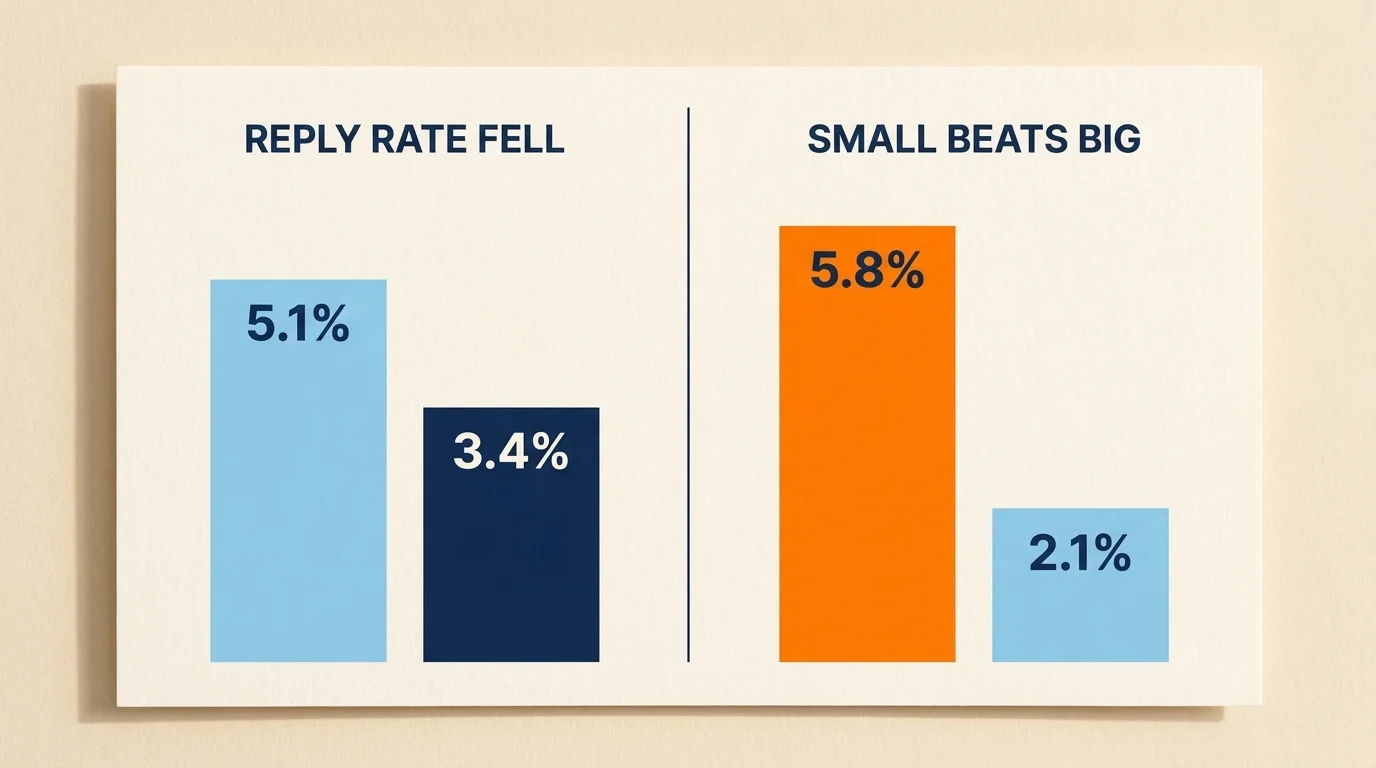
Here is the honest benchmark. The platform-wide average reply rate fell from 5.1% in 2024 to about 3.43% in 2026 (Instantly, 2026). Three things squeezed it: inboxes are saturated, Gmail and Outlook now enforce sender rules they used to merely suggest, and the market is drowning in low-effort AI-generated outreach that has trained everyone to delete faster. That is the decline the "cold email is dead" crowd points at, and it is real.
But look at what the same dataset shows underneath the average. Campaigns sent to fewer than 50 recipients average a 5.8% reply — roughly three times the 2.1% a mass blast gets. Verified lists reply about twice as often as unverified ones, and five to six times as often as a purchased list (Instantly, 2026). Read those two facts together and the whole game changes shape. The lever is not how many people you reached; it is how right they were for the message, and how sure you were that the address even worked.
So the practitioner rule — the one every section below serves — is this: fewer, better-targeted, verified, trigger-based emails beat spray-and-pray, on every metric a business actually cares about. It is also why "just send more" is now actively harmful advice: more volume on a weak list drags your sender reputation down and lands the next campaign in spam. It is the same logic that governs email marketing as a whole — reach the right person with the right thing, or stop reaching more of the wrong ones.
What is a cold email?
A cold email is an unsolicited message sent to someone you have no prior relationship with — the email equivalent of a cold call — to start a sales, business, or job-search conversation. That is the whole definition, and it is worth being precise about, because two things get confused with it.
It is not email marketing, which goes to a list of people who opted in and usually arrives as a bulk newsletter. And it is not spam, whatever your first instinct says. The difference is targeting and relevance: spam is bulk, irrelevant, and often deceptive; a real cold email goes to one specific person for one legitimate reason they can actually see. The line is not whether you technically had permission — it is whether the message deserves the recipient's attention.
Two kinds of sender live in this guide: B2B founders, salespeople, and marketers running outreach, and job seekers emailing recruiters, hiring managers, and professors. The mechanics are the same for both, which is why one guide can serve them both.
How to write a cold email that gets a reply
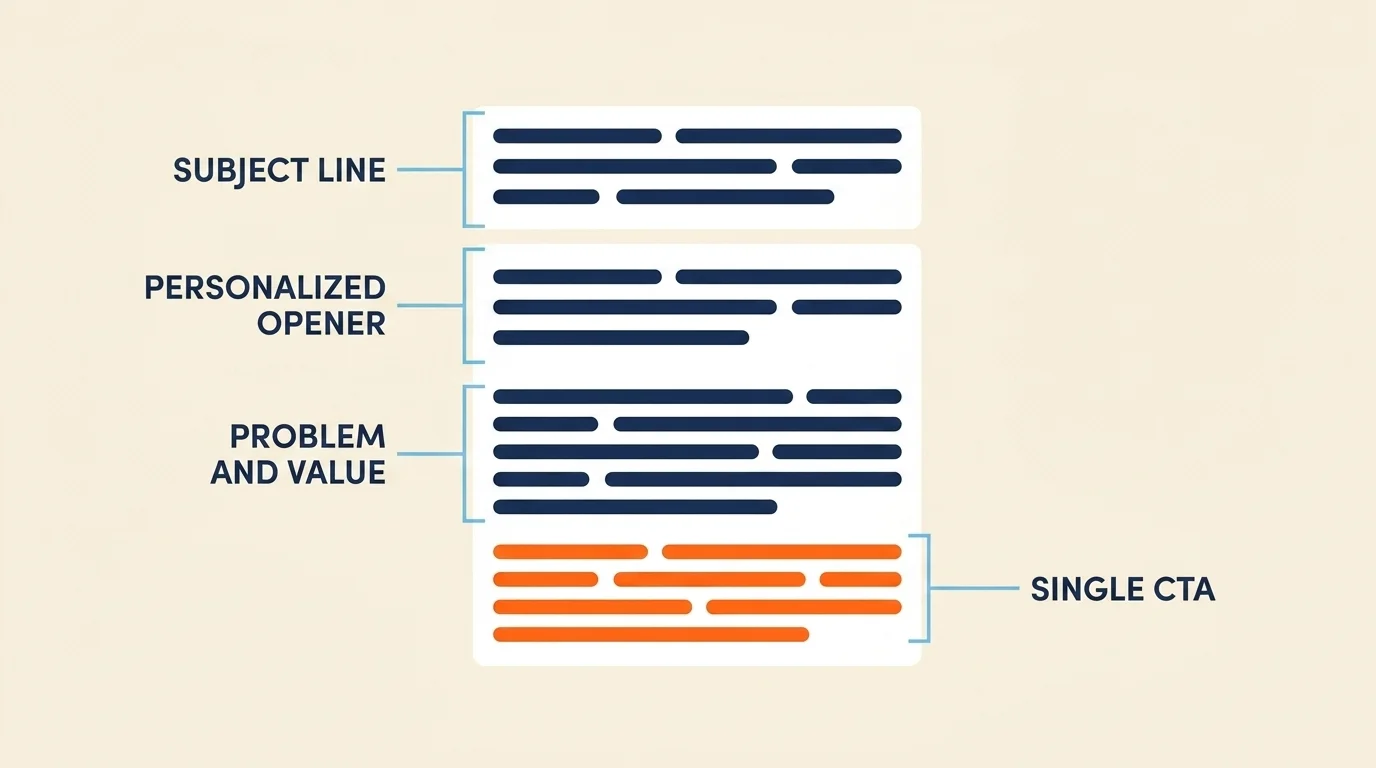
Every cold email that works runs the same four moves. Not five, not a clever framework with an acronym — four, in order.
Step 1: Research the one thing that makes this personal
Before you write a word, find the single fact that makes this person worth emailing right now. A trigger event — funding, a new job, a product launch, a new office — beats a generic compliment every time, because it answers the reader's first silent question: why me, and why now? This is the step people skip when they are chasing volume, and it is exactly the step the data rewards. Ten emails with a real trigger will out-earn a thousand with a merge field.
Step 2: Open with them, not you
The first line proves you did the homework. It is about the reader — their launch, their problem, their post — not your company and not your pitch. The fastest way to get deleted is to open with "I'm reaching out because we are a leading provider of…", because you have just told a busy stranger that this email is about you. Lead with them, and you earn the second sentence.
Step 3: State the problem and the value in one breath
Now, and only now, your reason for writing — framed as something that matters to them, not a feature list. One sentence on the problem you noticed, one on what changes if it is solved. Not what your product does; what their world looks like once it is better. If you cannot say it in two sentences, you do not understand the value well enough to sell it yet.
Step 4: Ask for one low-friction thing
Close on a single, specific, easy-to-say-yes-to request. Not "let me know your thoughts" — that outsources the work of deciding what happens next to the person you just interrupted. "Are you open to a 15-minute call on Thursday?" is a yes-or-no question, and yes-or-no questions get answered.
One discipline sits on top of all four: length. Keep a first touch between 50 and 125 words — emails in that band get about 2.4 times the reply rate of 200-plus-word emails (Instantly, 2026). Get the four moves right and short becomes easy; it is the emails trying to do three jobs at once that sprawl. Next come the two things that decide whether any of this gets read at all: the subject line, and the follow-up.
Cold email subject lines that get opened
Before a single word of your carefully-built email gets read, the subject line has already decided its fate — and often against you. Around 70% of people report an email as spam based on the subject line alone (Mixmax, 2026). The subject is the deliverability gate, not the packaging.
The data is unusually clear on what works. Lines of 21 to 40 characters average about a 49% open rate. Numbers lift opens by 113%, questions by 21%, and subject lines built on a trigger event — funding, a job change, a launch — top the charts at around 54.7% (Mixmax, 2026). Short, specific, and grounded in something real beats clever every single time.
Here is a copy-ready set to adapt — steal the shape, swap in your specifics:
Question about their projectMutual contact suggested I reach outIdea for their team3 notes on their launchCongrats on the funding / role / launchQuick one re: specific thingTheir company + your areaWorth 15 minutes?
One firm don't: clickbait and false-promise subjects — "You won't believe…", or "Re: our call" when there was no call. They tank trust the second the reader opens, and they are exactly the pattern spam filters are trained to catch. A subject line's job is to be true and specific, not irresistible — the same principle that separates a newsletter people open from one they route straight to a folder in email marketing.
Copy-ready cold email templates and examples
A template is a starting skeleton, not a magic spell — the personalisation from the framework above is what earns the reply. A great template sent to the wrong 500 people still fails. With that said, here are four you can lift and fill in.
B2B cold outreach template
Trigger-based opener, one line of value, a single call to action.
Subject: Their launch question

Hi first name,

Saw company just trigger — launched X / raised Y / opened in Z. Congrats. Teams at that stage usually hit specific problem within a quarter — we've helped a couple cut it down by specific outcome.

Open to a 15-minute call Thursday to see if it's relevant?

Thanks,
your name
Filled in, that reads like: "Saw your team just raised a Series A. Congrats. Teams at that stage usually outgrow their onboarding docs within a quarter — we've helped a couple cut new-user drop-off by a third." Concrete, about them, one ask.
Partnership / collaboration template
Lead with what is in it for them, not the logo swap.
Subject: Their audience + your thing

Hi first name,

Your newsletter / community / product reaches exactly the people we spend our days helping. I've got an idea for a joint webinar / content swap / bundle that gives your audience specific value and costs you nothing but a yes.

Worth a quick call to sketch it out?

Best,
your name
New-client / freelance pitch template
Prove relevance fast; make the ask small.
Subject: Their gap, quick idea

Hi first name,

I noticed specific gap — your blog hasn't shipped since March / your checkout has three extra steps. I'm a role who fixes exactly this for type of business.

Happy to send two specific ideas — want me to?

Thanks,
your name
Follow-up template
Reference the first email, add one new reason, stay short.
Subject: Re: original subject

Hi first name,

Circling back on my note about topic. Since I wrote, new reason — you launched X / I put together a relevant example. Still glad to original ask if it's useful — and equally glad to hear it's not a priority right now.

Thanks,
your name
Fill the brackets with something specific and true, send to a short, right-fit list, and these will out-perform anything generic sprayed at scale.
How to send a cold email for a job
A job cold email states the role you want in the first line, proves your relevance in the next two, and points to a LinkedIn profile or portfolio for the proof — recruiters and hiring managers reward brevity and specificity. It is the same four-move framework, aimed at a person who can hire you.
And it is worth the effort more than most outreach, because the numbers favour it: recruiting and job outreach posts the highest response rates of any category, around 5.8% to 7.2% (Martal, 2026) — well above the SaaS-to-SaaS grind. The inbox you are writing to is one that expects, and often welcomes, a direct approach.
To a recruiter or hiring manager
Name the exact role, and where you saw it, in line one. Two lines on the one or two things that make you an obvious fit — a shipped result, not a list of adjectives. Then a single ask: a 15-minute call, or simply whether they are open to your application. Link to the proof; do not paste your whole CV into the body.
To a professor (internship or research)
Reference the specific paper or project, not the department. One line on why it connects to what you have done, one on what you would want to contribute. Professors read a lot of these, and the specificity of the reference is the entire signal.
For an unadvertised role
State the role you believe they need before they have posted it, and why you think so. This is the highest-risk, highest-reward variant; it lives or dies on how well you understood their situation. Same rule as the rest of email marketing: the right message to the right person beats a perfect message to the wrong one.
Follow-ups: where nearly half your replies come from
Here is the statistic that should change how you work: about 58% of replies come on the first touch — which means 42% come from the follow-ups (Instantly, 2026). Send once and stop, and you are leaving nearly half your replies on the table. This is the most common mistake I see, and one of the easiest to fix, because it costs nothing but the nerve to write again.
The numbers back the persistence. A 3-to-5-step sequence roughly doubles reply rate against a single send — 8.3% versus 4.1% (Instantly, 2026). But there is a right way and a wrong way. Space follow-ups a few days apart, and give each one a new reason to exist — a fresh angle, a relevant update, a genuinely useful resource. What does not work is the "just bumping this up" email, which adds nothing and quietly tells the reader you have run out of things to say.
And to be clear, more follow-ups is not the same as more volume. It is persistence on a small, right-fit list — the precision game applied over time, not the spray-and-pray you were warned off at the top. Three thoughtful touches to fifty right people will always beat one touch to a thousand wrong ones.
Is cold emailing legal? CAN-SPAM, GDPR, and 2026 rules
No, cold email is not illegal — but it is regulated, and the rules differ by region and by whether you are emailing businesses or consumers. Here is the version that fits on one page.
United States (CAN-SPAM). You can send a cold email without prior consent, provided you use accurate sender information, a truthful subject line, a real physical mailing address, and a working opt-out that you honour promptly (Growleads, 2026). This is not a gentle guideline: FTC penalties run up to $53,088 per individual email (Scrap.io). Per email, not per campaign — which is the figure that should make you keep your list clean.
EU and UK (GDPR). B2B cold email is generally permitted under the "legitimate interest" basis, when the message is relevant to the recipient's professional role, the data is minimally processed, and there is a clear opt-out (Prospeo). Emailing consumers is a stricter and separate matter.
Canada (CASL). Stricter again, and consent-leaning — closer to opt-in than the US model. If you are emailing into Canada, check before you send.
What is changing in 2026. France introduces an explicit B2C consent mandate from August 2026 (Germany already requires it), and the EU AI Act's transparency rules for AI-generated content take effect the same month (Scrap.io) — directly relevant if you are mass-generating outreach copy for EU recipients.
One caveat, said plainly: this is general guidance, not legal advice. The penalties are real and the rules keep moving, so if you are sending at scale or into unfamiliar jurisdictions, have a professional look at your process before you rely on it.
What to send this week
In 2026, cold email rewards precision over volume — a small, verified, well-targeted list; a personalised message of 50 to 125 words; the right subject line; a single clear ask; and disciplined follow-ups, all kept inside the law. None of that requires a bigger list. It requires a better one.
So here is the assignment, and it is small on purpose. Pick one template above, personalise the first line for ten genuinely right-fit prospects this week — real triggers, verified addresses — and send. Then follow up twice, a few days apart, each time with a new reason. Ten precise emails will out-perform a thousand generic ones, and you will have the proof by next week. For more on outreach, subject lines, and what earns attention, the rest of our email marketing guides carry it forward.
Frequently Asked Questions
The 30/30/50 rule is a shorthand with two readings: it either splits the message as roughly 30% personalized opener, 30% value or body, and 50% clear call to action, or it attributes campaign success to 30% content, 30% list quality, and 50% follow-up. Either way, the lesson is the same: personalization, a tight list, and persistence matter more than clever copy.
Aim for 50 to 125 words on the first touch. Emails in that band get roughly 2.4 times the reply rate of 200-plus-word emails. Short, specific, and built around one clear ask beats a wall of text every time, especially since most cold emails are skimmed on a phone.
No. Spam is bulk, irrelevant, and often deceptive; a proper cold email is targeted to a specific person for a legitimate, relevant reason and follows CAN-SPAM and GDPR rules, meaning accurate headers, a real physical address, and a working opt-out. The difference is targeting and relevance, not whether you had prior permission.
The platform-wide average is about 3.4%, but that is the wrong bar to judge yourself against. Top-quartile campaigns hit around 5.5%, small verified lists reach roughly 5.8%, and elite campaigns exceed 10%. Bottom performers sit under 0.5%, and they are almost always big, unverified blasts to the wrong people.